Showing posts with label Canada. Show all posts

Sunday, January 12, 2020

A Return Trip to Manitoba

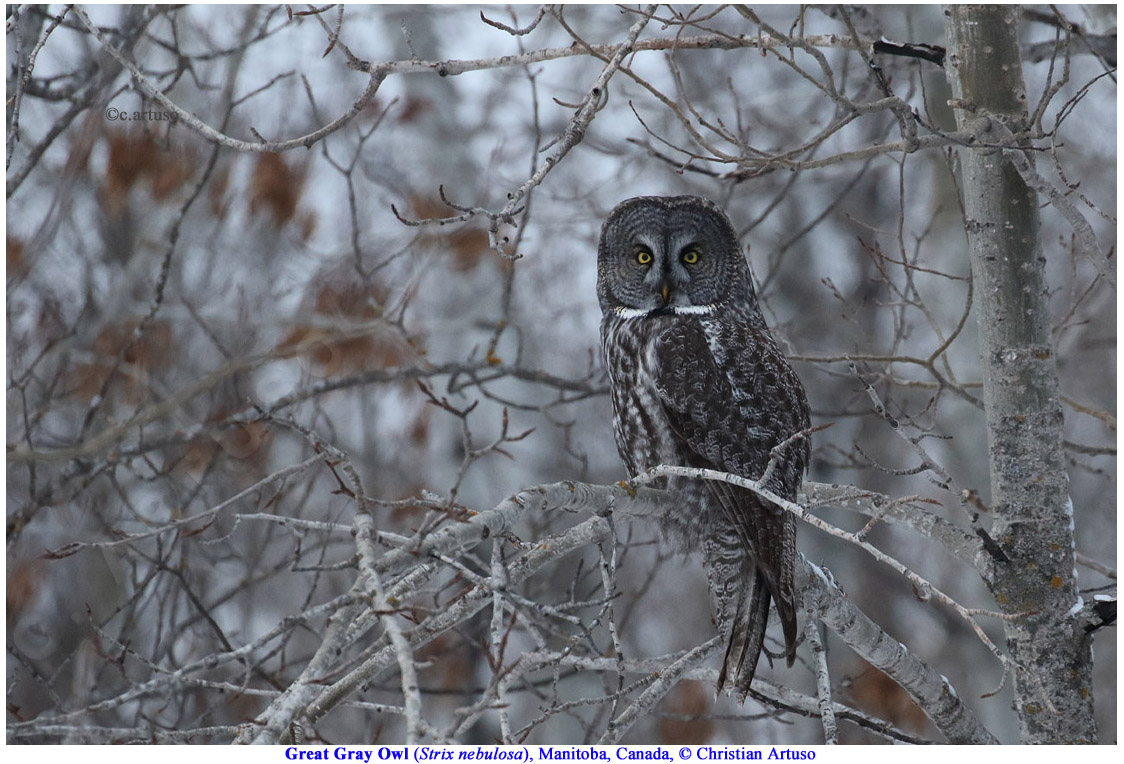
I had the good fortune to spend a fortnight back in Manitoba and to catch up with friends and colleagues. That included the opportunity to get out birding a few times and appreciate the owls that I always found to be one of the province's main attractions. In just a few outings I saw 15 Great Gray Owls and 5 Northern Hawk Owls; certainly not a lot by Manitoba standards (nowhere close to a personal best for any species) but a great joy to watch. To share the memories, I put together this short blog post on some of the birds we saw (clicking on any photo allows you to view it full screen).

Starting with the provincial bird, the Great Gray Owl, I had a hard time choosing which photos to share as there were some wonderful opportunities to observe them. The first four photos illustrate an example of a Great Gray Owl hunting. The owl was perched in some conifers (first photo) near a ditch and was moving its head in a manner that suggested it was listening intently to something below (most likely the movement of a vole in a subnivean tunnel). We parked the car back from the owl in the direction the owl seemed to be hunting and waited for a few minutes. 
When the Great Gray flew towards the sound it had been fixated on, it made an unexpected turn in our direction and hovered ever so briefly before plunging. This allowed me to capture a few photos in the classic "angel" pose just before the owl dove.
The first dive appeared to be unsuccessful so the owl perched a little closer to the area of interest. We had no choice but to remain inside the car and wait quietly so as to not disturb the hunt.

When the owl flew back and plunged a second time, it was basically coming towards us and it plunged into the ditch where it was hidden from view by the snowbank and the vegetation. We believe the owl was successful on its second attempt, although we couldn't really tell because it was blocked from view. The owl stayed in the snow for several minutes and its head motions, as far as we could see, seemed to suggest it was swallowing).  
This hunting sequence was the highlight of our Great Gray Owl observations but there were many other magic moments, some of them captured in the photos below.


For good measure, I like to include a habitat photo for those who like to play "spot the owl".
The other northern owl that we always look for is the Northern Hawk Owl. In some winters, Northern Hawk Owls are easier to see than Great Gray Owls, helped by their habit of sitting atop the tallest available perch. This winter though, I got out on windy days and the Northern Hawk Owls were lower down and harder to spot, although this did make for an interesting photo or two.
Once again, here is the obligatory habitat photo for those who like to play "spot the owl".
The Barred Owl is a common owl species but nonetheless harder to see in Manitoba than eastern Canada or British Columbia. Manitoban birders certainly appreciate a chance to see one in daylight and this trip offered one excellent such opportunity. This bird was hunting just before twilight but I did not manage to get really good photos of it in flight.


There were some other raptors to appreciate as well; for example, a couple of Northern Goshawks and quite a few Bald Eagles such as this one: 

I also enjoyed some of the winter songbirds on offer in Manitoba, including several Northern Shrikes,
and of course the ever-charismatic Canada Jay:
It does not seem to be a particularly big year fro Bohemian Waxwings but the flock we saw put on a truly splendid show:


Winter finches are rather sparse this year. I got to appreciate some Pine Grosbeaks and Evening Grosbeaks but, amazingly not a single redpoll! Here is one of the Evening Grosbeaks.


Normally White-winged Crossbills are the easy crossbill to see in Manitoba but this winter was the winter of the Red Crossbill and I got to see multiple flocks, an unexpected treat.


And it wouldn't be a Manitoba winter blog post without a mention of the amazing Snow Bunting that has brightened so many a winter day!

I ran out of time to look for other owls unfortunately but wanted to share these photos to say thank you to all the great friends who shared these moments with me!

Thursday, August 30, 2018

American Barn Owl in Vancouver


One of the highlights of my recent visit to Vancouver for the International Ornithological Congress and the COSEWIC (Committee On the Status of Endangered Wildlife in Canada) Bird Specialist Subcommittee meeting was seeing 10 Barn Owls. My international friends may be surprised by this because Barn Owls are common globally, and American Barn Owls are also common on this continent. Most of Canada, however, is beyond the range of the species. The only two areas where Barn Owls occur regularly in Canada are in southern Ontario (the eastern population is almost extirpated and listed as Endangered in Canada) and southwest British Columbia (listed as Threatened in Canada).  This magnificent Barn Owl (three photos below) on a day roost (presumably a female based on colouration and the size and extent of spotting), glowing red in the smoky air wafting over the city from northern forest fires, left a lasting impression on the whole committee. Note how powerful the talons of these owls, so useful is dispatching large rodents, are:


(American) Barn Owl (Tyto alba pratincola OR Tyto furcata pratincola), British Columbia, Canada, © Christian Artuso.


Monday, August 7, 2017

Piping Plover Update 2017

In 2017 there have been at least two pairs of Piping Plover in the province (i.e. that we know of), one of which fledged at least one young (maybe more young fledged but this was hard to confirm given the difficulty of access). This year’s successful nesting attempt was near the always amazing Whitewater Lake, where two failed attempts occurred in 2012. This pair was first found by Julie Yatsko and Nicole MacPherson. In addition to this pair, a third banded Piping Plover was found by Colin Blyth and Gillian Richards. This bird was banded as an adult on Lake Sakakawea June 2015 near New Town, North Dakota and was observed on the 16th of June, 2017 near Coleharbor, North Dakota ten days before being photographed at Whitewater lake.   The photo below shows one of the unbanded birds believed to be the male of the nesting pair.


As a side note: While at Whitewater Lake, Colin Blyth found a male Cinnamon Teal on June 4th which was seen by me later the same day. Since Colin and Gillian had earlier found a hybrid Cinnamon Teal X Blue-wing Teal nearby, we studied this one as best we could and found no evidence of hybridisation (my photo below). Unfortunately, this bird was not found again in checks the following day nor in the days/weeks that followed.


This year was another great year for observing Clark's Grebe at Whitewater Lake. The Clark's Grebe in the below was paired with a bird that was either a Western Grebe or perhaps a hybrid an they fledged three young.


There is always a rarity or two at Whitewater Lake and this year at least three "obliging" Glossy Ibis were outstanding amongst the hundreds of White-faced Ibis (and the many Great Egrets, Snowy Egrets and Cattle Egrets).


Special thanks to all who reported their sightings and helped monitor our Threatened and Endangered species with such great care and consideration to ensure the birds were not disturbed: Colin Blyth, Ken De Smet, Nicole MacPherson, Ken Porteous, Gillian Richards, Julie Yatsko (and of course Wally Jansen and Jake Peters for their great find and efforts in 2016). If anyone with a canoe or kayak (or canoeing skills) is interested in helping out next year, please get in touch!

Sunday, November 6, 2016

Manitoba's Painted Redstart

Manitoba's first and Canada's third Painted Redstart (Myioborus pictus), also known as "Painted Whitestart", showed up in Pinawa 11 days ago. This species breeds from Arizona and New Mexico down through the mountains of western Mexico into Nicaragua. Although the southern populations are resident, the populations in the southern U.S.A migrate south. Sometimes, the phenomenon of "reverse migration" takes a bird in the wrong direction, presumably due to a miscue of the innate (genetic) aspect of migration. In this case, instead of heading south towards Mexico this Painted Redstart has flown north to Manitoba and found itself in Pinawa. Its behaviour over the past 11 days suggests it has set up a winter territory in a small residential area. Currently it has enough to eat and appears very healthy (flying well and foraging actively) but its prospects of escaping winter's inevitable grip are slim. For now though, the balmy November weather southern Manitoba is enjoying is keeping our rare visitor in fine form and a steady stream of birders have come to watch this rarity. Seeing this bird today along with northern species like Hoary Redpoll, felt a little surreal. The four photos below show the bird perched, feeding by gleaning invertebrate prey from bark, and calling. Most interesting for me was to observe how it foraged like a nuthatch (third photo) in an effort to glean food from bark crevices (and also dead insects presumably from gutters and the like).


Saturday, October 15, 2016

Brief visit to Alberta

I enjoyed a recent visit to Alberta to attend the Global Roundtable for Sustainable Beef and the Canadian Roundtable for Sustainable Beef and specifically to look at what these roundtables can do for the plight of declining grassland birds.  I also enjoyed a little birding on the weekend following the meetings from the foothills west of Calgary. In addition to my previous two posts on the Northern Pygmy-Owl and the Clark's Nutcracker, here are a few images from this area.

I start with two scenery shots of the foothill country, coated in a light dusting of snow and hoarfrost in early October to give you a sense of the landscape.


There were some thoroughly enjoyable mammal sightings in this beautiful landscape including  several elk. This magnificent male was rubbing his heard on a tree, seemingly with great relish:


There were lots of opportunities to observe Mule Deer, including this stotting pair. The stott of the Mule Deer (a jump with all four legs leaving the ground and landing at once), and some other deer and gazelles, is considered by many to be a form of "honest signalling", i.e. telling a predator "I am so fit you will never be able to catch me".

And this Red Fox posed for just long enough to allow a few photos:

There were some thoroughly enjoyable raptor sightings as well, not least of which were five Golden Eagles seen migrating along the foothills east of the Rocky Mountains within a few hours. This is a first year bird with more white in the underwing than adults. These huge and magnificent Aquila eagles are always a great pleasure to watch!  

There were many Rough-legged Hawks on the move and this female on a frosty perch was too striking not to take a habitat photo.

One of the highlights was  watching two Common Ravens mobbing an adult Northern Goshawk. Ravens are of course a large and audacious species but the Northern Goshawk is an apex predator that is not to be trifled with.  Unintimidated by those powerful talons, the ravens escorted the Accipiter "off the premises".
 
The handsome male American Kestrel also warranted a quick stop! The only other falcon seen was a flyby Peregrine Falcon.

I did not spend a lot of time looking for waterfowl but did record an impressive number of Hooded Mergansers. This male (not in breeding plumage) chasing a female Common Merganser was rather comical. The size difference was immediately apparent.

One of the first passerines I saw on this trip was the Mountain Chickadee. This species is endemic to the mountainous regions of western North America and I seldom get to see them so I especially enjoyed photographing this one with a caterpillar.

Although I am used to seeing the other two chickadee species that were present in the flocks here (Black-capped and Boreal), I couldn't resists a few photos of Boreal Chickadees of perches laden with snow and hoarfrost:


A first-year Northern Shrike also provided a thoroughly enjoyable photo opportunity, albeit distant.

And I photographed a few other familiar faces such as this American Tree Sparrow

 And this Rusty Blackbird on yet another frosty perch: 

A thoroughly enjoyable short trip with special thanks to Doug Collister and family!
 
Nature Blog Network Birdwatching Blogs - BlogCatalog Blog Directory Fatbirder's Top 500 Birding Websites