Showing posts with label book review. Show all posts

Saturday, February 26, 2011

The Crossley ID Guide - a review

The new Crossley ID Guide has been touted as a revolution in field guide layout so I was very keen to take a look. The thing that needs to be said right off the bat; however, is that at 20 x 25.5 cm (8 x 10 inches) and with 529 pages and weighing 2 kg, the Crossley ID Guide is NOT a field guide! It is however a very useful reference for home consultation.

The Crossley Guide covers U.S.A and Canada east of the Rocky Mountains and has a photomontage for each species with a brief text discussing status, habitat and ID, and a range map (maps a little outdated for parts of Canada as so often the case). Though it is natural to market this as a “new” concept, it is of course is a very old concept that has been revisited with new technology, i.e. with photos rather than illustrations. It differs from other recently published photo-based guides in the placement of each species in a "three-dimensional" montage. Each plate can be likened to a museum diorama, packed with illustrations of the species in question in numerous postures (including many flight shots) and all the main plumage types. In most cases, all the major plumage types are well illustrated, with a handful of exceptions, e.g. the ptarmigans. Most of the plumages are labeled, with just a few errors of omission. It is an extraordinary achievement to have assembled so many photographs of so many species, including vagrants and accidentals and including ultra skulkers like Yellow Rail and Black Rail, though of course Crossley borrowed some photos from friends. Most of the photos are excellent; only a few being pixellated or soft or poorly exposed. The photomontages are crowded but this is a deliberate choice to pack in as much information as possible. Some birds are hidden in the background, which provides for a certain element of “fun” and realism. For the most part they are flawlessly executed and show the relevant ID features to good effect (there are a few exceptions, e.g. Sharp-tailed Sandpiper). The text is succinct and generally useful, though would benefit from augmentation in a few cases. Arrows to point to key ID features or other such highlights are not used.

This book does not follow a taxonomic arrangement of species, which decreases the utility for experienced birders (makes it harder to find things) but is possibly useful to beginners. The governing principle seems to similarity of appearance. In the layout of the photomontages themselves, great attention has been paid to aesthetics, even over utility. Many easy to identify species get full-page treatment whereas others that are more difficult to identify get much less space and consequently less detail. I find that decision perplexing. Furthermore, confusingly similar species are not always placed side by side, which also seems incomprehensible. Occasionally two or more species are shown together in one corner of the same plate for comparative purposes but this technique could have, and I feel should have, been used much more, especially in groups like waterfowl and seabirds.

Here are two examples of two-page spreads to give you a sense of the concept. The Sedge Wren + Marsh Wren is discussed below under “Specific Criticisms” and the “Forster’s Tern + Common Tern” is discussed under ‘Specific Advantages”.


Detailed comments provided below:

Specific criticisms:
· The background photo for the Marsh Wren and Sedge Wren are very poorly chosen. The Marsh Wren shows some birds appropriately perched on reeds in the foreground but the background is a sedge meadow, i.e. the right habitat for Sedge Wren and the wrong habitat for Marsh Wren. Conversely the Sedge Wren is shown in a cattail marsh, great habitat for Marsh Wren but wrong for Sedge Wren. This suggests the author is unfamiliar with these species and gives the reader a completely inaccurate impression.
· The photomontage for the Common Ringed Plover should have been placed opposite Semipalmated Plover for ease of comparison. Instead we find Mountain Plover occupying that space. A bizarre choice especially given that the book is not arranged taxonomically. The author has achieved an incredible feat in having a photo of both Semiplamtaed Plover and Common Ringed Plover head on with one foot raised so as to be able to show the differences in the inner webbing (that gives the Semipalmated Plover their name); however, inexplicably, he chose to crop the raised foot at the page edge and ruin the comparison. There are numerous other examples of poor placement, e.g. Bay-breasted Warbler and Blackpoll Warbler, Connecticut Warbler and Mourning Warbler and others.
· Though I fully admit it is difficult to take photos of different species in identical postures, I think there are several examples where the photos used in the plate were poorly chosen or poorly positioned. This is true in some cases with flight shots where one is hoping to compare “apples with apples” in terms of a field mark such as wingtip pattern but despite the large number of photos used, the dissimilarities in posture make comparison difficult. An example of a pair of common species where this could be better done is Downy Woodpecker versus Hairy Woodpecker. All the field marks are shown but the images could be better chosen and better positioned on the plate to highlight the differences in bill size and, especially, tail pattern.
· Position on plate of similar age / sex / plumage should be more consistent to enable easier comparisons of similar species. Examples of this include the two-fold spread of Black-bellied Plover versus American Golden-Plover, the comparison of Lazuli Bunting versus Indigo Bunting, and the Chimney Swift versus Vaux’s Swift distinction (marred by poor layout, underexposed photos and unequal sizes, especially tiny size of the latter, that makes comparison extremely difficult).
· Some plumages are missing (not many). The Ross’s Gull plate does not show a bird in full alternate plumage but rather a bird where the collar is curiously faded. Likewise the only photo of a male Yellow-bellied Sapsucker in full breeding plumage is very small and backgrounded. A few others, e.g. some warblers, have bird photos that are labeled as breeding plumage but which are not quite in full breeding plumage. The worn plumage of Black-capped Chickadee is not shown (nor any photo of that species that shows how buffy they can be in the flanks in summer and winter)
· More attention should be paid to size of species relative to other species, especially similar looking species on neighbouring plates. For example, the American Three-toed Woodepcker looks larger than the Black-backed Woodpecker when the reverse is true
· One of the Eurasian Collared-Doves looks like a domestic variety or Ringed Turtle-Dove (though the undertail is partially obscured)
· A flight shot of a roding American Woodcock should have been included
· The Western Willet is shown in the type of habitat one would find this bird in winter (on a sandy beach), whereas the Eastern Willet appears in summer habitat. This was done because the western Willets winter further north and can be seen through the winter in U.S.A; however, these two subspecies exhibit considerable ecological differences which pertains especially to their breeding habitat selection (they overlap much more in passage and winter in terms of habitat utilised) so a good opportunity was missed to demonstrate how the western Willet “fits” their habitat and a reader who is not familiar with the species could get rather confused as to why the “prairie breeding” form is being shown on the coast! (still, great to see the plumage differences between western and eastern Willets illustrated)
· The text of Red-naped Sapsucker says the species occurs in the Black Hills and rare elsewhere in “our region” but the background photo looks like the Rocky Mountains and does not look at all like Red-naped Sapsucker habitat.

Specific advantages:
· Wonderful to see different subspecies side by side in photos. This alone is enough to make this book a useful reference resource! (e.g. Greater White-fronted Goose)
· Great to see male and female difference defined for so many species where the difference is subtle (e.g. Common Nighthawk)
· Generally excellent effort to show each species’ association with their habitat, although done better in some cases than others
· Some of the two-fold spreads are a wonderful way to study differences; for example, Warbling Vireo versus Philadelphia Vireo, though I thought it should have included a more yellowish Warbling Vireo as well.
· Likewise, the two-page spread of Common Tern versus Forster’s Tern is an example of a carefully planned and well-executed comparison of two similar species, showing key features such as upperwing and underwing pattern. Although there is a statement in the text of Forster’s Tern that reads “Diagnostic dark mask in most plumages”, which is counterfactual and unhelpful (requires A LOT of qualification!).
· Text generally very useful although not all of the terms used in the text are defined in the bird topography section, which beginners will find frustrating.
· Generally attractive appearance could generate interest amongst younger readers and encourage them to start scanning everyday scenes for birds

In summary, I’ll keep a copy at home and will consult regularly but won’t throw it into my backpack!

Saturday, November 6, 2010

Parrots of The World

I was very interested in getting a chance to review the new Princeton Field Guide “Parrots of the World” by Joseph Forshaw because I found the concept of taking a large-format comprehensive identification guide on one cosmopolitan family of birds and turning it into a field guide format intriguing. Part of the mystique of the large-format is the ability to cram in life-history and ecological information that serves as a convenient reference. The field guide format on the other hand is forced to use abbreviated text and rely on the strength of the illustrations.

Fortunately for this book, Frank Knight’s illustrations are excellent and the subject matter lends an exceptional amount of colour. Of course, with only 356 species to illustrate this book could afford the luxury of well-spaced and artistically laid-out plates, which further add to the aesthetic appeal. Best of all, a genuine effort has been made to illustrate all the visually distinct subspecies; for example, 13 subspecies of Rainbow Lorikeet are illustrated over 3 plates! So, with a total of 146 high quality color plates, this book is indeed a visual delight.

I had wondered how useful this book would be as a field guide since, let’s face it, not many birders are likely to carry it into the field! One useful feature is the organization principle based on biogeographical realms — Australasian, Afro-Asian, and Neotropical — which makes it useful as a “post-field” reference guide, i.e. to confirm identifications of species, subspecies, sex or age based on one’s field notes or photographs. After perusing this book and reflecting on its purpose (identification primarily) and presumed target audience, I was surprised to conclude that it works well an identification guide, rather than a comprehensive natural history guide. This is due to the lay out and the considerable detail provided in the illustrations (including perched and the all important flight illustrations showing both dorsal and ventral views), along with a concise text that focuses on field identification and discusses similar species. In addition, the full-colour maps, which illustrate the ranges to the subspecific level (excellent information to have at one’s finger tips), greatly increase the utility of this book.

There were a few aspects that I did not like about this book; for example, I find the nomenclature rather arbitrary and Forshaw’s explanation of the naming principle employed unconvincing. I would have greatly preferred a standard global nomenclature were adopted in its entirety (e.g. IOC or Clements) and alternative names also given. In general, I prefer it when an artists makes an attempt to illustrate the habitat of a species in some way, although this can be tricky and if done poorly can negatively influence the utility of the drawings for identification (if done well it enhances this!). Most of the plates in this book are birds on a tiny slither of a perch against a white background. This works well for the book’s purpose but I prefer the few plates, like some of the Pygmy Parrot plates, that show a little more “interaction” with plants (looks less “bleached”)! The paired flight illustrations that show a dorsal view with one wing outstretched left and a ventral view with one wing outstretched right look terribly unnatural, but it should be noted that they are a practical way to illustrate a lot of information while greatly reducing the space required and it would be hard to show this much detail any other way. My biggest objection is that some of the illustrations are drawn as though the bird were a museum study skin, i.e. ventral and dorsal view with wings folded and legs “suspended” as though the bird was dead and lying on a table… to me, whenever this style was used, it strongly detracted from my enjoyment of the plates and I really see no reason for it at all – perched views from front and back would show exactly the same detail!

Although the text is minimal, as necessary to reduce the book to field guide size, I was glad to see a few other points added to the text such as each species’ status (conveniently and cleverly in red) and a few locations provided where one might see each species, which increase the book’s usefulness. Overall, I consider this book to be a very useful addition to my library and I am sure I will find occasion to use it when struggling with an ID of a colourful family of birds that can sometimes pose surprising identification challenges, for example with flight views only.

An example of one of the plates is shown below, where you can see the features discussed above (click on image for larger view)…

Saturday, September 25, 2010

Some nocturnal eye-candy

As a photographer with a passion for owling (going out at night to look for nocturnal species of birds and mammals), I was very excited to learn of the publication of an extremely ambitious new book — Nightjars, Potoos, Frogmouths, Oilbird and Owlet-Nightjars of the World by Nigel Cleere. Nigel was planning to put together a photographic guide of some of the most difficult species to photograph, no easy task! Much as I find them fascinating, I have always found nightjars, potoos and frogmouths much more difficult to photograph than my favourite group, owls. Since many nightjars are so difficult to identify, a book devoted to this group seemed like an absolute must for a night birder like myself. I was therefore very keen to see what it would look like.

This book indeed features some spectacular photography — images that make me green with envy! Of course, there are some very low quality images too, in many cases these being the only images available of certain extremely rare and seldom seen species. There are also some images of birds in the hand, which I personally prefer to avoid at (nearly) all costs, but which again were probably the only images available to illustrate certain field marks. In some cases images of museum specimens are used, which make comparisons against photos of live birds difficult but again there is really no choice.

Nigel’s text is minimal to say the least. The idea is to offer the viewer the opportunity to view multiple photographs of each species side by side to compare ID features and relevant field marks. Personally, I think this is a mistake for two main reasons. Firstly, although I absolutely love looking at bird photography, when it comes to identifying birds, I prefer illustrations. The photographs in this book show too many different states (e.g. live versus dead birds), postures, and lighting effects to permit one to compare apples with apples. In other words, I believe the book’s use for identification of this extremely difficult group would be greatly enhanced with much more discussion on how to separate species X from other similar species (each species has a section on “main confusion species” but I have found this text to be too scant to be useful and not cross-referenced to the photographs). Secondly, since many of the features are so difficult to see well, one finds oneself flipping back and forward between photographs looking at a particular feature on species X and species Y. The chosen layout is just not well suited to an ID reference, or at least is far less useful as an ID reference than some succinct text and/or drawings with or without arrows pointing at the most salient ID features. In short, the choice to make this guide so photo heavy has resulted in a superbly aesthetically pleasing book, almost a coffee-table style of book, except that not all photos were selected on aesthetic grounds (they were selected to cover every species and photo quality therefore varies considerably) but has severely compromised its utility. I have therefore found my colour photocopies of the plates of Handbook of Birds of the World to be more useful than this publication.

The beauty of a newly printed edition like this is of course having a single up-to date reference on the taxonomy of a difficult group. I have always found this type of book to be an extremely useful supplement to regular field guides for trips abroad. For example, before any trip, I consult König’s Owls of the World and make notes on taxonomy, distribution, and salient ID features including song. I tried to use Nightjars, Potoos, Frogmouths, Oilbird and Owlet-Nightjars of the World for this purpose before my latest trip to Peru and found it to be woefully lacking for this purpose because the text was so scant that I did not find any information that I had not already found in other sources (I just got back from Peru so stay tuned for some exciting blog posts). Perhaps, this book would serve better for consultation after a trip when one could compares one’s field notes or photographs to the photos in the book.

I did find this book useful for its taxonomic treatment, though here again I would have liked more text, but other information criteria were so sparse as to severely limit the utility of this book. Most troubling though were the many inaccuracies that have crept into this publication. In particular, if one is going to use such a book as a reference, detailed information on distribution of species is critical. This book contains very scant text on distribution and the range maps are sadly so full of errors as to render them unusable. Here are just a few examples: The map of the Whip-poor-will misses huge chunks of the species range, for example in Manitoba where I live the range map for this species misses out hundreds of square kilometers of some of the portions of the range where Whip-poor-wills are very common. Many other species suffer similar woeful inadequacies, especially Asian species. Worst of all however are the glaring inconsistencies within the book itself, of which it only took me a quick perusal to spot several, e.g. the three images of Bonaparte’s Nightjar were all taken in Way Kambas National Park on the island of Sumatra but according to the range map Way Kambas is outside of the range of this sedentary species. Likewise the photograph of Blyth’s Frogmouth taken at Khao Noi Chuchi in Thailand falls outside of the range as drawn in this book and the photo of Blyth’s Frogmouth from the Genting Highlands was taken at a higher elevation than the altitudinal range given.

In summary, this book falls far short of the high expectations (admittedly, perhaps unfairly high expectations) placed on it. I will be using this book as a coffee-table book, to enjoy some of the delightful photography from time to time but I won’t be consulting it as a reference book – that niche still waits to be filled! I will say though that this book is extremely ambitious in scope and that the concept of a photographic guide to nocturnal species is well worth a dedicated effort. This book was years in the making and clearly a great deal of preparation has gone into it. Perhaps a revised edition with more emphasis on accuracy and a layout that permitted slightly more text would be all that is required.

Wednesday, March 31, 2010

Improving on a masterpeice

Like many birders I have long enjoyed thumbing through field guides from exotic locals, marveling at the stunning avian wonders that can be seen there. This day dreamy habit has generated a strong interest in field guides and their relative strengths and weaknesses. Perhaps not surprisingly, there is a considerable range in quality in field guides. A good field guide enhances your birding experience; a bad one can lead to considerable frustration. If I had to rank the field guides I have read in terms of quality, I would say that beyond any shadow of a doubt, the best ever produced, to date, in my humble opinion (IMHO), is the Birds of Europe by Lars Svensson, Peter Grant, Killian Mullarney and Dan Zetterström (first published in 1999). Naturally, therefore, I was delighted to learn that a second edition has now been released! I should add though that, at the same time as being delighted, there was a little trepidation that they might have messed with a good thing – fortunately that fear was unfounded as overall the GISS of this new edition is much the same as the first!

The second addition is, in a nutshell, an improvement on a masterpiece. The same superb illustrations and ingenious format, cramming in an extraordinary amount of information in a small amount of space and presenting the reader with a wealth of tools to improve field identification. Killian Mullarney and Dan Zetterström’s illustrations are truly remarkable in their accuracy and beauty and the way they seem to capture the GISS of each species along with the intricate details of plumage and structure.

Allow me to illustrate this with an example — I have added a scan of the illustrations of the European Honey Buzzard. As you can see there are 18 different illustrations for one species crammed into half a plate. The level of detail in both text and illustration is extraordinary and so many of the variations in plumage of this highly variable species are accounted for. Compare the photo I took of this species on the right with the plate and see how identification and ageing and sexing (the bird in this photo is a darker juvenile – note the dark eye among other features). Very few field guides can match this level of detail! If any of thee pictures in this post seem too small to be legible, click on them for a larger version.


Another feature I love about the Birds of Europe is the way they compare and contrast similar species or common versus rare species from various angles and postures. Look at the illustrations for the North American vagrant Spotted Sandpiper (sorry for the poor quality scan). In a tiny amount of space they capture the GISS and illustrate all the subtle difference that enable separation from the Common Sandpiper, which as the name suggests is common in Europe.


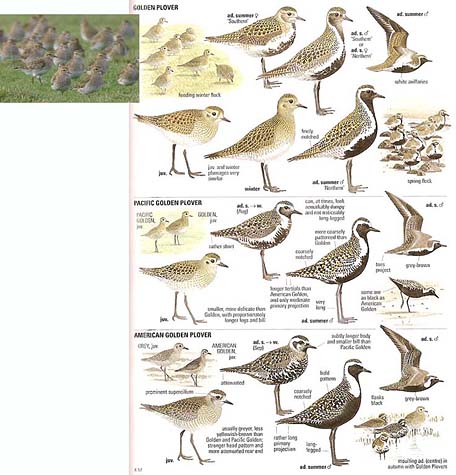
Likewise look at this full plate on the three species of golden plovers. Again, so many points of comparison in plumage, posture, age, sex, on the ground versus in flight – you name it! I also love the way they frequently include a “zoomed out” picture that portrays the way one might see the species under field conditions – in this case compare the illustration of a feeding flock with my photo of a loafing flock of European Golden Plovers. These “small” pictures really help one in learning and appreciating GISS. The “floating captions” with the picture also serve to direct the reader’s attention to the key points.


But perhaps above all, is the just the truly extraordinary quality of the illustrations themselves. To illustrate this allow me to juxtapose the illustrations of two North American species, Greater Yellowlegs and Lesser Yellowlegs in the Bird of Europe and the National Geographic Field Guide to the Birds of North America. In both cases these two species occupy half a plate and these two field guides are very similar in size. You might expect the North American guide to have more detail or better portray the species but as far as I am concerned, in terms of “capturing the species’ likeness”, quality, detail, comparative merit, and utility in the field, the Birds of Europe is the hand-down winner. In addition to the comparison between these two species, you’ll also notice the comparison with other potentially confusing species, Common Greenshank and Wood Sandpiper, on the same page (in addition to the more detailed treatment of those European species on previous pages) and other useful extras like a size comparison (as viewed from a distance) with a very common species, Common Redshank.


Another useful comparison is these plates of North American Thrushes (Birds of Europe on the left versus National Geographic on the right). Both are excellent for field identification but again the European guide does at least as good, and in my opinion even better, a job of the North American vagrants as the American guide does. The Birds of Europe also makes several comparisons with Song Thrush (not necessary in North America). Small wonder I often keep a copy of the Birds of Europe with me as I bird around the North American continent!


But is this new edition worth buying if you have the old? I would say yes — there are enough good changes to make it worth owning. Of course, this includes treatment of the various splits that have occurred since the publication of the first edition and, clearly, the taxonomic treatment is consistent and carefully considered. The text has been updated and the results of various recent publications as they pertain to field identification incorporated, especially if you are a “larophile” (lover of gulls) – there is a lot of new information on gulls! The maps have also been improved where relevant; for example, I was happy to see that the new map for Rock Partridge had been corrected to show the southern Italian population. Some of the drawings are redone and others added (love the new half plate on scops owls!), with about 16 extra pages from the first edition. The Nearctic Wood-Warblers have been redone by Killian Mullarney in a style that is much more consistent than previously (in the first edition the two plates by Larry McQueen were in a different style than the rest of the book). As always, the additions and changes are treated with superb precision and care (perhaps only the illustration of Yellow Warbler is a little below the usual high standard in terms of capturing the GISS).

Now, even a masterpiece cannot be perfect and, unfortunately, some of the inconsistencies that weakened the first edition have also crept into the second. There are still inconsistencies in the treatment of rarities and vagrants as to whether or not they get included in the main section of the guide or get relegated to the appendix (in which case quite a few are not illustrated). There has been some shuffling of species, especially the introduced ones, with species like Mandarin Duck and Wood Duck moved from the main section to an appendix, but not nearly enough for consistent treatment.

North American readers, many of whom, like me, consider this book a highly valuable resource, will be frustrated that there has still been no effort for consistency in nomenclature. Some Holarctic species are given both British and American English names, e.g. under Lapland Bunting the text reads (Am: Lapland Longspur), and after Slavonian Grebe in brackets we see (Horned Grebe) but many others still lack this “courtesy” such as Goosander, Guillemot and Kentish Plover (Common Merganser, Common Murre and Snowy Plover respectively).

It is wonderful that the book treats new splits so well, but an oversight was made in not indicating their former names or what they were split from. For example, a person who had the first edition and who wanted to compare Little Shearwater will not find it anywhere in the second edition (not even in the index nor anywhere in the text nor is there any table of splits or additions) unless they already know to look for Macronesian Shearwater.

Typesetting is expensive, so perhaps the authors wanted to make some of these changes but space or cost meant sticking with the old. On the whole though, a great amount of care has gone into improving most aspects of this guide and I am delighted to conclude that the very best modern field in the world (IMHO) is now even better! Looks like I am going to need two copies again – one for the book shelf and one for the glove compartment! Maybe it’ll help me find a European stray (in Manitoba not too likely but hey…).
 
Nature Blog Network Birdwatching Blogs - BlogCatalog Blog Directory Fatbirder's Top 500 Birding Websites