Showing posts with label Palearctic. Show all posts

Thursday, July 13, 2017

For the love of pipits!


After a splendid season of surveying Sprague’s Pipits in Manitoba’s grasslands, I am feeling rather pipit-inspired and have decided to share a series of photos of different species from around the globe. Pipits are not as boldly patterned as their relatives the wagtails but the pack in a lot of mystique and offer a wonderful birding challenged to find and identify.

Sprague’s Pipit (Anthus spragueii), Manitoba, Canada:
One of the highlights of so much surveying in cattle pastures this year was getting some exceptional opportunities to SEE Sprague’s Pipit. I emphasise the word “see” because 9 times out of 10 one hears Sprague’s Pipit but cannot spot the speck in the sky. These grassland birds make their haunting song carry further by singing high in the air over the grasslands. This year though, having spent so much time in grasslands such as cattle pastures for #MBSARPAL (http://www.mbbeef.ca/sarpal/) and on  community pastures, I saw no less than six of them on the ground (more than I have seen on the ground in 15 years of birding in Manitoba). Here is one that shows the bird well (including the white outer rectrices) stitched together with a habitat shot that shows a pipit walking through some beautiful mixed-grass prairie. . 


Buff-bellied Pipit, a.k.a American Pipit (Anthus rubescens), Manitoba, Canada and Wyoming, U.S.A.:
The other pipit we regularly see in North America is known in North America as “American Pipit” but this species also breeds in much of Siberia and northernmost China and winters in Asia as well so most of the world prefers to call the species Buff-bellied Pipit. Different populations breed in Arctic, Subarctic or alpine tundra and can look rather different (some more pink in breeding plumage and some more buff). The first collage shows a bird in the subarctic tundra of northern Manitoba, Canada and a close-up of a bird foraging in the inter-tidal zone of Hudson Bay. The second collage shows a bird in rocky alpine habitat in Wyoming and then a juvenile on a boulder slope.


Yellowish Pipit (Anthus lutescens), Salta Argentina:
The Yellowish Pipit is one of the more widespread and smaller of the South American pipits. This species is found in grasslands and other relatively open habitat types from the dry zone of southern South America to the tropical wet savannas, even as far north as Panama. 


Hellmayr’s Pipit (Anthus hellmayri), Tucumán, Argentina:
The subtly beautiful Hellmay’s Pipit is an enigmatic grassland pipit, found most commonly in the drier grasslands of the Puna (as high as 3700 m ASL) but also in pastures in some contexts. Some populations are resident and some are migratory and there is the possibility that some subspecies may in fact be cryptic species. This composite shows the bird up close on a rock and in the typical Puna habitat it calls home. It reminds me a lot of our Sprague’s Pipit but perhaps with a more speckled face.


Rosy Pipit (Anthus roseatus), Sichuan, China:
There are a few pipits that have soft pink or red in their plumage and the Rosy Pipit is one of my absolute favourites. This collage shows a bird in breeding plumage in the high mountains of Sichuan, China. This species is an altitudinal migrant, breeding in the alpine meadows and grassy slopes of the Himalayas and eastern Asia, even at the snow line, and wintering in the mid elevations plains.


Olive-backed Pipit (Anthus hodgsoni), South Korea and China:
The Olive-backed Pipit is one of the more common and widespread Asian pipits. This species breeds in a diverse mixture of habitat types especially where the taiga meets the tundra and where the montane forest meets the alpine zone, and, at least in the breeding season, seems to spend more time perched in shrubs and trees than many other pipits. You can even find them walking on the forest floor or fallen conifer needles at times. Like the Rosy Pipit, the alpine populations migrate down slope in winter and some go as far south as Borneo. This collage shows a few habitat types and plumages (a bird perched on a shrub in breeding plumage, a bird on a lawn in spring and a bird on the forest floor in autumn). 


Tawny Pipit (Anthus campestris), Rajasthan, India:
The Tawny Pipit is mostly a Western Palearctic breeding species that winters in sub-Saharan Africa (Sahel) and parts of the Middle East and the Indian Subcontinent. The large and fairly plain (i.e. unstreaked) pipit is easier to identify than many other pipits. It is found mostly in dry habitats as shown here in western India on the wintering grounds. Although it can be found in grassland you will also find this species in sand, gravel, semi-desert and shrubland.


Plain-backed Pipit (Anthus leucophrys), Cameroon:
The Plain-backed Pipit is one of the African resident pipit species (i.e. does not migrate) and a striking bird with its rich tawny underparts. This species is found in savanna and grassland with scattered shrubs and trees as shown here (photo from Cameroon).

Sunday, October 11, 2015

ON THE VERY BRINK...


I photographed this Spoon-billed Sandpiper (Calidris pygmaea) in South Korea in 2005 (the bird on the right is a Dunlin) but this critically endangered species in now on the very brink of extinction. Their massive decline, and the decline of many other species that use the East Asian-Australasian Flyway is strongly linked to the ecological devastation of major stop-over sites (much more so than to changes on the breeding grounds or wintering grounds) as this post http://www.birdskoreablog.org/?p=16846  and this article http://news.sciencemag.org/environment/2015/10/hostile-shores discuss. This is a compelling example of the need for full life cycle monitoring and conservation planning.

Wednesday, May 13, 2015

A few owls of South Korea


A recent visit to South Korea was not primarily a birding trip but will a little help from some old friends I managed to find a few of South Korea’s wonderful owls that I have wanted to see for many years.

First and foremost on that list was this Ural Owl (Strix uralensis) in the mountains of the northeast, who offered a splendid viewing opportunity shortly after dusk.  These large, pale owls are widespread across the taiga / boreal portions of Eurasia are somewhat of an ecological equivalent of Barred Owl in North America.  With the largest females measuring 62 cm and weighing as much as 1.3 kg, Ural Owl is one of the largest species is the genus Strix (Great Gray Owl is larger but Ural Owl is approximately 10 cm longer than Barred Owl.  The Korean subspecies is S. u. nikolskii.


Similar to the Ural Owl but much smaller in size and darker in colour is the Himalayan Owl (Strix nivicolum). This species is also known as the Himalayan Wood-Owl or the Chinese Tawny Owl, although none of these names are apt (the distribution is not restricted to the Himalayas nor China). I was delighted to find this roosting bird tucked in against a tree trunk and definitely aware of my presence probably well before I spotted them. This species used to be considered conspecific with Tawny Owl (Strix aluco) from Europe and westernmost Asia but their song is quite different and the Himalayan Owl is generally darker with a shorter and more barred tail and a second “wing bar” usually visible.  This bird is a grey-brown morph, although there is apparently also a rufous morph, which I have never seen. You will see how the owl's plumage works so well as camouflage against the tree bark. The Korean subspecies is S. n. ma.
  

Finding a nest of Japanese Scops-Owl (Otus semitorques) was a major highlight. They were super secretive around their nest but I managed a few photos including one where a small mammal prey item was brought in. I was surprised to observe a pair of Siberian Flying Squirrels (Pteromys volans) that seemed to be using a cavity lower in the same tree (third photo). Interestingly, this northern scops-owl species is apparently resident in South Korea, unlike some other northern scops-owls such as Oriental Scops-Owl that are migratory. Nonetheless, there may be some altitudinal or short-distance migratory movements of this species in other parts of their range. Famous for their red eyes, unlike most other members of their genus, this species was once considered conspecific with “Collared Scops-Owl” which has now been divided into at least 4 species (they differ in voice, wing formula and some subtle plumage details).  The Korean subspecies is the nominate. 


I also saw two Eurasian Eagle-Owls in South Korea but it was raining and a few poor flight shots were all I managed such as the one below.


I hope you enjoyed this glimpse at the owls of South Korea!

Saturday, November 3, 2012

The World of Nuthatches

Nuthatches (Sittidae) are a northern hemisphere family that are most commonly found in temperate forests. Of the 28 species of Nuthatch in the world, only two have ranges that extend south of the equator (Blue Nuthatch and Velvet-fronted Nuthatch, both of which occur in Southeast Asia and also on Sumatra and Java).  Only four species occur in the Nearctic, the remainder occurring in Eurasia (one, the Algerian Nuthatch, occurs in northernmost Africa but only within the Palearctic Ream and not within the Afrotropical Realm). As you can imagine, that means that a large percentage of the world’s nuthatches occur in Asia and this family is thought to be “Old World” in origin. Of the 28 species, 14 occur in the Oriental Ream and 10 in the Palearctic Realm of which 6 in Asia, hence there are no less 20 species of nuthatch in Asia. The Himalayan region, with a total of eight species, has the greatest number of species of nuthatches of any area, although the ranges of all eight do not overlap.

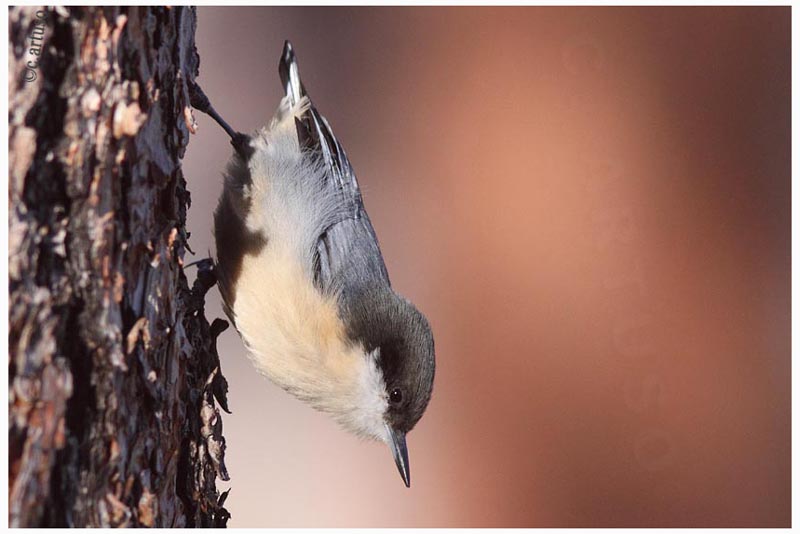
Although not a particularly large family, and not very diverse in their size, plumage colouration and morphology; wherever they occur, the most distinctive feature of nuthatches is their behaviour, especially the way they climb both upward and downward on branches. This immediately distinguishes them from all other “climbing” birds such as woodpeckers and treecreeper, that only move upward on tree trunks and branches (or at least position their bodies upward), although woodpecker and treecreepers, like nuthatches, will forage along the underside of branches. The difference is in part anatomical: since the majority of the “climbers” including most woodpeckers and treecreepers, have pointed stiffened tail feathers that act as a brace when climbing. Nuthatches on the other hand rely on their exceptionally strong toes to grip to the bark, whether going up or down. There is also a behavioural difference in that nuthatches have evolved a unique “stride” to accompany their anatomical adaptations, i.e. when walking downwards they are able to place one foot directly below the other and hence walk in a straight line downward. This technique is presumably important for balance and for maximizing the effectiveness of their toe grip. These anatomical and behavioural characteristics are illustrated by four photos below: a Sulphur-billed Nuthatch of the Philippines (note large toes and ability to “hang”), followed by a Blue Nuthatch of Southeast Asia (note downward motion), a Pygmy Nuthatch of North and Central America (note downward-pointing posture with the legs aligned in a straight line one below the other and hence ability to hang on while walking down the tree trunk) and a female White-breasted Nuthatch of North America (note how the large hallux toes clings to bark).


One of the most widespread of the nuthatches is the Eurasian Nuthatch. The first photo is from South Korea, but this species occurs across temperate Asia and Europe and even a tiny amount into the northernmost Africa. The first photo shows their remarkable ability to seemingly hang off the side of tree trunks using their strong toes. The second photo shows the western European subspecies for comparison (note the difference in underpart colouration).  The second photo also shows a behaviour of food storage – ramming a food item into bark crevices either to assist in cracking them open or for storage – a habitat that presumably earned this family their name.


Of course the short, straight, chisel-like bills of nuthatches are designed for probing into bark but several species show a willingness to forage on other substrates (as opposed to just probing into tree bark). This Eurasian Nuthatch is picking tasty morsels off a rocky outcrop. Other species such as the two “Rock Nuthatch” species (Eastern and Western) are more specialized in this technique.


Some of the Old World nuthatches are very similar in appearance and require a little care in identification. This is a Chestnut-vented Nuthatch (photo taken in China) that is similar in appearance to Eurasian Nuthatch (the distinctive undertail coverts not visible in this photo).

Another similar species, whose range partially overlaps with similar species like the Chestnut-bellied Nuthatch is the White-tailed Nuthatch shown here. This species has a predominantly Himalayan distribution and I took this photograph in northern India.The white base to the tail feathers that gives this species their name are seldom visible in normal field conditions.

The identification of nuthatches is simplified by the fact that in most parts of the world there are no more than two or three species that coexist. This is presumably due to similarities in foraging niche. Nonetheless, there are certainly differences in niche that reduce competition where overlap occurs. Where I live in North America, for example, the ranges of the Red-breasted and White-breasted Nuthatches overlap partially and you do sometimes see them together at a feeder in winter. Nonetheless, the former is primarily a bird of boreal/coniferous forest and the latter primarily of deciduous forest. Here is a photo of a Red-breasted Nuthatch on a pine tree and a White-breasted Nuthatch on a riverside deciduous tree, both taken in southeastern Manitoba, Canada. The White-breasted Nuthatch in this photo is a male and, if you like, try comparing with the photo of a female White-breasted nuthatch above to see if you can spot the differences.


In Central Asia, the White-cheeked Nuthatch is remarkably similar to the White-breasted Nuthatch of North America, although the more eastern subspecies, like this one shown from western China, have more extensive rufous below. If you can imagine this bird without the rufous underparts, you’ll understand what I mean.


This Yunnan Nuthatch, endemic to southwest China, is a small species, but this series of three photos illustrate their ability to probe into large seed cones to retrieve large seeds. 


North American observers will recognise this behaviour – in this case, the diminutive Pygmy Nuthatch illustrates the same technique…


One of the most distinctive species is the Velvet-fronted Nuthatch shown here. This is a widespread Southeast Asian species (this photo taken in India). The Sulphur-billed Nuthatch shown above was once considered conspecific with this species, though it differs in having a yellow as opposed to a red bill.  This photo further illustrates the utility of the probe-feeding strategy (in this case for prying open a tree wound) so typical of this fascinating family.


So ends this glimpse into the life of the Sittidae…

Friday, September 14, 2012

Common British Birds: Part 2 (Passerines)

This post features some of the common songbirds (passerines) of the British Isles and of course features species I photographed there in rough taxonomic order. Arguably the two most common swallow species (well, at least at the times of year i have visited) are the Common House Martin (left) and the Barn Swallow (right). North American birders will notice how much whiter below (as opposed to red) the Barn Swallow’s on this side of the pond are…

The pipits and wagtails (family Motacillidae) are much more diverse in the Palearctic than the Nearctic and there are at least 12 species in Europe as compared to 6 in North America. Some of the common species in the British Isles includes the aptly named Meadow Pipit,

the coast-dwelling Rock Pipit,

and the very common White Wagtail. The birds in Britain and Ireland (subspecies yarrellii) have a distinct plumage and some consider them to be a full species "Pied Wagtail".

The wrens (Troglodytidae) on the other hand are very much an "American" family, distributed throughout the Nearctic and Neotropics (North and South America) with only one species found in the Palearctic, the Eurasian Wren (split from the Winter Wren and Pacific Wren with which they were formally considered conspecific). The Eurasian Wren is a garden bird in Britain and elsewhere, so different from North America, where the larger House Wren occurs in that setting and our Winter Wren is a boreal forest species (at least where I live).

The White-throated Dipper is one of two dipper species in the Palearctic and the only one in western Europe.

The Dunnock is a member of the Accentor family (Prunellidae) and is also known as Hedge Accentor. Accentors are a small family (worldwide 13 species) that are basically confined to the Palearctic Realm (spill over slightly into the Oriental Realm in the Himalayas for example) that have short pointed bills and forage by hopping along the ground, especially at high elevations or northern areas.

The Palearctic has many species with the large family Muscicapidae, which of course translates (from Latin) as “flycatchers” (musca = fly, capere = to seize), generally referred to as “Old World flycatchers”.  The common names of many of the birds in this “familiar” family (to Europeans), were later re-applied to unrelated species from different parts of the world. Hence today, North American flycatchers (tyrant flycatchers) and Old World flycatchers are unrelated, the American Robin is not closely related to the birds called robins in Europe (the American Robin is actually a thrush and not a robin), the American Redstart is a New World wood-warbler (different from Old World warblers of course) and not closely related at all to the 15 species of redstarts within the Muscicapidae family, and the bird North Americans call “chat” (Yellow-breasted Chat) is not closely related to the chats, which, like Old World robins, are usually placed with the Old World Flycatcher family.  Here are a few examples. The European Stonechat (Stone Chat) is one of about 14 species in the genus Saxicola (different authors terat species limits differently in this genus). This is a female.

This is the dapper little European Robin (a.k.a Robin Redbreast). Like other species called robins in the Muscicapidae family in genera including Erithacus, Luscinia, Tarsiger and others, this is a very small bird (14 cm) that hops on the ground and often cocks or at least half cocks their tail. Most “robins” are very shy and some are ultra skulkers but the European Robin is a very familiar garden bird and easy to observe.

The wheatears (23 species in the genus Oenanthe with a mostly Palearctic and African distribution) are closely related to the “true” chats and robins. The only one to occur regularly in the U.K is generally called Northern Wheatear to distinguish them from the 22 others but most British birders simply refer to them as “wheatear”, a name that is said to be a euphemistic or “corrupted” pronunciation of the older name “white arse” referring to their prominent white rump. This bird is in fall / autumn plumage.

Here is yet another example of a borrowed name. This is the bird the British call “blackbird”, i.e. Eurasian Blackbird, featured in music and poetry, e.g. the beetles line “blackbird singing in the dead of night…”(yes, they do sing at night a lot). The Eurasian Blackbird is a thrush in the genus Turdus, i.e. congeneric with American Robin! Famed for the beautiful song and not closely related to the birds North Americans call “blackbirds” at all. This is a male, females are browner.

The Thrush family is well represented in the Palearctic. In addition to the Eurasian Blackbird above, here are some of the common U.K species. This is a Song Thrush, also in the genus Turdus.

Similar to Song Thrush but much larger and paler, this is a Mistle Thrush.

In fall and winter the thrushes that breed in the U.K are joined by some northern visitors such as this Redwing (also a Turdus thrush).

And yet another Turdus thrush, the Fieldfare.

The family Paridae (tits and chickadees) is well represented in the U.K. One of the most common garden birds is the European Blue Tit.

And there are various other similar species such as the Coal Tit,

and the Great Tit.

and, in a different family, Aegithalidae (Bushtits or long-tailed tits), there is the Long-tailed Tit, a.k.a Long-tailed Bushtit.

As mentioned above, “warblers” in the Old World and in the New World are very different. The taxonomy of the MANY species that are called warblers is somewhat complicated and in a bit of a state of flux it seems but the majority are now placed in a family called Sylviidae by the IOC. . Some of the genera of Old World warblers are very large, the genus Phylloscopus, which contains arguably some of the world’s most difficult species to identify by sight alone,  contains no less than 62 species (and most of them look extremely similar). This is a Willow Warbler, one of the commonest in the U.K.

The Eurasian Treecreeper is one of two treecreeper species in Europe and the only one in the U.K. This widespread species is found across the Palearctic.

The Eurasian Jay is the European equivalent of North America’s Blue Jay although not a garden bird to the same extent.

The many finch species in the U.K offer a lot of colour and many of them regularly visit feeders. Most of the photos below were taken from the photo hide of the RSPB Lochwinnoch reserve near Glasgow. The Chaffinch is one of the commonest garden and feeder visitors. These three photos show a male, female then juvenile.


These next three photos show a male, female then juvenile Eurasian Siskin. This is also a common species.


These two photos show an adult then juvenile of the beautiful European Goldfinch.

 
And here are a male and female European Greenfinch, a most striking and large and "well-built" finch!


And last but not least a male Eurasian Bullfinch. You can see how they earned their name from the bull-necked appearance!

Of course this is only a small sampling of the birds of Great Britain.
 
Nature Blog Network Birdwatching Blogs - BlogCatalog Blog Directory Fatbirder's Top 500 Birding Websites