Showing posts with label China. Show all posts

Sunday, April 13, 2014

the critically endangered Chinese Crested Tern

Once feared extinct, and with fewer than 50 mature individuals in the world, the critically endangered Chinese Crested Tern is one of the rarest birds in the world. They breed on islands in the Strait of Taiwan and visit the Minjiang Estuary on Fujian’s coast typically in May – June. It is therefore hard to describe the emotion I felt when two of these magnificent birds flew in and landed at the estuary on April 5th (one of the earliest records ever) – I think I am still in a state of shock!

曾经我们担心中华凤头燕鸥已经灭绝, 现在知道在整个世界有少于50!
中华凤头燕鸥筑巢在台湾海峡的一些小岛, 5,6月到闽江. 因此, 45日在闽江口看到两只飞过来上滩, 很难交待那一刻的情感. 我还不敢相信!


Saturday, November 3, 2012

The World of Nuthatches

Nuthatches (Sittidae) are a northern hemisphere family that are most commonly found in temperate forests. Of the 28 species of Nuthatch in the world, only two have ranges that extend south of the equator (Blue Nuthatch and Velvet-fronted Nuthatch, both of which occur in Southeast Asia and also on Sumatra and Java).  Only four species occur in the Nearctic, the remainder occurring in Eurasia (one, the Algerian Nuthatch, occurs in northernmost Africa but only within the Palearctic Ream and not within the Afrotropical Realm). As you can imagine, that means that a large percentage of the world’s nuthatches occur in Asia and this family is thought to be “Old World” in origin. Of the 28 species, 14 occur in the Oriental Ream and 10 in the Palearctic Realm of which 6 in Asia, hence there are no less 20 species of nuthatch in Asia. The Himalayan region, with a total of eight species, has the greatest number of species of nuthatches of any area, although the ranges of all eight do not overlap.

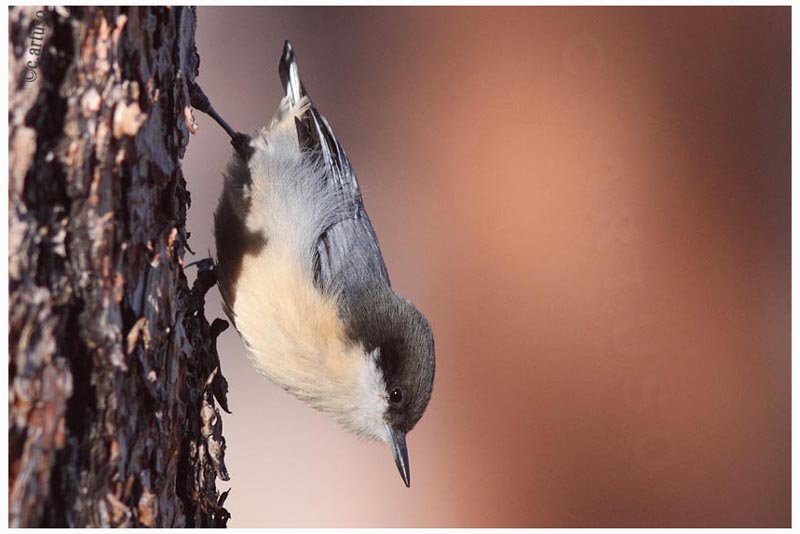
Although not a particularly large family, and not very diverse in their size, plumage colouration and morphology; wherever they occur, the most distinctive feature of nuthatches is their behaviour, especially the way they climb both upward and downward on branches. This immediately distinguishes them from all other “climbing” birds such as woodpeckers and treecreeper, that only move upward on tree trunks and branches (or at least position their bodies upward), although woodpecker and treecreepers, like nuthatches, will forage along the underside of branches. The difference is in part anatomical: since the majority of the “climbers” including most woodpeckers and treecreepers, have pointed stiffened tail feathers that act as a brace when climbing. Nuthatches on the other hand rely on their exceptionally strong toes to grip to the bark, whether going up or down. There is also a behavioural difference in that nuthatches have evolved a unique “stride” to accompany their anatomical adaptations, i.e. when walking downwards they are able to place one foot directly below the other and hence walk in a straight line downward. This technique is presumably important for balance and for maximizing the effectiveness of their toe grip. These anatomical and behavioural characteristics are illustrated by four photos below: a Sulphur-billed Nuthatch of the Philippines (note large toes and ability to “hang”), followed by a Blue Nuthatch of Southeast Asia (note downward motion), a Pygmy Nuthatch of North and Central America (note downward-pointing posture with the legs aligned in a straight line one below the other and hence ability to hang on while walking down the tree trunk) and a female White-breasted Nuthatch of North America (note how the large hallux toes clings to bark).


One of the most widespread of the nuthatches is the Eurasian Nuthatch. The first photo is from South Korea, but this species occurs across temperate Asia and Europe and even a tiny amount into the northernmost Africa. The first photo shows their remarkable ability to seemingly hang off the side of tree trunks using their strong toes. The second photo shows the western European subspecies for comparison (note the difference in underpart colouration).  The second photo also shows a behaviour of food storage – ramming a food item into bark crevices either to assist in cracking them open or for storage – a habitat that presumably earned this family their name.


Of course the short, straight, chisel-like bills of nuthatches are designed for probing into bark but several species show a willingness to forage on other substrates (as opposed to just probing into tree bark). This Eurasian Nuthatch is picking tasty morsels off a rocky outcrop. Other species such as the two “Rock Nuthatch” species (Eastern and Western) are more specialized in this technique.


Some of the Old World nuthatches are very similar in appearance and require a little care in identification. This is a Chestnut-vented Nuthatch (photo taken in China) that is similar in appearance to Eurasian Nuthatch (the distinctive undertail coverts not visible in this photo).

Another similar species, whose range partially overlaps with similar species like the Chestnut-bellied Nuthatch is the White-tailed Nuthatch shown here. This species has a predominantly Himalayan distribution and I took this photograph in northern India.The white base to the tail feathers that gives this species their name are seldom visible in normal field conditions.

The identification of nuthatches is simplified by the fact that in most parts of the world there are no more than two or three species that coexist. This is presumably due to similarities in foraging niche. Nonetheless, there are certainly differences in niche that reduce competition where overlap occurs. Where I live in North America, for example, the ranges of the Red-breasted and White-breasted Nuthatches overlap partially and you do sometimes see them together at a feeder in winter. Nonetheless, the former is primarily a bird of boreal/coniferous forest and the latter primarily of deciduous forest. Here is a photo of a Red-breasted Nuthatch on a pine tree and a White-breasted Nuthatch on a riverside deciduous tree, both taken in southeastern Manitoba, Canada. The White-breasted Nuthatch in this photo is a male and, if you like, try comparing with the photo of a female White-breasted nuthatch above to see if you can spot the differences.


In Central Asia, the White-cheeked Nuthatch is remarkably similar to the White-breasted Nuthatch of North America, although the more eastern subspecies, like this one shown from western China, have more extensive rufous below. If you can imagine this bird without the rufous underparts, you’ll understand what I mean.


This Yunnan Nuthatch, endemic to southwest China, is a small species, but this series of three photos illustrate their ability to probe into large seed cones to retrieve large seeds. 


North American observers will recognise this behaviour – in this case, the diminutive Pygmy Nuthatch illustrates the same technique…


One of the most distinctive species is the Velvet-fronted Nuthatch shown here. This is a widespread Southeast Asian species (this photo taken in India). The Sulphur-billed Nuthatch shown above was once considered conspecific with this species, though it differs in having a yellow as opposed to a red bill.  This photo further illustrates the utility of the probe-feeding strategy (in this case for prying open a tree wound) so typical of this fascinating family.


So ends this glimpse into the life of the Sittidae…

Tuesday, June 9, 2009

China - raptors

Too busy for words in the field season but will squeeze in a quick post to finish off the China series while I can.

There were some great raptors on show in China, although not nearly as many species as in India. One of my favourite experiences was watching the huge Himalayan Griffons sailing around the cliffs high in the mountains, using updrafts and soaring over the valleys. At one point I walked up to a ridge only to be greeted by the huge bill of one of these magnificent birds riding the current and coming straight up the cliff face… for a split second I thought we might have a head-on collision but the huge bird cleared my head by a few metres… needless to say I was awestruck. The series below shows them from several angles – the first from a distance to show how they sail over the forest, the others up close and personal.


Another extremely impressive raptor of the Himalaya is the Lammergeier. This huge vulture with their distinctive shape always leaves an impression… on birds as well as people!


This second image shows the Lammergeier in their habitat – above the rocky cliffs


I also enjoyed great views of the classy Upland Buzzard flying around on the Tibetan Plateau.


A rather different raptor in a rather different ecozone (down in the forest not high above the trees) from the above, this Besra (a small Accipiter) was waiting by a bat cave in the very early morning, perhaps hoping to snatch breakfast.


Switching to my favourite order – the owls – this Asian Barred Owlet pokes out from behind the foliage in the early morning


Up on the Tibetan Plateau, the huge Eurasian Eagle Owl, largest owl in the world (or perhaps equal first with Blakiston’s Fish Owl) and much bigger than their cousin the Great Horned Owl, sits on a pole at dawn before disappearing into one of the smallish copses of trees that dot the high elevation grasslands.


While nearby a Little Owl also finds the pole tops an attractive perch in the open landscape


Even in Beijing one can find interesting birds! An afternoon visit to Yiheyuan before flying out seemed doomed to be rather fruitless as rain was clearly imminent. Discouraged by the enormous number of people in the gardens and the subsequent lack of birds, not to mention the sweltering heat, I paused to remove my sweaty shirt and take a quick breather under a waterside willow. Lying on the grass I noticed a “strigidesque” lump above my head, which turned out to be none other than this beautiful Oriental Scops Owl. What a bonus! Ten minutes after I got this photo the heavens opened and the downpour began.


That's it for China - sorry for the delay. I'll try to process some photos from this summer as soon as possible!

Friday, May 15, 2009

China - tits, nuthatches, creepers and a wren

I don’t often blog about the familiar birds although these can be just as fascinating as the rare and elusive species. I thought it worthwhile to show some photos of a few families that will be very familiar to many readers, but with some Chinese colour and characteristics” of course (if you don’t get the reference it’s a play on the oft-touted ol’ propaganda slogans such as “Marxism with Chinese characteristics” (the word they often used for “characteristics” 特色 literally means “special colour” so it seems appropriate to apply this to birds). This post is about a somewhat miscellaneous accumulation of families Paridae (tits or titmice and chickadees), Aegithalidae (long-tailed tits or bushtits), Sittidae (nuthatches), Certhidae (treecreepers) and with a member of the Troglodytidae (wrens) thrown in for good measure. These families don’t have a lot in common except that they are mostly small passerines and in China it is not uncommon to see several species from these families together in mixed flocks.

Starting with the family Paridae the beautiful Rusty-breasted Tit (also called Père David’s Tit) exhibits a very familiar pattern – a colourful version of a Marsh Tit or A Black-capped Chickadee. Indeed the genus Poecile all have this basic pattern or variation upon it, although not everybody agrees as to what constitutes a genus within the Paridae, e.g. some place the Poecile species under Parus.


The handsome Grey-crested Tit with its very noticable crest is China’s equivalent of Europe’s Crested Tit. Together these two species are sometimes place in their own genus Lophophanes. Although superficially similar they are not directly grouped with the Baeolophus titmice of North America such as Tufted Titmouse (these have smaller crests).


The colourful Yellow-bellied Tit is pretty much endemic to China and may belong to a subgroup of tits that includes Coal Tit (sometimes placed in the genus Periparus).


The Yellow-browed Tit is a peculiar tit and rather unlike most other members of the family with it unmarked green plumage overall, very subtle crest and hint of yellow behind the eye that gives the common name (if you look hard you can see it in this photo). So unlike other member of the Paridae is this species that they are placed in a monotypic genus Sylviparus.


And if you think Yellow-browed Tit is unusual, get a load of this next tit – Hume’s Groundpecker looks so unlike other tits that for the longest time no-one realised their true affinity (although there are some similarities with other tits for example in social behaviour). IT was a real treat to see these birds hopping around on the high Tibetan grasslands, or interacting and flicking their wings on the walls of a Tibetan monastery as seen here. Their decurved bill serves them well when probing in the ground for food.


Next we have two similar species from the Aegithaidae - the Black-browed Tit and the Black-throated Tit, both illustrated here by juveniles (if you're wondering why their plumage doesn't match their names).


Moving to the nuthatches, here is a close-up of the endemic Yunnan Nuthatch


and here is one in their habitat feeding on cones in the high elevation conifer forests of Yunnan


The White-cheecked Nuthatch also likes the high elevation conifer forests but has a different distribution (this one photographed in western Sichuan).


The treecreepers are a small family of small birds that occur across the Northern Hemisphere but reach their peak diversity in Asia. On the left is the newly discovered endemic Sichuan Treecreeper in the fog and mist of Wawushan (note the short bill) and on the right the Brown-throated Treecreeper at Gaoligongshan in Yunnan.


I thought I should end with a bird that is familiar to so many in a less familiar context. This is of course the Winter Wren, also present in the mountains of China. The first photo shows the dark plumage of this wren in the moist forests of Sichuan. The second photo is for comparative purposes and is of a North American bird (Manitoba, Canada) from a drier climate with paler plumage.

More photos from China at artusophotos.com

Wednesday, May 6, 2009

China - thrushes, robins, redstarts

Two closely related families that are well represented in China are the Turdidae (thrushes and allies) and Muscicapidae (Old World Flycatchers and allies). Sibley and Monroe placed them all in the same family whereas others separate out the Saxicolidae as a family of their own containing groups such as “robins”, “redstarts”, and some species called “chats” (although not all birds called chats). North Americans may find that commentary surprising or confusing since the same names are used for very different families, e.g. American Robin is a thrush not a robin, American Redstart is a wood-warbler not a redstart, and Yellow-breasted Chat is also a wood-warbler and not a chat. Some recognition of this in nomenclature has been the recent changing of the common name of other New World thrushes, e.g. Clay-colored Robin to Clay-colored Thrush.

Some of my personal highlights from this group included killer looks at the beautiful Kessler’s Thrush (a.k.a White-backed Thrush)… first female then male. A truly magnificent high elevation thrush – these photos were taken up on the Tibetan plateau above 4000m asl.


Among the “robin” group there were many highlights of my trip to Yunnan and Sichuan including this White-tailed Rubythroat. This shot shows a male in flight. Similar to the Siberian Rubythroat both rubythroats are true gems – secretive, elusive and stunning! Unfortunately his ruby throat doesn’t show so well in this photo.


More common and widespread but equally beautiful is the Orange-flanked Bush Robin. This species goes by many names including Red-flanked Bluetail.


Next the Golden Bush Robin, again first female then male. A true gem I was delighted to get great looks at this species at several sites in Yunnan. These shots show the characteristic long-legged structure of the robins and their typical posture as they hop around on the ground or in shrubs. The photo of the male shows the tail half cocked. Most robins frequently cock their tails (again remember American Robin is not a “robin”).


Next we move to the group called redstarts, so named because many flash red or orange in the tail. Most hop around in fairly open habitats such as high elevation or high latitude rocks and grassy areas or by waterways. Rather than cock their tail like robins, most tend to flash the colour in their tail by flicking them open and then closed. Redstarts comprise several genera. The White-throated Redstart is in the largest genus Phoenicurus (no relation the flamingoes — probably the connection has more to do with pink or reddish colour). This is a truly magnificent redstart and I was delighted to see them so well. The second photo shows the scaled pattern of an immature bird.


High up in the rocky Tibetan plateau shrub community a male Blue-fronted Redstart feeds his young one.


Whilst nearby along a rocky stream hops the beautiful White-capped Water Redstart.


When a female White-bellied Redstart give a little tail flick you can see the she too has some reddish colour at the base of her tail.


You might not know about the male’s colourful tail at first


Until you see the feathers fan out as in this flight shot. In this shot you can also see the berries he was feeding on.


The Grandala is an aberrant thrush or robin (some disagreement as to which) of high altitudes. The stunningly deep blue of the male will take your breath away as they fly across the slopes. The female and juvenile on the other hand are superbly camouflaged with the rocks of their high elevation home.


The forktails are one of those uniquely Asian groups of robin-like birds. Patterned mostly in black, grey and white with long, usually forked tails, they are characteristic streamside birds throughout much of southern Asia. The Little Forktail doesn’t have the deeply forked tail of other forktails but their pattern and behaviour easily reveal their identity.


More photos from China at: http://artusophotos.com/
 
Nature Blog Network Birdwatching Blogs - BlogCatalog Blog Directory Fatbirder's Top 500 Birding Websites