Showing posts with label South America. Show all posts

Thursday, July 13, 2017

For the love of pipits!


After a splendid season of surveying Sprague’s Pipits in Manitoba’s grasslands, I am feeling rather pipit-inspired and have decided to share a series of photos of different species from around the globe. Pipits are not as boldly patterned as their relatives the wagtails but the pack in a lot of mystique and offer a wonderful birding challenged to find and identify.

Sprague’s Pipit (Anthus spragueii), Manitoba, Canada:
One of the highlights of so much surveying in cattle pastures this year was getting some exceptional opportunities to SEE Sprague’s Pipit. I emphasise the word “see” because 9 times out of 10 one hears Sprague’s Pipit but cannot spot the speck in the sky. These grassland birds make their haunting song carry further by singing high in the air over the grasslands. This year though, having spent so much time in grasslands such as cattle pastures for #MBSARPAL (http://www.mbbeef.ca/sarpal/) and on  community pastures, I saw no less than six of them on the ground (more than I have seen on the ground in 15 years of birding in Manitoba). Here is one that shows the bird well (including the white outer rectrices) stitched together with a habitat shot that shows a pipit walking through some beautiful mixed-grass prairie. . 


Buff-bellied Pipit, a.k.a American Pipit (Anthus rubescens), Manitoba, Canada and Wyoming, U.S.A.:
The other pipit we regularly see in North America is known in North America as “American Pipit” but this species also breeds in much of Siberia and northernmost China and winters in Asia as well so most of the world prefers to call the species Buff-bellied Pipit. Different populations breed in Arctic, Subarctic or alpine tundra and can look rather different (some more pink in breeding plumage and some more buff). The first collage shows a bird in the subarctic tundra of northern Manitoba, Canada and a close-up of a bird foraging in the inter-tidal zone of Hudson Bay. The second collage shows a bird in rocky alpine habitat in Wyoming and then a juvenile on a boulder slope.


Yellowish Pipit (Anthus lutescens), Salta Argentina:
The Yellowish Pipit is one of the more widespread and smaller of the South American pipits. This species is found in grasslands and other relatively open habitat types from the dry zone of southern South America to the tropical wet savannas, even as far north as Panama. 


Hellmayr’s Pipit (Anthus hellmayri), Tucumán, Argentina:
The subtly beautiful Hellmay’s Pipit is an enigmatic grassland pipit, found most commonly in the drier grasslands of the Puna (as high as 3700 m ASL) but also in pastures in some contexts. Some populations are resident and some are migratory and there is the possibility that some subspecies may in fact be cryptic species. This composite shows the bird up close on a rock and in the typical Puna habitat it calls home. It reminds me a lot of our Sprague’s Pipit but perhaps with a more speckled face.


Rosy Pipit (Anthus roseatus), Sichuan, China:
There are a few pipits that have soft pink or red in their plumage and the Rosy Pipit is one of my absolute favourites. This collage shows a bird in breeding plumage in the high mountains of Sichuan, China. This species is an altitudinal migrant, breeding in the alpine meadows and grassy slopes of the Himalayas and eastern Asia, even at the snow line, and wintering in the mid elevations plains.


Olive-backed Pipit (Anthus hodgsoni), South Korea and China:
The Olive-backed Pipit is one of the more common and widespread Asian pipits. This species breeds in a diverse mixture of habitat types especially where the taiga meets the tundra and where the montane forest meets the alpine zone, and, at least in the breeding season, seems to spend more time perched in shrubs and trees than many other pipits. You can even find them walking on the forest floor or fallen conifer needles at times. Like the Rosy Pipit, the alpine populations migrate down slope in winter and some go as far south as Borneo. This collage shows a few habitat types and plumages (a bird perched on a shrub in breeding plumage, a bird on a lawn in spring and a bird on the forest floor in autumn). 


Tawny Pipit (Anthus campestris), Rajasthan, India:
The Tawny Pipit is mostly a Western Palearctic breeding species that winters in sub-Saharan Africa (Sahel) and parts of the Middle East and the Indian Subcontinent. The large and fairly plain (i.e. unstreaked) pipit is easier to identify than many other pipits. It is found mostly in dry habitats as shown here in western India on the wintering grounds. Although it can be found in grassland you will also find this species in sand, gravel, semi-desert and shrubland.


Plain-backed Pipit (Anthus leucophrys), Cameroon:
The Plain-backed Pipit is one of the African resident pipit species (i.e. does not migrate) and a striking bird with its rich tawny underparts. This species is found in savanna and grassland with scattered shrubs and trees as shown here (photo from Cameroon).

Saturday, November 21, 2015

Alianza del Pastizal - The Grassland Alliance


It was an enormous honour to see the Alianza del Pastizal (Grasslands Alliance - see: http://www.alianzadelpastizal.org) in action at the 9th Southern Cone Grassland Ranchers Meeting. This alliance is an amazing conservation initiative that is doing the Birdlife International network proud! Those of us striving for meaningful conservation in North America’s grasslands could learn a lot from Argentina, Uruguay, Paraguay and Brazil and their remarkable collaboration that offers great hope for South American grassland (“pampa”) threatened species as well as over-wintering Bobolink, Upland Sandpiper, Buff-breasted Sandpiper, American Golden-Plover and others. Thank you to the Alianza del Pastizal for the generous invitation and to my many Brazilian friends who were so generous and hospitable and to all those new colleagues for a profound dose of inspiration. Special thanks to John Beaver of National Audubon who co-presented with me in Spanish in front of 460 people! Special thanks to the Schad Foundation for supporting Bird Studies Canada’s grassland bird research and conservation initiatives. I gave my impressions at the meeting here: https://www.facebook.com/492198510843369/videos/1023976417665573/?pnref=story
(y en español para mis amigos hispanoparlantes a: https://www.facebook.com/492198510843369/videos/1024014864328395/?pnref=story). Here is the group photo on the final day, followed by a photo of John and I presenting and a snapshot of the meeting summary that talks about our presentation (in Spanish):.  


After having so greatly enjoyed the chance to see how the Alianza del Pastizal is working in the Southern Cone grasslands of Argentina, Uruguay, Paraguay and Brazil, I decided to share a few photos of some of the avian beneficiaries of this conservation initiative.

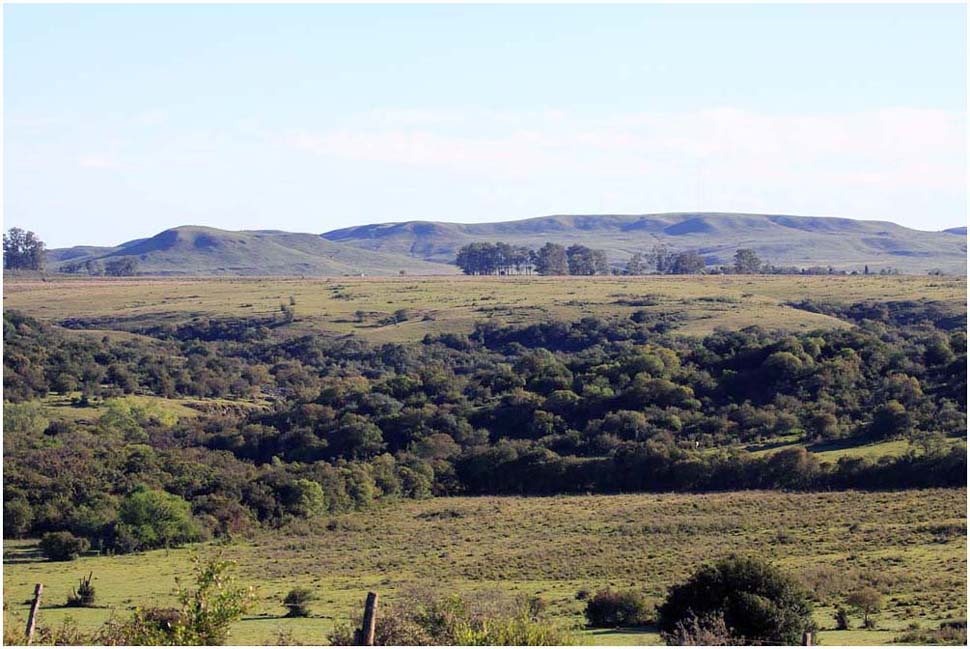
Let’s start by painting a little picture of the landscape in the southern cone where a variety of native grassland types occur. I took this photo in the Cerro Verde area near Santana Do Livramento (special thanks to Glayson Benke for guiding us there) in extreme southern Brazil near the border with Uruguay, where the 9th annual Southern Cone Grassland Ranchers Meeting was held. You can get a sense of the grassland interspersed with trees, shrubs and wetlands that occurs here. As you can see from the fences, and as with the North American prairie, today, this is a “working landscape” where “gauchos” (cowboys) and others make their livelihood. The Alianza del Pastizal uses a system of best management practices and other techniques to support ranchers that participate in conservation. Organic, grass-fed beef is raised following careful protocols in such a way as to maintain the ecological integrity and biodiversity of the lands. The intent is to benefit the birds and other biodiversity (and these birds risk losing their habitat if the pasture changes to other land use types as a result of market whims) but the ranchers also benefit because they sell their product under a registered label (carne del pastizal) and consumers pay a premium to support conservation and receive a high quality product. After 10 years, the alliance is starting to demonstrate just how effective this strategy is in maintaining the occupancy of threatened species on these lands. I will share just a few photos of some of the area’s birds. 


Red-winged Tinamou (Rhynchotus rufescens)
If you are surprised by the association of birds and cattle it is important to remember that these grasslands have been home to endemic bird species for a long time and they have been home to their share of megafauna over evolutionary history. Today, one of the key practices is controlled stocking rates so that the grasslands are not degraded and still provide cover for species like this large Red-winged Tinamou and you can see the tall grass in this photo. At 36 cm in length this somewhat chicken-like tinamou is about the size of a small grouse. The tinamous are a single ancient family (Tinamidae) within the order Tinamiformes. They only occur in the Neotropics and although they may look like grouse and quail they are not closely related at all (they are closer to the ratites).  


Spotted Nothura (Nothura maculosa), Cerro Verde, Brazil
Another grassland tinamou in this area is the beautifully cryptic Spotted Nothura, also in the tinamou family but much smaller than the previous. You may have to look twice to spot this bird hiding in the tall grass.


Greater Rhea (Rhea americana)
The southern cone grasslands are home to two ratite species – the rheas (there is also a third species of rhea in South America’s montane desert). The ratites are of course large flightless birds that include the largest extant species of birds. The Greater Rhea stands about 130 – 140 cm tall (not nearly as large as an ostrich) and they roam the pampas and some other open habitat types of southern South America. They are mostly reliant on natural grassland; however, they make good use of the well managed pastures of the Alianza ranchers. Apparently they have a skill to be able to walk between or under the wires of the cattle fences, although I have not witnessed this myself.    


Giant Wood-Rail (Aramides ypecaha)
In the wet grass surrounding one of the many lagoons and shallow wetlands of Cerro Verde, we were greeted to magnificent looks at the elegant Giant Wood-Rail. Although a member of the rail family (Rallidae), these large inhabitants of the pampas are not nearly as secretive as many other rails.


Grassland Yellow-Finch (Sicalis luteola)
In the tall grass we find the Grassland Yellow-Finch,  a small but elegant grassland species that is easily located by their display flight and song. Like many grassland birds around the world, delivering their song from above the grasses (in flight) helps it to carry further.   


Burrowing Owl (Athene cunicularia)
A familiar face occurs here too. Unlike in Canada however, these Burrowing Owls are not migratory and their populations are doing well in the area (they also occur in urban areas here).


Sadly though, I didn’t manage to photograph any North American migrants on this short trip, nor was there time to seek out some of the rarest inhabitants of the region. I shall return one day to explore the Southern Cone grasslands more thoroughly! I especially want to see the progress of the Alianza del Pastizal and what they are doing for grassland birds!

Thursday, January 29, 2015

Subtlety and beauty

On a recent visit to the high Andes of Ecuador, I was absolutely delighted to find a truly extraordinary shorebird of the high elevation bogs and alpine tundra, The Rufous-bellied Seedsnipe (Attagis gayi). The seedsnipe are a small family (Thinocoridae) of only four species of rather stocky shorebirds, found only in South America, whose diet is largely vegetarian (seeds and plant material) unlike the majority of shorebirds.

These birds are exquisitely plumaged such that their camouflage is exceptional but when seen well the feather detail is also truly breathtaking. I will try to let the photos speak for themselves. The first photo shows two Rufous-bellied Seedsnipe in their habitat. Can you spot them? If not, take a look at the second photo for help...


If you spotted those birds, congratulations! Now here are two photos with a telephoto lens to show off their exceptional beauty up close and personal. 

I hope you enjoy looking at these photos as much as I enjoyed finding these magnificent birds!

Saturday, January 17, 2015

Tanager dreamin’ on such a winter’s day!

Just because we don’t have any tanagers in Canada anymore (the Piranga genus that includes species like Scarlet Tanager is now considered to belong to the family Cardinalidae) and because it is -30°C and blanketed in snow, I decided to share a splash on colour with some of the MANY tanagers (family Thraupidae) that have brightened my Neotropical haunts. I tried to pick 50 species that represented the diversity of the family (currently 374 species in 97 genera), although that wasn’t easy! I hope you are sitting down—this could be overload so I will add photos approximately 10 at a time over the course of this week!

Beryl-spangled Tanager (Tangara nigroviridis)
The seemingly electric colour of the genus Tanagara tanagers, such as this Beryl-spangled Tanager, have bedazzled many an observer. A good mixed-species flock of these gems feels like a kaleidoscope exploding in your binoculars!


Burnished-buff Tanager (Tangara cayana)
Possibly the best named tanager, this male Burnished-buff Tanager sure flexes some bicep colour!


Paradise Tanager (Tangara chilensis)
I missed the bright red rump in this photo but even still you can’t miss the Paradise Tanager!


Brassy-breasted Tanager (Tangara desmaresti)
This beauty is a Brazilian endemic from the southeastern Atlantic forest.


Golden Tanager (Tangara arthus)
Not so mellow yellow!


Saffron-crowned Tanager (Tangara xanthocephala)
Sheer elegance!


Bay-headed Tanager (Tangara gyrola)
The Santa Marta endemic subspecies is very green (other subspecies have blue underparts).


Scrub Tanager (Tangara vitriolina)
There’s no vitriol when you see this tanager! The Latin species name describes the colour, deriving from “vitriolium referring to suphates such as copper sulphate (>“vitrium” (glass)).  Note how this tanager is feeding on an insect/bug.


Blue-necked Tanager (Tangara cyanicollis)
A gem in the rain, here demonstrating the genus’s frugivorous side.


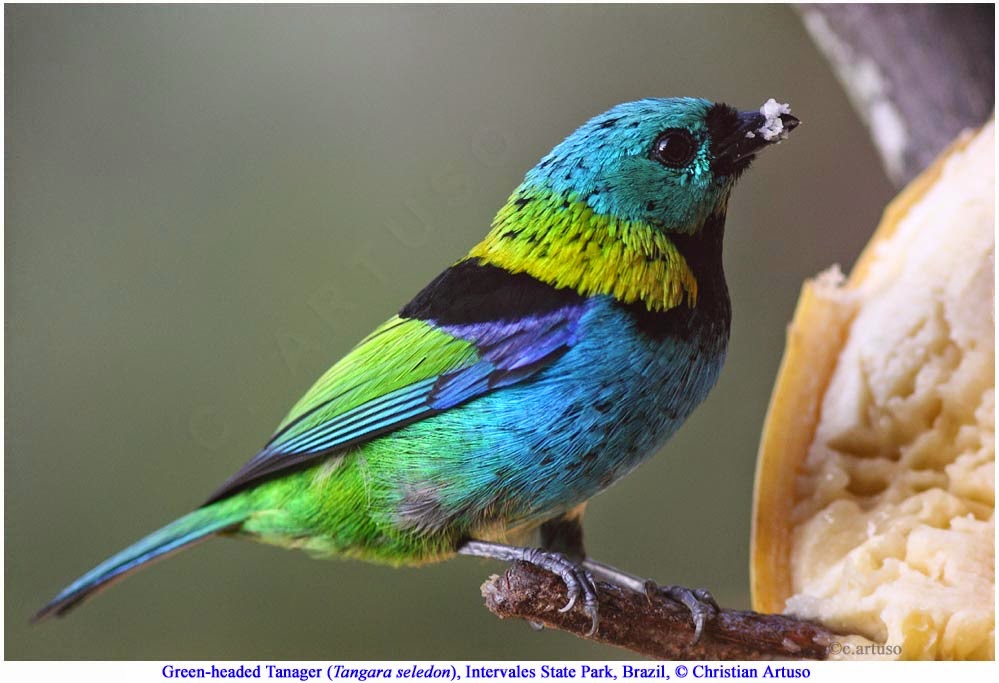
Green-headed Tanager (Tangara seledon)
These tanagers are sometimes attracted to fruit feeders allowing one to gawk... 


Swallow Tanager (Tersina viridis)
The unique Swallow Tanager is in a genus all of their own (this is a male, females are a delightful green).


Grass-green Tanager (Chlorornis riefferii)
Personally, I’d go with “canopy-green”!


Multicolored Tanager (Chlorochrysa nitidissima)
For such a colourful bird, the Multicolored Tanager is hard to find in the canopy. This range-restricted Colombian endemic is considered globally Vulnerable..


Orange-eared Tanager (Chlorochrysa calliparaea)
Another amazingly brilliant Chlorochrysa that lights up the forest (Alas, I have never managed to photograph them well).


Black-capped Hemispingus (Hemispingus atropileus)
A little less vibrant but very classy, the Hemispingus are also tanagers.


Rufous-chested Tanager (Thlypopsis ornata) 
May look like a warbler but this little gem is a high elevation tanager!


Hooded Mountain Tanager (Buthraupis montana)
The so-called “mountain tanagers” make high elevation birding a treat. Here is the large and beautiful Hooded Mountain Tanager of the high Andes.


Lacrimose Mountain Tanager (Anisognathus lacrymosus)
So named for the “teardrop” marking behind the eye, the Lacrimose Mountain Tanager has a rather unique orange colour in my opinion.


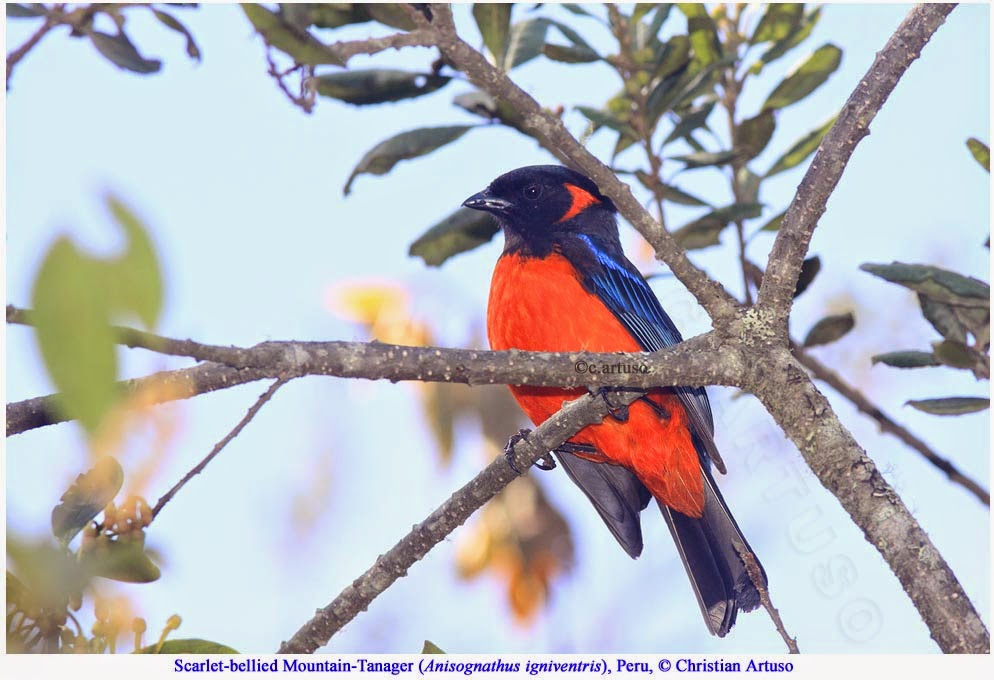
Scarlet-bellied Mountain Tanager (Anisognathus igniventris)
Studies have shown that nine out of ten birders run out of adjectives before they lower their binoculars on a Scarlet-bellied Mountain Tanager!


Blue-winged Mountain Tanager (Anisognathus somptuosus)
The Blue-winged Mountain Tanager needs no introduction as a very common species of the montane mixed-species flocks but “somptuosus” is an understatement!


Black-chinned Mountain Tanager (Anisognathus notabilis)
The range restricted Chocó endemic Black-chinned Mountain Tanager is a lot harder to find than the former species (though similar in appearance).


Golden-collared Tanager (Iridosornis jelskii)
Another truly extraordinary beauty of the high Andes! These tanagers seem to hit you where it hurts when you are already low on oxygen!


Blue-capped Tanager (Thraupis cyanocephala)
The Blue-capped Tanager is another tanager of mid to high elevations.


Blue-grey Tanager (Thraupis episcopus)
Perhaps one of the most widespread and common tanager species.


Golden-chevroned Tanager (Thraupis ornata)
Another endemic of Brazil’s Atlantic forest.


Brazilian Tanager (Ramphocelus bresilius)
Switching from blue to red… the Ramphocelus tanagers, like this Brazilian Tanager, have some extraordinarily brilliant shades of reds. This male also impressed me with his twinkle toes.


Crimson-collared Tanager (Ramphocelus sanguinolentus)
The Crimson-collared Tanager is another brilliant Ramphocelus tanager but with a little less red...  just don’t mistake them for a bishop or a cardinal!


Flame-rumped Tanager (Ramphocelus flammigerus)
In the Flame-rumped Tanager and a few other Ramphocelus the brilliant splash of colour is confined to the rump.


Lemon-rumped Tanager (Ramphocelus icteronotus)
The Lemon-rumped Tanager replaces red with yellow and was formerly considered conspecific with Flame-rumped Tanager.


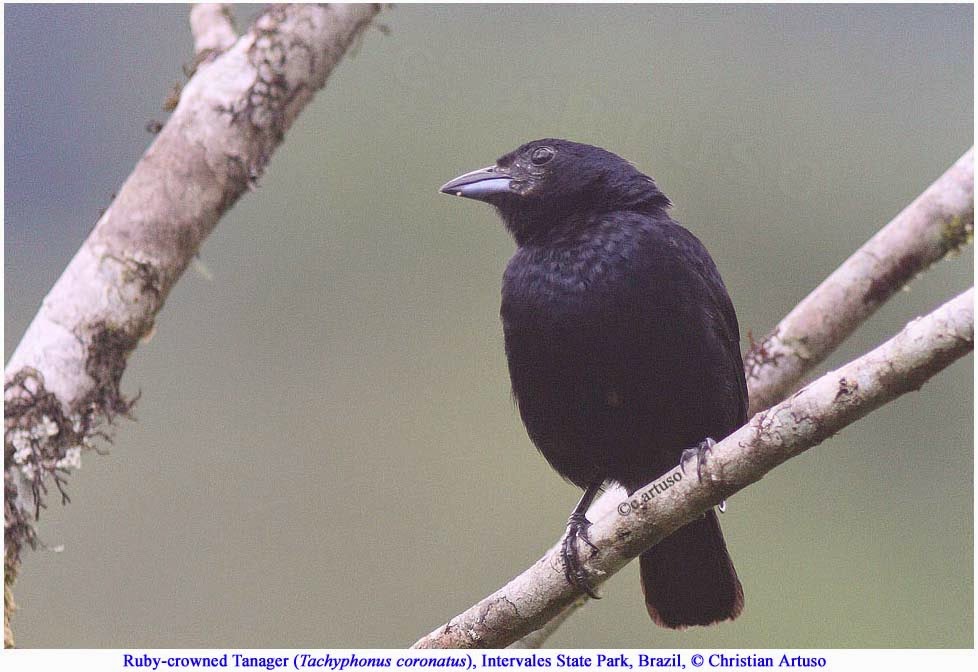
Ruby-crowned Tanager (Tachyphonus coronatus)
Unless you see the red crown spot of the Ruby-crowned Tanager you could easily be forgiven for mistaking them for an icterid.


Flame-crested Tanager (Tachyphonus cristatus)
The Flame-crested Tanager replaces a red crown with a red crest!


Fawn-breasted Tanager (Pipraeidea melanonota)
The Fawn-breasted Tanager is now placed in their own genus. Tanagers also eat invertebrates as you can see here!


Magpie Tanager (Cissopis leverianus)
Who needs colour when you can be this classy in black and white!


Brown Tanager (Orchesticus abeillei)
The unique (monotypic) Brown Tanager showing the family’s more sombre side.


Rufous-browed Conebill (Conirostrum rufum)
The tanager family is actually remarkable large and diverse (374 species in 97 genera by current IOC taxonomy). Many tanagers go by other names and their diet can be primarily frugivorous, insectivorous or granivorous. Two largely insectivorous genera of tanager are referred to as conebills for obvious reasons. This Rufous-browed Conebill demonstrates how the cone-shaped bill is used.


Giant Conebill (Oreomanes fraseri)
The unique Giant Conebill (monotypic genus) is a denizen of the high elevation Polylepis forests and is listed as Near-threatened because of the high degree of habitat loss and fragmentation in this unique woodland type. This photo also gives a little glimpse at the gnarled beauty of Polylepis.


Bay-chested Warbling-Finch (Poospiza thoracica)
The warbling-finches are tanagers that feed on both invertebrates and fruit.


Cuban Grassquit (Tiaris canorus)
Some readers may be surprised to learn that there are some tanagers that are seed eaters with very finch-like bills (may also east small fruits). This includes the Tiaris grassquits like this magnificent Cuban endemic.


Plain-coloured Seedeater (Catamenia inornata)
They may look more like finches but the “seedeaters” are tanagers too! (yes, I know it is hard to believe)


Saffron Finch (Sicalis flaveola)
No, I am not kidding, these so-called “finches” (and certainly they are finch look-alikes) are really tanagers! If you’re just wild about saffron, this is a bird you’ve got to see!


Chestnut-bellied Seed-finch (Oryzoborus angolensis), female. 
No prizes for guessing what this tanager eats!


Wedge-tailed Grass Finch (Emberizoides herbicola) and Great Pampa Finch (Embernagra platensis)
Just in case you though all tanagers were forest birds, here are two seed-eating tanagers of grassland and shrubland in a single photo.


Red Pileated Finch (Coryphospingus cucullatus)
Also called the Red-crested Finch, this is yet another “unexpected” tanager in a genus with only two species. This is a poor photo but I felt this species should be included in this overview.


Red-capped Cardinal (Paroaria gularis)
Ironically (especially since the genus Piranga which goes by the common English name of tanager, as in Scarlet Tanager and Summer Tanager and others, has now been determined to belong to the family Cardinalidae), some real tanagers in the genus Paroaria go by the common English name of “Cardinal”. These recent taxonomic changes have certainly made the nomenclature very confusing. This Red-capped Cardinal is trying to pick a fight with their arch-nemesis!


Black Flowerpiercer (Diglossa humeralis)
Some tanagers are nectar specialists and have a hooked bill tip that enables them to pierce flowers and extract nectar. This Black Flowerpiercer demonstrates the unusual bill shape.


Masked Flowerpiercer (Diglossa cyanea)
This Masked Flowerpiercer shows how the bill tip is used in foraging. This method is less likely to pollinate plants than the more “straightforward” feeding style of hummingbirds but the flowerpiercers may still transport some pollen.


Red-legged Honeycreeper (Cyanerpes cyaneus)
As their name suggests, the honeycreepers are tanagers with a penchant for nectar. They also pack a lot of colour. This is a male Red-legged Honeycreeper.


Green Honeycreeper (Chlorophanes spiza)
A male Green Honeycreeper—widespread and unmistakable!
Add caption


Yellow-bellied Dacnis (Dacnis flaviventer)
Dacnis are a genus of small and stunning canopy-dwelling tanagers, mostly from lower elevations. When someone calls “Dacnis!” they will not be ignored (by other birders at least)!


Western Spindalis (Spindalis zena)
Spindalis is a Caribbean endemic genus that packs a lot of punch! This is a male Western Spindalis from Cuba.

I hope you enjoyed this glimpse into this incredible family of songbirds.
 
Nature Blog Network Birdwatching Blogs - BlogCatalog Blog Directory Fatbirder's Top 500 Birding Websites