Showing posts with label seabirds. Show all posts

Saturday, December 4, 2010

Peru: Part 1 - A Rich Coast

The plan for my Peru blog series is to start at sea level on the Pacific coast and travel up and over the Andes to the Amazon basin. The journey starts on the rocky coastline and then through the arid scrub and lightly wooded habitats of the western foothills of the Andes under the influence of the enormous rain shadow of the Andean cordillera, along with some of the dry inter-montane valleys, then up to the high plateaus at dizzy elevations before descending the humid eastern slope of the Andes through the moist elfin forests, rich cloud forest, tall upper tropical forest and down into the tropical rainforest of the Amazon basin…

Tropical oceans are often fairly low in productivity, in part (and this is a bit of an over-simplification) because the rich nutrient-loaded cold water remains deep and does not mix with the warm water near the surface, where photosynthesis can occur (plants need light for photosynthesis but they also need nutrients). Unless there are upwellings to mix cold and warm water, tropical waters quickly become nutrient depleted and they therefore cannot support a wide variety of life. People often asked me why the waters off the coast of some tropical destination they have visited seemed so void of life compared to the temperate waters and this is a large part of the answer. The people who ask this question often assume that because tropical terrestrial ecosystems are generally more biodiverse than temperate ones, this might also be the case in marine ecosystems (not true) or they may associate tropical oceans with the amazing diversity of coral reefs. Coral reefs are in fact a remarkable exception to the general pattern of ocean biodiversity, mainly because their nutrients remain “trapped” and recycled in the reef ecosystem rather than sinking to the light-deprived depths of the ocean floor.

Since Peru lies close to the equator, you might expect her waters to be low in productivity. However, off the coast of Peru, the remarkable Humboldt Current brings nutrient-rich cold water northward along the Pacific coast of South America (then west towards the Galapagos) to equatorial latitudes. This upwelling and mixing of cold and warm water, creates the conditions for phytoplankton to thrive, i.e. there is high primary productivity. Where you have high primary productivity, a food chain can form and Peruvian waters therefore draw an astounding array of fish, marine birds and marine mammals. In fact, Peruvian waters support some of the highest biodiversity of any area of the world’s oceans (outside of coral reefs). Consequently, a trip to a Peruvian beach or rocky coastline is bound to be accompanied by sightings of marine birds. This post will highlight a few of them…

One of the first birds you are likely to encounter along the Peruvian coast is the large and spectacular Peruvian Pelican. Although very similar to a Brown Pelican in plumage, the Peruvian Pelican is much larger. When seen up close, as seems so easy to do in Peru, these pelicans are surprisingly colourful and their black and white streaked plumage is particularly handsome!


Penguins (family Spheniscidae) are confined to the nutrient rich cold waters of the southern oceans. Most species are Antarctic or Sub-Antarctic in distribution; however, thanks to the Humboldt Current, there are two species that occur in the tropics close to the equator – the Galapagos Penguin and the Humboldt Penguin that occurs off the Peruvian coast (a third species, the African Penguin, breeds just barely north of the Tropic of Capricorn and hence technically in tropical waters). The Humboldt Penguin is of course named for the current that permits their existence by providing the primary productivity that supports the huge shoals of anchovies that the penguins rely on. The Humboldt Penguin is listed by Birdlife International as Vulnerable to extinction, who suggest their decline is due to incidental take (these birds are often accidentally caught in fishing nets), illegal hunting and capture (for the pet trade believe it or not!!), over-fishing, guano-mining, predation by rats and cats, and global warming, in particular in the form of El NiƱo, that greatly reduces the normal pattern of upwelling that all marine life in this region depends on.

The penguins are well camouflaged on the coastal rocks. See if you can spot the Humboldt Penguin in this photo alongside the Peruvian Pelicans and others… If not, look at the second photo (cropped in) then back at the first photo again…


Here is a view of these birds swimming just off the coast. They are very difficult to photograph as they don’t surface for long…


Rocky outcrops, headlands and islands are also the home of the Peruvian Booby and you may have spotted one in the first penguin photo above (the lowest bird on the rocks). As you can tell from the shape of their beak, they are superb plunge divers, feeding in the rich coastal waters. They also have a habit of flying by in steady streams of birds, revealing their distinctive sulid shape...


Surely, one of the most spectacular inhabitants of the rocky coast in the Inca Tern. The unique plumage of this bird seems to be a blend of camouflage (against grey rocks)…

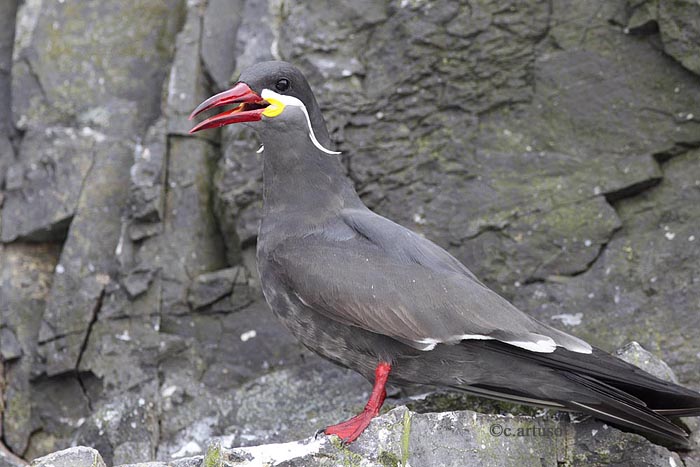
... and showiness (what a face pattern - check out that 'stache!!)


If you had super sharp eyes you may also have picked out the flying Inca Terns in the first penguin photo above (look for their dark grey plumage with white trailing edge to wings).

Several shorebirds also make a living on the rocky coast. Feeding at the water’s edge, is a Blackish Oystercatcher (Haematopus ater). They use their long, powerful bill to probe and forage as shown here.


The Blackish Oystercatcher is the South American equivalent of the Black Oystercatcher (Haematopus bachmani) in the Northern Hemisphere; however, it would take consummate skill to separate these species on plumage!! Here is a scan of an old slide I dug out of a Black Oystercatcher taken on Vancouver Island for comparison – bill structure (Blackish seems to have broader tip), leg colour and possibly mantle colour seem to be some of the only subtle differences…


The Blackish Oystercatchers also share their home with American Oystercatchers. Unlike Black and Blackish Oystercatcher, the American Oystercatchers found in the southern and northern hemispheres are considered conspecific. Here is a pair whipping along the coast…

Cormorants are another group that benefit from the rich coastal waters. In addition to the widespread and common Neotropic Cormorant, there are two species of coastal cormorants in Peru. This is the distinctive Guanay Cormorant.


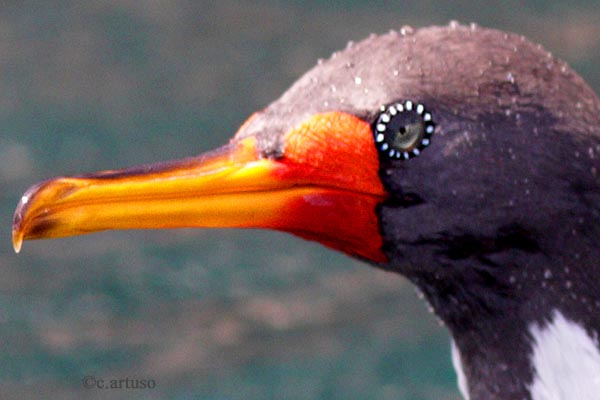
And this is the stunning Red-legged Cormorant.
Take a closer look at their remarkable eye pattern!

And here is a series of a Red-legged Cormorant coming in to land on the water...


It is not just birds that capitalize on the abundance of plankton and fish in this area. Hauled out on the rocks are also some Southern Sealions.


The sealions offer oppotunities for scavengers like Black Vulture and Turkey Vulture to find an easy meal in the form of scraps and maybe the odd carcass. The Black Vulture in this photo may have been picking parasites off the sealions body, although I could not get close enough to be sure of this...


Gulls are more common in cold waters than in warm waters so the coast of Peru has a surprising number of Gull species for a location so close to the equator. Here is part of the roll call:

Band-tailed Gull (A.K.A Belcher’s Gull), adult then immature,


Gray Gull, accompanied by a Sanderling,


Gray-hooded Gull,


and Kelp Gull, adult perched then immature in flight.


You might not expect to find many passerines along the rocky coast and intertidal zone, but this is home to an exceptional songbird, the Surf Cinclodes. Cinclodes are a member of the very large Neotropical suboscine family Furnariidae. Cinclodes are quite terrestrial in their habits so the Surf Cinclodes has managed to adapt to foraging on coastal rocks and sand (as opposed to the rocks and sandy habitats of deserts and high elevations that some of their relatives exploit). Here are two images of this unique bird taking a break between foraging bouts amist the mussels on the pier…


The “miners” are relatives of the Cinclodes (in the same family) and are clad in the same brown tones and share similar terrestrial habits. Like the cinclodes they are also more diverse at high elevations and, also like the cinclodes group, at least one member has managed to adapt to coastal living. The Coastal Miner is well camouflaged in the open sandy habitats they prefer (not right on the beach but nearby in dune areas). This bird has found a tasty morsel by probing in woody debris.


Before leaving the coast, I want to share a nice surprise I found just a few hundred metres from the ocean – a roosting Lesser Nighthawk, a resident of the coastal strip throughout Peru, that presented a super photo opportunity.

Next, we move back from the coast proper into the surrounding arid scrub and woodlands.

Saturday, August 22, 2009

Shear water

“Shearwater” is a beautiful word - describing the way these birds speed low across the sea surface as if cutting (shearing) the water with their long and slender (knife-like) wings. To me it also is like a play on the word "sheer" (versus “shear”) because these birds can be seen out in the sheer immensity of the ocean, earning a living in what seems like the harshest of environments to a land bound primate.

The flight style of shearwaters and other seabirds – tilting their body to slice the ocean breeze and serpenting across the surface, rising above the waves while seldom flapping – is a product of their incredibly long and narrow wings. When comparing wing shapes, ornithologists talk about “aspect ratio”, i.e. the ratio between a wing’s length and its depth. For example, large hawks and eagles that soar on thermal currents have broad rounded wings that maximize the wing area and hence increase their ability to ride on thermals. Shearwaters live on the windy ocean and out there their long narrow wings reduce drag, in part because the wing tip is so small in comparison to the length of the leading edge of the wing. It is the aerodynamic properties of this wing shape that make it so common for pelagic species and this is what has made the large albatrosses have the longest wingspans of any living bird (but remember their wings are narrow not broad like a condor for example). Shearwaters can also reduce drag by sticking close to the water surface, especially in calmer winds. In windier conditions, they can also use the updrafts created by waves for lift. In the first two photos of this post, an Audubon’s Shearwater demonstrates their flight style…


And here the larger Cory’s Shearwater also demonstrates, tilting back and forth and gliding low across the water on a calm day…


Of course, even these amazing flyers need a rest from time to time and they are quite happy to sit on the surface. Here are two Cory’s Shearwaters.

Here is a comparison of Cory’s Shearwater (right) and Greater Shearwater (left). You would think that, given their name, the "Greater" Shearwater should be larger but that is clearly not the case.

And here is a mixed flock of Cory’s Shearwaters and Greater Shearwaters. You may wonder why so many birds would congregate in one place. The shortest answer is because thy go where there is good feeding.


To understand why some areas are so rich in seabirds whereas in other areas you can go for miles without seeing even one, you need to understand the food web in the ocean. For seabirds, as with landbirds, everything comes back to primary productivity. Sunlight can only penetrate a certain depth and oxygen can be quickly depleted unless there are currents to stir things up. This is why ocean currents are so vital – they cycle nutrients towards the surface and allow the food web to regenerate itself without exhausting the available resources. Where the water is still, such as in many tropical areas (unless there is a current moving in from colder areas), seabirds are few and far between due to limited feeding opportunities near the surface. The vast majority of the world’s true pelagic species occur in the vast, cold southern oceans and, to a lesser extent, in the cold northern waters (there is more land and less water in the Northern than the Southern Hemisphere).

The above photo of a large flock of shearwaters was taken on the edge of a very large underwater canyon called Baltimore Canyon. In this case, it is the topography of the canyon that forces cold water upward towards the surface and the nutrients that these where upwellings bring create many feeding options for many forms of wildlife… and wildlife that east other wildlife and… you get the picture! That is why we made the long journey (4 hours of straight sailing) to get out to this area.

Of course, it is one thing to use your long wings to slice the wind when aloft but getting airborne in the first place is a greater challenge. An albatross’s or shearwater’s wings are so narrow that they don’t generate much lift in flapping flight. On nesting cliffs, it is easy to dive off the cliff to build up speed and then swoop upward; however, on level land or level water, large seabirds have to run or “paddle” to generate lift. Their long, wobbly, running take off can be rather comical at times. Allow this Greater Shearwater to demonstrate how it is done…


You'll find some more photos of seabirds on my homepage (http://artusophotos.com/5_Raptors%20-%20Pelagics/index.htm). My next post with showcase some marine wildlife other than birds.

Thursday, August 20, 2009

The abundant ocean

After participating in the American Ornithologists’ Union (AOU) conference in Philadelphia, I got the chance to do a little birding on the Delaware coast and to take a pelagic trip (http://www.paulagics.com/site/) out of Lewes, Delaware. I owe a great debt of gratitude to the local birders who made this possible by taking me out and giving me rides – it is one of the things I love about birding, feeling a part of an international community.

As we left Lewes and got out beyond the breakwater a magnificent sunrise over a calm sea bode well for the day ahead. Indeed, we would be treated to some phenomenal ocean wildlife watching!


We were escorted out to sea by Laughing Gulls such as this youngster following the boat…


One of the first pelagic (i.e. open ocean) species we saw was the Wilson’s Storm-Petrel. The storm-petrels are very small seabirds, completely dwarfed by the large shearwaters and albatrosses. The Wilson’s Storm-Petrel, for example, measures 18cm from head to tail, about the size of a Barn Swallow! With their somewhat eratic flight style I think they look like tiny bats on the ocean. It always amazes me that such tiny birds can make a living out in the ocean squall!


Looking at the above photo, you should notice a few interesting features. The first is the way the feet project beyond the tail. This is because the legs are very long and is an important ID feature when separating this species from several other very similar looking Storm-Petrels. If you’re wondering why the legs are so long, well… my attempt at an answer is below….

Another thing you may notice is what looks like a bump on the bill. This is actually the specialized nostril tubes that extrude salt. They are a feature of the order Procellariiformes, which includes albatrosses, shearwaters, petrels, diving-petrels and storm-petrels. This features earns this group the nickname “tube noses”. Since they are a little hard to see on such a small bird as a Wilson’s Storm-Petrel, I made this comparison with the much larger Corey’s Shearwater to show the tubes to full effect. Notice also how the legs tuck up under the tail with the feet pointing skyward in the Wilson’s Storm-Petrel.


The Wilson’s Storm-Petrel is very common in these waters. In fact, some ornithologists have suggested that this species is among the most abundant of any bird on the planet. It just goes to show that if you can adapt to harsh conditions, there are resources to be found. Indeed, the ocean provides for an abundance of life… hence the title of this post. What amazes me most about seeing Wilson’s Storm-Petrels off the Delaware coast is that they don’t breed anywhere near North America but rather way down in Antarctica and the Subantarctic islands. The thing is that when not breeding during the short austral summer (December – February) they roam the oceans and spend their time feeding at sea far from their breeding colonies. The birds in this photo are just a tiny fraction of a huge feeding flock.


The next two photos show dorsal views of Wilson’s Storm-Petrels and the prominent white rump and pale wing coverts, creating a diagonal bar on the wings (although this can be obscured by harsh direct sunlight)


Revisiting the feeding flock, you can easily see the foraging behaviour known as "paterring" in the following photos. Pattering is hitting the surface of the water with the feet while thrusting the head forward to feed on tiny organisms near the surface, using the wings to balance. The long legs of the Wilson's Strom-Petrel allow them to execute this type of foraging with characteristic "dancing" style.


A closer examination reveals that the webs between the toes are yellow in colour (look at the bird on the left). When I compare Wilson's with other storm-petrels it seems possible that the yellow webs might be a foraging aid, possibly attracting some prey items or assisting them to hunt in low light (many Storm-Petrels also feed at night). On the other hand, older birds develop black spots on the webbing so it could be an indication of age. Interestingly, other long-legged storm-petrels such as White-faced Storm-Petrel also have yellow webbing whereas some of the shorter legged ones such as Leach's Storm-Petrel that typically use more of a hovering style to feed and rarely "patter" do not.


The long-legged Wilson's are so good at pattering that they sometimes seem to be standing or walking on the water...


But when they hop using both legs, their legs trail backwards as the upper body is propelled forward so it looks like they’re on pogo-sticks.


Here are a few more sea dance moves


More to come from the water soon...
 
Nature Blog Network Birdwatching Blogs - BlogCatalog Blog Directory Fatbirder's Top 500 Birding Websites