Monday, September 27, 2010

Curve-billed Thrasher in Manitoba

Curve-billed Thrashers have an interesting history of wandering in fall/winter. The phenomenon of fall dispersal has made it difficult to understand the migration patterns of this species. Amazingly one showed up this weekend in Manitoba’s Whiteshell Provincial Park – a long way away from their breeding range in Arizona, New Mexico, Texas and Oklahoma.

This bird was originally reported as Bendire’s Thrasher but, as we drove up to the dumpsters where the thrasher was feeding, we quickly realized that this was a Curve-billed Thrasher, the bright orange eye and the decurved all dark bill being the most salient features. You can see this in these two photos. You will also notice how worn the plumage is…

This bird was foraging right in front of our vehicle on the gravel pull-out. It was almost as though we were observing them in a tiny patch of their preferred desert habitat! We had ample opportunity to study the features although the amount of feather wear complicated the picture.

Curve-billed Thrasher subspecific taxonomy is a little complicated but two main groups are recognised - the eastern T. c. curvirostre group (breeds in areas like Texas) and the western T. c. palmeri group (breeds in areas like Arizona). If you study the photos below you can see that this bird had fairly extensive white tail corners (outermost rectrices tipped white), visible from above (first photo) and below (second photo), despite heavy wear, but most visible when the bird flew. This made me think that this birds might be of the eastern subspecies group.


The photo above also shows the spotting on the breast, which showed a fairly pale ground colour creating contrast between the breast spots and background. This also seems consistent with an eastern bird. The wing bars were hard to gauge, this bird being in such heavily worn plumage, but certainly, although they were buffy overall, there was white tips to the outermost greater coverts and outermost median coverts (as opposed to buffy tips as expected in western birds) as you can see in the first of the two photos above (although if you compare with the very first photo of this post you will notice that the white tips on the median coversts on the bird's other side have worn away). I did not manage a good look at the undertail coverts, another useful feature, as the bird was almost always on the ground.

If you are wondering why the bird is on one leg in both of the above photos, they appeared to have an injured right foot. This and the heavily worn plumage makes me think that this bird is not likely going anywhere soon and will stick near the food supply they have found. This bird also exhbited a curious sneezing behaviour - almost as though they were trying to cough up a pellet but repeated constantly.

It is also worth studying the interesting mix of dark and light flight feathers and tail feathers. Even at a glance the birds gives a somewhat striped appearance due to the mix of light brown and dark brown feather. This suggests multiple feather generations and thus an adult bird, although at first glance the buffy "wing bars" seemed to match Sibley's illustration of a juvenile.

On a bird this worn and this far out of range, it is hard to know how to interpret such features. The bird didn't seem all that happy either, though I guess the problem with a decurved bill is that you always wear a frown!


Amazing to see this bird so far out of range!

Saturday, September 25, 2010

Some nocturnal eye-candy

As a photographer with a passion for owling (going out at night to look for nocturnal species of birds and mammals), I was very excited to learn of the publication of an extremely ambitious new book — Nightjars, Potoos, Frogmouths, Oilbird and Owlet-Nightjars of the World by Nigel Cleere. Nigel was planning to put together a photographic guide of some of the most difficult species to photograph, no easy task! Much as I find them fascinating, I have always found nightjars, potoos and frogmouths much more difficult to photograph than my favourite group, owls. Since many nightjars are so difficult to identify, a book devoted to this group seemed like an absolute must for a night birder like myself. I was therefore very keen to see what it would look like.

This book indeed features some spectacular photography — images that make me green with envy! Of course, there are some very low quality images too, in many cases these being the only images available of certain extremely rare and seldom seen species. There are also some images of birds in the hand, which I personally prefer to avoid at (nearly) all costs, but which again were probably the only images available to illustrate certain field marks. In some cases images of museum specimens are used, which make comparisons against photos of live birds difficult but again there is really no choice.

Nigel’s text is minimal to say the least. The idea is to offer the viewer the opportunity to view multiple photographs of each species side by side to compare ID features and relevant field marks. Personally, I think this is a mistake for two main reasons. Firstly, although I absolutely love looking at bird photography, when it comes to identifying birds, I prefer illustrations. The photographs in this book show too many different states (e.g. live versus dead birds), postures, and lighting effects to permit one to compare apples with apples. In other words, I believe the book’s use for identification of this extremely difficult group would be greatly enhanced with much more discussion on how to separate species X from other similar species (each species has a section on “main confusion species” but I have found this text to be too scant to be useful and not cross-referenced to the photographs). Secondly, since many of the features are so difficult to see well, one finds oneself flipping back and forward between photographs looking at a particular feature on species X and species Y. The chosen layout is just not well suited to an ID reference, or at least is far less useful as an ID reference than some succinct text and/or drawings with or without arrows pointing at the most salient ID features. In short, the choice to make this guide so photo heavy has resulted in a superbly aesthetically pleasing book, almost a coffee-table style of book, except that not all photos were selected on aesthetic grounds (they were selected to cover every species and photo quality therefore varies considerably) but has severely compromised its utility. I have therefore found my colour photocopies of the plates of Handbook of Birds of the World to be more useful than this publication.

The beauty of a newly printed edition like this is of course having a single up-to date reference on the taxonomy of a difficult group. I have always found this type of book to be an extremely useful supplement to regular field guides for trips abroad. For example, before any trip, I consult König’s Owls of the World and make notes on taxonomy, distribution, and salient ID features including song. I tried to use Nightjars, Potoos, Frogmouths, Oilbird and Owlet-Nightjars of the World for this purpose before my latest trip to Peru and found it to be woefully lacking for this purpose because the text was so scant that I did not find any information that I had not already found in other sources (I just got back from Peru so stay tuned for some exciting blog posts). Perhaps, this book would serve better for consultation after a trip when one could compares one’s field notes or photographs to the photos in the book.

I did find this book useful for its taxonomic treatment, though here again I would have liked more text, but other information criteria were so sparse as to severely limit the utility of this book. Most troubling though were the many inaccuracies that have crept into this publication. In particular, if one is going to use such a book as a reference, detailed information on distribution of species is critical. This book contains very scant text on distribution and the range maps are sadly so full of errors as to render them unusable. Here are just a few examples: The map of the Whip-poor-will misses huge chunks of the species range, for example in Manitoba where I live the range map for this species misses out hundreds of square kilometers of some of the portions of the range where Whip-poor-wills are very common. Many other species suffer similar woeful inadequacies, especially Asian species. Worst of all however are the glaring inconsistencies within the book itself, of which it only took me a quick perusal to spot several, e.g. the three images of Bonaparte’s Nightjar were all taken in Way Kambas National Park on the island of Sumatra but according to the range map Way Kambas is outside of the range of this sedentary species. Likewise the photograph of Blyth’s Frogmouth taken at Khao Noi Chuchi in Thailand falls outside of the range as drawn in this book and the photo of Blyth’s Frogmouth from the Genting Highlands was taken at a higher elevation than the altitudinal range given.

In summary, this book falls far short of the high expectations (admittedly, perhaps unfairly high expectations) placed on it. I will be using this book as a coffee-table book, to enjoy some of the delightful photography from time to time but I won’t be consulting it as a reference book – that niche still waits to be filled! I will say though that this book is extremely ambitious in scope and that the concept of a photographic guide to nocturnal species is well worth a dedicated effort. This book was years in the making and clearly a great deal of preparation has gone into it. Perhaps a revised edition with more emphasis on accuracy and a layout that permitted slightly more text would be all that is required.

Sunday, August 1, 2010

Late Atlas Rarities +++

The end of July may not seem like the best time to be atlassing but it can produce some great results! My good friend Jo Swartz and I just completed a short visit to southwestern Manitoba to tie up some loose ends and try to find a new atlas record or two. Here is the first bonus of the weekend - a gorgeous male Lazuli Bunting - quite a rarity in Manitoba. This bird has been on territory since the end of May and was first noted by proud property owners. I was hoping to find a nest and to secure the first documented breeding in the province but, alas, we had to be content to watch the male for several hours and did not find a female this time. Nonetheless, he is quite a bird!


Of course, we knew that the Lazuli Bunting was around - we just had to find him but we had no idea there was also a Northern Mockingbird in the area (another rare bird in Manitoba although not nearly as rare as Lazuli Bunting). As we drive down the highway, I spotted a large, long-tailed mimid on someone's front lawn as we were travelling at high speed. Since the only expected mimids in Manitoba are Gray Catbird and Brown Thrasher, I called it as a Brown Thrasher based on shape (the bird was in shadow as I caught them out of the corner of my eye). Wanting to be sure of the record, we decided to turn around for a better look. Well, as it turned out, this bird was in fact a Northern Mockingbird, and the generous home owners did not object to us sticking around to look for evidence of a nest. Sure enough, we found the bird carrying nesting material (photo below) and a possible nest but no proof of breeding. A real bonus nonetheless!


At Whitewater Lake we looked for breeding evidence of some of the rare egrets and White-faced Ibis that have frequented the site in the last few years as water levels have risen. We indeed saw White-faced Ibis, Great Egret, Cattle Egret and this Snowy Egret but, alas, did not find any juvenile birds that might have confirmed breeding. Can anyone lend me an airboat?


One thing that can be done while atlassing in the late season is to revist areas to try to obtain higher breeding evidence codes. This weekend I was able to increase some of the "possible breeding"codes I had ("S" for singing bird, or "H for bird in suitable "breeding habitat in the breeding season) to higher codes (probable or confirmed breeding). For example, the Grasshopper Sparrow was still singing in his old spot, allowing me to use the code T (bird on territory).


And the same goes for this handsome Black-billed Cuckoo, such a striking image in this wispy Peachleaf Willow (took this photo with my crew on July 13th and heard him in the very same yard on July 30th)...

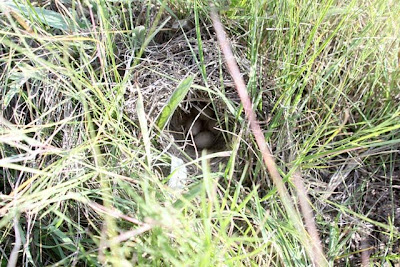
Now, not all birds have finished breeding at the end of July. I found this Vesper Sparrow nest with four eggs in the grasslands and hastily snapped this record photo before leaving as quickly as possible.

Other birds are a little more advanced but still with young in the nest. While we were waiting for the Northern Mockingbird I heard the song of an Orchard Oriole in the distance. I went a little closer and saw this male fly in towards us with food in his beak that was obviously not for his own consumption... guess, that is what you get for singing with your mouthful!!

Alerted to the possibility of a pair with young, it didn't take us long to spot the female and she led us right to her well-hidden nest in a Shubert Chokecherry. She has just fed the young, who were audible but not visible in the nest, a grasshopper.

Other birds have young out of the nest - it was an agitated parent Upland Sandpiper that alerted me to the presence of four downy young (juveniles) in the grass...

Some young birds have been outside the nest a little longer and have more developed feathers (immatures). This Gray Catbird looks almost like an adult, although if you look closely you can still see the down feather and note how the markings are not fully developed. The "Atlas question" in this situation is always "Is this youngster capable of sustained flight?" If the answer is yes, you can't count it as breeding evidence because you don't know where breeding occured. In this case, the youngster was begging and follwing their parents so I felt it was good enough evidence of local breeding. Won't be long before this one will be fending for themself though!

I am finding atlassing is really opening my eyes to observing behaviour - a great way to improve one's skill!

Wednesday, July 28, 2010

A taste of atlassing

This is the first year of the Manitoba Breeding Bird Atlas. There has been a LOT going on!! (see http://www.birdatlas.mb.ca/). I thought I would like to share a photographic highlight or two from a summer's worth of atlassing (see the "Atlas Photos" section under the "About the Atlas" tab on the web site for more)...

One of the first nests I found in Riding Mountain National Park this year was of the beautiful Black-backed Woodpecker.

A territorial Connecticut Warbler is always a good find... what a powerful song!

Eastern Phoebe's like to nest under eaves of various human structures and are easy to get confirmed breeding of...

Finding owl nests is mostly a lot of hard work, with the exception of Great Horned Owl nests (their nests are usually easy to find because they start so early in the year when there are no leaves on the trees and they often nest in conspicuous places like old stick nests). here are some of this year's owl finds...

A Short-eared Owl nest


An Eastern Screech-Owl leaving the nest in their typical stealthy fashion (they fly low in the shadows and swoop up into or down away from a nest rather than a direct line flight).


Finding a Great Gray Owl nest was one of the summer highlights for me (as always)!


Great Horned Owl fledglings have a lot of character!


Gray Jays breeding remarkably early and I found fledged young in mid May...


A young Wilson's Phalarope out for a promenade - put that down as FY (fledged young)!


Red-headed Woodpeckers put on a good show this year... This one, seen first flying through the trees...


happened to have a partner...


allowing me to eventually track down the nest site.


A big find was a Loggerhead Shrike on territory just south of Riding Mountain National Park, well north of their expected range...


And as always, atlassing gives you the opportunity to refine your knowledge of different species and their habitat associations... here is a Le Conte's Sparrow singing in typical habitat (along with other marsh buzzers!)


And there is sometimes time for a close-up too!


Waterbirds are relatively easy to atlas - we would find them either nest building like ths pair of Horned Grebes


Or more commonly with fledged young like this Eared Grebe family....


Two heads are better than one - well if you find a pair of birds that is - here is a handsome male and female Evening Grosbeak pair...


I enjoyed doing some grassland atlassing this year. One of my favourite Manitoba Grassland species, the Chestnut-collared Longspur put on a splendid show. Here is some agitated behaviour, an angelic pose, and a nest I found near St Lazare...


Plenty more great finds! An awesome summer contributing to monitoring and conservation.

 
Nature Blog Network Birdwatching Blogs - BlogCatalog Blog Directory Fatbirder's Top 500 Birding Websites