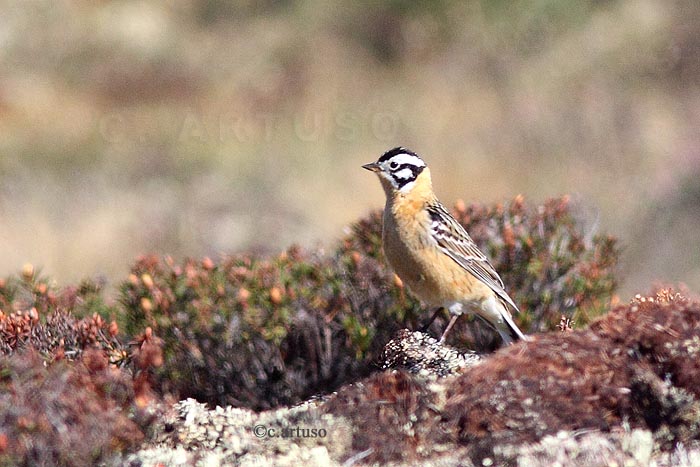
Driving southwest into eastern Colorado we spent a few hours in arid habitats where I enjoyed sightings of species like Scaled Quail and others that I have not seen many times in my life. In a rather comical moment, this Sage Thrasher and Lark Bunting posed side by side on a wire, permitting an unexpected size comparison.

Another surprise was a pair of Mississippi Kites, which the range maps in my field guides did not show in Colorado… just goes to show how quickly field guides become out of date!

We then planned a drive westward across Colorado with a stop or two in the Gunnison Valley where I wanted to seek out a potential lifer in Gunnison's Sage-Grouse. The scenery here was much more mountainous but also still somewhat dry. Youn-Young’s photo of the canyon rim at Black Canyon of the Gunnison National Park, Colorado gives a sense of the shrubby habitat broken by coniferous forest in places that we encountered here.

As it was August, my search for Gunnison's Sage-Grouse consisted of cruising along creeks in dry sage brush habitat (exactly the strategy that had found me my lifer Greater Sage-Grouse in Oregon many years ago) at recommended sites. Sure enough, just south of the town of Gunnison, I spotted a hen with her brood. Amazingly, they were not skittish and allowed us to park on the roadside and photograph them (without getting out of the vehicle). Note the very prominent white tail bands (one of the features that differs from Greater Sage-Grouse).

Higher up we took a short hike in Black Canyon of the Gunnison National Park, where an obliging brood of Dusky Grouse appeared magically on the trail in front of us. The speckled dusky (current name) bluish (recall their former name “Blue Grouse” before the split) plumage of this individual exhibited remarkable camouflage against the mottled rocks.


From here we drove west into eastern Utah to Arches National Park, an extremely arid landscape of red stone and patchy juniper… you get a sense of the grandeur of this place in this photo Youn-Young snuck in of me birding...

There were relatively few birds to be seen in the desert heat although Western Scrub-Jays were an almost constant campground companion…

Black-throated Sparrows also seemed relatively easy to see here, at least in the early morning,

But my real interest was to search any juniper patches for another species I had never seen before - Gray Vireo. At first, I found little else in the juniper but Juniper Titmice and Blue-gray Gnatcatchers; however, after a morning walk I noticed a ravine with a lot of juniper and suggested to Youn-Young that we go over and sit down in the shade there. When we got there, I tried playing the Gray Vireo song, a little speculatively, once on my mp3 player. Lo and behold, with a few minutes, a Gray Vireo flew in and landed above Youn-Young’s head and started scolding her... Oops! Sorry! Before long, I had located what appeared to be a family party and got a few photographic souvenirs of a long-awaited lifer!

Next stop was the spectacular Bryce Canyon! We came for the scenery of course but I was delighted with how birdy this place was – at a higher and cooler elevation with tall coniferous forests (considering the aridity of most of the surrounding landscape).

Mixed species flocks here produced many exciting western species like the handsome Grace's Warbler,

The common and curious Mountain Chickadee,

And three species of nuthatch including the fascinating Pygmy Nuthatch (I was delighted to see them low down on the trunks where I could get quality photos like this one), and many others.

From Bryce, we formulated a plan to go down to the Grand Canyon, which Youn-Young naturally wanted to see, before coming back up through Zion National Park and then homeward via Yellowstone. I insisted that we postpone ur lunch stop until we got to Vermillion Cliffs, Arizona, where I could look for California Condor. We arrived in the early afternoon at it was an unbearable 38°C and Young-Young thought I was crazy! Worse, there was no sign of anything alive except for an inquisitive Say’s Phoebe. I had almost finished lunch when I spotted three specs high above the cliff and nervously found them in my scope… immediately the large white windows on their wings indicated that I was viewing none other than the living phantom, the California Condor. Vermillion cliffs is of course one of the earliest release sites (1996) of the famous reintroduction effort that has kept this species alive… at least for now!

In the sweltering heat it was a relief to climb up to higher elevations at the rim of the Grand Canyon. One certainly learns to appreciate the staggering force of water in a place like this! The Colorado River, with its mighty erosive power, seemed to be miles below us…

Birding in the Grand Canyon area was surprisingly good with treats like Northern Pygmy-Owl, Pinyon Jay and the beautiful Acorn Woodpecker shown here.

Back up into Utah on the return leg, we stopped in at Zion National Park as planned, a landscape of more monumentous red rock and coniferous trees. This beautiful place nonetheless stirred sadness in me when I learnt of its inappropriate renaming to Zion National Park from the former Mukuntuweap National Monument (this word “apparently means “Straight Canyon” in Southern Paiute)… felt like the sad modern history of a continent wrapped up in a simple word swap! The Freemont Cottonwood trees in the canyon provided much appreciated shade and a variety of birds including species like Wild Turkey and Black-chinned Hummingbird and that I had not seen elsewhere on the trip. A second sighting of California Condor here was not much closer than my first sighting, and came only an hour after I had watched a Golden Eagle gracing the cliffs.
In the early morning, while Youn-Young slept in, I went up towards Kolob Reservoir, stopping on the sage brush slopes before dawn in the hopes of a third lifer. I only had to wait until a few minutes after dawn to hear the beautiful song of the Black-chinned Sparrow, though it took many more agonizing minutes until I got good views. In the end I saw quite a few birds, nearly all of them juveniles, as shown here, which lack the black chin that gives this species their common name.

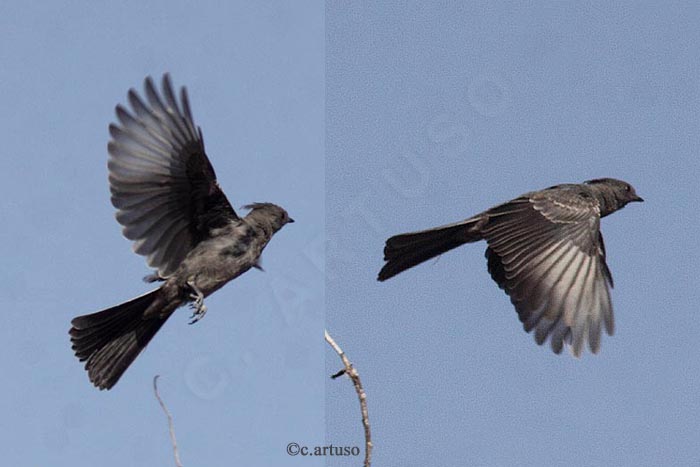
Higher up in the forested areas near the reservoir I found more trip birds like Western Tanager and Virginia Warbler but I wanted to spend more prime time down in the arid scrubland where I could see species like this Phainopepla that I have only seen a few times in my life.
We left Zion and traveled north on the Interstate with a short stop at Bear River Migratory Bird Refuge on the edge of Great Salt Lake. The gates were closed but we found a few waterbirds and shorebirds like this Snowy Plover (recently split from the Old World Kentish Plover).

We drove through the night to arrive in the magical world of Grand Teton National Park – since a picture is said to paint 1,000 words, here are three photos (poorly stitched together into one) of the mountain chain that includes Grand Teton (the pointy peak second from left).

On the mountain slope stood lush coniferous forest; however, the flatter valley floor was clad in low shrubs, especially sagebrush, shown here.

And in that sagebrush roamed bison, deer and pronghorn (deer and antelope play). Here is a wide angle photo that tries hopelessly to capture the grandeur of pronghorn feeding in the sagebrush.

And now two with a telephoto lens to show the fine features of those beautiful animals!


Grand Teton was also good for raptors. Swainson's Hawk is not a bird one expects in the mountains (although if you have seen the trailer for the new movie the Big Year you will notice one bizarrely placed in a downhill ski scene) but they are quite at home on the sagebrush flats. This one posed on a fence pole and was unperturbed by my parking the vehicle beside them for a portrait.

Our last stop was to be Yellowstone National Park, famed for its geysers and wildlife viewing opportunities. Indeed Yellowstone was to prove excellent for wildlife watching on this visit (almost as good as the stunning Jasper National Park in Canada to give you a sense of just how good). We enjoyed sightings of mammals such as beaver, coyote, back bear, mule deer, and elk…

I see plenty of black bear in Manitoba so I didn’t spend a lot of time trying to get photos but seeing a total of FIVE Grizzly Bears was an enormous treat! Here is a photo with four of the five (in the Hayden Valley) all at once… a large male is feeding on a bison carcass while a female and two cubs wait their chance…

Another awesome highlight was seeing this timber wolf (grey wolf) in the Lamas Valley. Smaller but even better than the one I had seen in Wapusk National Park, Manitoba this year because I managed to photograph this one. Here are two photos on the wolf walking up a sagebrush slope and then a closer image.


We departed Yellowstone but there was one more order of business – the ascent of the Beartooth Pass and the quest for one more new bird for me – Black Rosy Finch. The Beartooth Pass is just northeast on Yellowstone on the Wyoming – Montana Border, and at 3,337 m ASL (almost 11,000 feet) seemed like the perfect place to look for a high altitude specialist! As we drove up into the rocky alpine zone dotted with snow packs and their pink flushes caused by snow algae (Chamydomonas nivalis) as seen in this photo, I started to feel that I had come to the right place… surely, these dappled browns, greys and pinks would harbour the black and pink gem I was seeking…

Youn-Young wanted us to head back at an appropriate hour and so I only had 90 minutes to search. Walking around the rocks, I saw several American pika, a fascinating, mouse-sized rabbit relative!

However, the only bird I seemed to be able to find was American (Buff-bellied) Pipit. I couldn’t resist trying to get a few photo of the few that were still in breeding plumage as the alpine subspecies are much more colourful than the tundra-breeding subspecies that I usually see.

The clock was ticking and over an hour went by before it happened… I heard a choppy call note from below the summit that I strongly suspected was Black Rosy Finch. Walking quickly across a boulder field I stared down in a wide rocky ravine and far below me caught sight of some small birds on the rocks. No time to waste! I scampered down until finally I caught sight of some all-dark birds feeding amongst the rocks and on the pink snow. I was looking for their pink highlights but the first birds I saw well were all juveniles with yellow bills and very little pink (like the one below) that threw me for a loop for just a few seconds until I realised why they didn’t look quite like what I was expecting…

Maneuvering into position, I watched them feeding and finally saw some adults. The Black Rosy Finch below was particularly obliging, landing close to where I sat, and also interesting in that it showed some yellow at the base of the bill but otherwise adult features… I had good intentions to try to photograph the wing feathers to see if i could find a moult limit but I got distracted by a most unexpected Brewer’s Sparrow and missed the moment when the finch flew.

A whirlwind tour and not nearly long enough to appreciate the American southwest but nonetheless packed with fond memories…