As part of our Manitoba Breeding Bird Atlas
(ww.birdatlas.mb.ca) efforts this year, I was fortunate to travel to
northernmost Manitoba this summer. In particular, the atlas owes a great debt
to the Webber and the Reimer families for their truly exceptional in-kind
contribution to the atlas this year that enabled me to survey Dymond Lake, the
Seal River Important Bird Area and Schmok Lake near the Nunavut border.
Dymond Lake is situated northwest of Churchill across Button
Bay. This area has very little tundra and is mostly forested except for a
narrow strip along the coast. Nonetheless, coast ponds and the intertidal zone
were beginning to attract many migrant shorebirds in mid July. The Dymond Lake Lodge is well situated
between Dymond Lake and the coast.
The Seal River meets Hudson Bay 60 km northwest of Churchill
and 8 km north of the river mouth lies the simply MAGNIFICENT Seal River
Heritage Lodge offers bay-side dining with phenomenal views and bear, beluga,
seal and bird watching. The incredibly rich intertidal zone is a major staging
site for staggeringly large shorebird and waterfowl flocks that have earned
this area the designation of a globally significant Important Bird Area (e.g.
apparently flocks of several thousand Black Scoter move through the area each
year). There was still ice in the bay when i first arrived in late June this
year but it soon melted away and by mid July the polar bears were swimming
ashore.

When you travel over 50 km northwest of Churchill you expect to see tundra, but i must confess to being a little surprised at the habitat in Seal River area, when i encountered mile after mile of willow swales that made for very difficult walking. A treed ridge approximately 3.5 km inland made for better walking and the tundra – treeline transition here was very rich and especially good for Smith’s Longspur and Harris’s Sparrow.
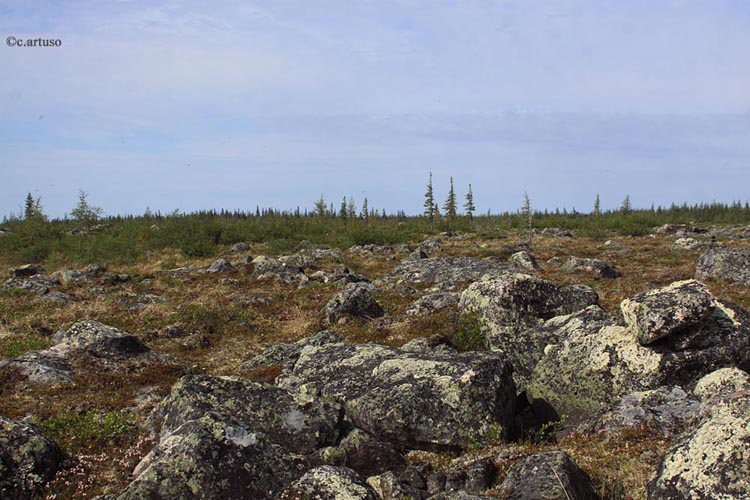
Schmok Lake sits in a fascinating part of Manitoba with some exceptional topography by Manitoba standards of tall rocky outcrops and hills, lakes with forested edges, and open wet and dry (rocky) tundra in a mosaic of exceptional beauty. I am told the area is stunning in fall when the bearberries turn the landscape red and the caribou migrate through in numbers. As it turns out, this summer I even got to set foot in Nunavut by virtue of a 24 km round-trip hike from Schmock Lake across some truly beautiful tundra as in the photo below.

As one approaches treeline in northern boreal forests, a variety of different species occur that are either rare or absent in the taller forests of the central boreal. One highly sought-after species of the treeline to tundra transition zone is the Harris’s Sparrow – the only species whose breeding distribution is confined to Canada. The mournful whistled song of the Harris’s Sparrow is a common and unmistakable part of the northern treeline soundscape, although sadly they seem to be declining from the Churchill area proper. This photo shows one foraging on the ground, as they frequently do, on a peaty hummock beside a forested copse.

As relatively few nests of Harris’s Sparrow have ever been found, I was fortunate this year to find several of their nests, each containing three greenish eggs with dark brown splotches. This first photo shows the typical nesting habitat of this species (the nest is situated near the base of the tamarack in the left of the photo) and the second photo show the nest (lower right corner of photo).


Another special bird of the treeline to tundra transition zone is the Smith’s Longspur, although unlike Harris’s Sparrow their range extends slightly into Alaska. Their very limited winter range and their ability to hide within mixed longspur flocks (non-breeding plumages of several longspur species are similar) makes them tough to find away from the breeding grounds. Nonetheless, most of their breeding grounds are difficult to access, making this a key target species for visitors to the Churchill area. Like the Harris’s Sparrow, the Smith’s Longspur seems to spend most of their time foraging on the ground and singing from tree perches, although they arguably prefer slightly more open habitat and I have often found them associated with small rocky outcrops as shown in the composite photo below, where I found several pairs.

And now for some photos of the birds themselves on those rocks - first a female Smith's Longspur in her habitat and then a closer look at her subtly beautiful plumage.


And now for a couple of photos of a male Smith's Longspur in his habitat and then a closer look at his unique orange and black plumage, followed by one silhouetted in the rising sun.


Lapland Longspur sometimes co-occur with Smith’s Longspur but they are more a tundra bird and not tied to the treeline transition. Here are two photos of a female and a juvenile Lapland Longspur to compare with the Smith Longspur above.


In addition to the thrill of finding Harris’s Sparrow nests, I was also lucky enough to find the nests of other secretive species such as Blackpoll Warbler. Here are three photos showing one of the Blackpoll Warbler nests in a “zoom out sequence” (if you can spot the nest in the last photo, kudos!)


There were other species that I didn’t manage to find nest of but I still was able to confirm breeding by seeing adults carrying food for young, as in this photo of a Northern Waterthrush.

And this year, thanks to a slightly later visit (July), I
also got to confirm breeding of many species in the northern forests by finding
recently fledged young – here are a few examples:

Two shots of a family of recently fledged Northern Shrikes,


A young Rusty Blackbird, apparently eying up a fly that they’ll never catch,

A fledgling White-crowned Sparrow doing their level best to hide,

And one of my favourite moments from the summer – two young Northern Hawk Owls waiting patiently for mum and dad to return...


In our next post we will go out onto the open tundra for more avian treats!


