
Sunday, March 29, 2015
Great Canadian Birdathon
American Woodcocks will be back very soon and
"spring" shortly behind them! This spring can you help us raise funds
for bird conservation
with the Great Canadian Birdathon
either by becoming a member of the atlas birdathon team or by supporting one of
the team members. See: http://birdscanada.kintera.org/faf/search/searchTeamPart.asp?ievent=1129177&lis=0&kntae1129177=7AD9B5FE4684468FB0FDDBDC92EC9C49&team=6319959

Thursday, February 26, 2015
On the Mobbing of Owls
The photos in this blog post
show six owl species from five genera being mobbed by potential prey species. Although
only one individual of each prey species is visible in the photo, other individuals
were present during the mobbings and sometimes multiple species were present. Mobbing
is when prey species, usually in groups, harass a predator using loud calls and
possibly also stereotypic movement sequences (that can recruit other birds to
join the mobbing party). Note that mobbing is an interaction between predator
and prey and is different to a competitive interaction as may occur between an
owl species and a hawk species for example. Mobbing sometimes succeeds in
driving a predator away from an area, which is an obvious benefit, but it also
comes with risks. These risks may be higher when mobbing certain predators. Mobbing
nocturnal owl species during the daytime is probably less risky than mobbing
diurnal raptors and is sometimes successful in driving the owl away from a
roost site; however birds that mob owls are sometimes killed by the owl they
are mobbing. Although many owls seem disturbed by mobbing, some owls might
benefit. One of the several competing hypotheses as to why certain species have
large “false face” markings on the back of their head is to evoke a mobbing
response that subsequently provides either a prey assessment opportunity or a
hunting opportunity. Mobbing is not restricted to owls of course, nor is it
restricted to nocturnal owl species (one of the photos above shows a day-active
Northern Hawk Owl being mobbed). Sometimes recently fledged juvenile owls get
mobbed and if they are knocked from their perch during the mobbing the result
can be fatal (the owlets are vulnerable on the ground).


In the case of owls, the loud
mobbing calls of diurnal songbirds are often the first clue for the human
observer that a nocturnal owl is roosting nearby. Therefore, if you learn to
recognise the mobbing calls of bird species that are common in your area you
will increase your chances of locating owls.
We really don’t know why
small birds mob owls but there are many hypotheses to consider. Curio (1978)
listed nine hypotheses as follows: silencing-offspring, selfish herd, confusion
effect, move on, perception advertisement, alerting others, attract the
mightier, cultural transmission and site avoidance. These have been grouped
into three main “classes” of hypothesis: parental care, altruistic or selfish
(Ostreiher 2003). At this point, we don’t have enough evidence to evaluate
which of these hypotheses is correct and therefore detailed observations of
mobbing behaviour are especially useful. Especially in situations where you can
distinguish the age or sex of prey birds, your observations may be informative.
In the very rare situation where the observer understands the kinship amongst
mobbers, there is also potential for garnering new information (kin selection
is a possible mechanism to consider in behaviour of this type).
Eastern Screech-Owl (Megascops asio) being mobbed by Blue Jay
(Manitoba, Canada)
The crow family are some of
the most frequent and most ardent mobbers of owls and they are capable of
causing an owl to flee. This male Eastern Screech-Owl retreated into his
roosting cavity when mobbed by Blue Jays (the female and large nestlings
remained ensconced in the nesting cavity nearby).
Great Horned Owl (Bubo virginianus) being mobbed by
American Crow (Manitoba, Canada)
Another example of a crow
family mobbing owls. Crows are aggressive but tangling with a Great Horned Owl
is risky business (I once observed a Great Horned Owl that was apparently
fleeing from a flock of mobbing crows perform a near barrel-roll manoeuvre and
grab a crow in flight, then killing and eating the crow on the ground).
Northern Hawk Owl (Surnia
ulula) being mobbed by Gray Jay (Manitoba,
Canada)
Mobbing a day-active owl is also risky business but this nimble Gray Jay got the owl's attention but did not encounter any problems, nor did the Northern Hawk Owl budge from the perch. Although I have seen Gray Jays mobbing Northern Hawk Owls on relatively few occasions, I have never seen them mob Great Gray Owls and I suspect that may be because Great Gray Owls are so specialised in the prey selection that they almost never take birds.
Mobbing a day-active owl is also risky business but this nimble Gray Jay got the owl's attention but did not encounter any problems, nor did the Northern Hawk Owl budge from the perch. Although I have seen Gray Jays mobbing Northern Hawk Owls on relatively few occasions, I have never seen them mob Great Gray Owls and I suspect that may be because Great Gray Owls are so specialised in the prey selection that they almost never take birds.
Pearl-spotted Owlet (Glaucidium perlatum) being mobbed buy Senegal
Eremomela, Cameroon
Mobbing a day-active
Glaucidium species (pygmy-owls) is probably the most risky of all. These tiny
owls are lethal predators and they strike with surprising speed. Some authors
have hypothesised that the false-face on the back of the head of some
pygmy-owls incites mobbing and that the owls use this to their advantage.
Peruvian Pygmy-Owl (Glaucidium peruanum) being mobbed by Amazilia Hummingbird, Peru
Owls are mobbed by more than just songbirds as this Amazilia Hummingbird demonstrates. This is another case of one of those highly–feared pygmy-owls being mobbed by nervous prey species.
Owls are mobbed by more than just songbirds as this Amazilia Hummingbird demonstrates. This is another case of one of those highly–feared pygmy-owls being mobbed by nervous prey species.
Tengmalm’s Owl, also known as Boreal Owl (Aegolius funereus) being mobbed by
Red-breasted Nuthatch (Manitoba, Canada
In North America, chickadees and nuthatches are amongst the
most frequent of mobbers and they seem to understand each other’s alarm calls
and readily mob owls together.
Of course, these are only a few examples.
Thursday, January 29, 2015
Subtlety and beauty
On a recent visit to the high Andes of Ecuador, I was absolutely delighted to find a truly extraordinary shorebird of the high elevation bogs and alpine tundra, The Rufous-bellied Seedsnipe (Attagis gayi). The seedsnipe are a small family (Thinocoridae) of only four species of rather stocky shorebirds, found only in South America, whose diet is largely vegetarian (seeds and plant material) unlike the majority of shorebirds.
These birds are exquisitely plumaged such that their camouflage is exceptional but when seen well the feather detail is also truly breathtaking. I will try to let the photos speak for themselves. The first photo shows two Rufous-bellied Seedsnipe in their habitat. Can you spot them? If not, take a look at the second photo for help...


If you spotted those birds, congratulations! Now here are two photos with a telephoto lens to show off their exceptional beauty up close and personal.

 I hope you enjoy looking at these photos as much as I enjoyed finding these magnificent birds!
These birds are exquisitely plumaged such that their camouflage is exceptional but when seen well the feather detail is also truly breathtaking. I will try to let the photos speak for themselves. The first photo shows two Rufous-bellied Seedsnipe in their habitat. Can you spot them? If not, take a look at the second photo for help...
If you spotted those birds, congratulations! Now here are two photos with a telephoto lens to show off their exceptional beauty up close and personal.
Saturday, January 17, 2015
Tanager dreamin’ on such a winter’s day!
Just because we don’t have any tanagers in Canada anymore (the Piranga genus that includes species like Scarlet Tanager is now considered to belong to the family Cardinalidae) and because it is -30°C and blanketed in snow, I decided to share a splash on colour with some of the MANY tanagers (family Thraupidae) that have brightened my Neotropical haunts. I tried to pick 50 species that represented the diversity of the family (currently 374 species in 97 genera), although that wasn’t easy! I hope you are sitting down—this could be overload so I will add photos approximately 10 at a time over the course of this week!
Beryl-spangled Tanager (Tangara nigroviridis)
Beryl-spangled Tanager (Tangara nigroviridis)
The seemingly electric colour of the genus Tanagara tanagers, such as this
Beryl-spangled Tanager, have bedazzled many an observer. A good mixed-species
flock of these gems feels like a kaleidoscope exploding in your binoculars!

Burnished-buff
Tanager (Tangara cayana)
Possibly the best named tanager, this male Burnished-buff
Tanager sure flexes some bicep colour!

Paradise Tanager (Tangara chilensis)
I missed the bright red rump in this photo but even still
you can’t miss the Paradise Tanager!

Brassy-breasted
Tanager (Tangara desmaresti)
This beauty is a Brazilian endemic from the southeastern
Atlantic forest.

Golden Tanager (Tangara arthus)
Not so mellow yellow!

Saffron-crowned
Tanager (Tangara xanthocephala)
Sheer elegance!

Bay-headed Tanager (Tangara gyrola)
The Santa Marta
endemic subspecies is very green (other subspecies have blue underparts).

Scrub Tanager (Tangara vitriolina)
There’s no vitriol when you see this tanager! The Latin
species name describes the colour, deriving from “vitriolium” referring to
suphates such as copper sulphate (>“vitrium” (glass)). Note how this tanager is feeding on an
insect/bug.

Blue-necked Tanager (Tangara cyanicollis)
A gem in the rain, here demonstrating the genus’s
frugivorous side.

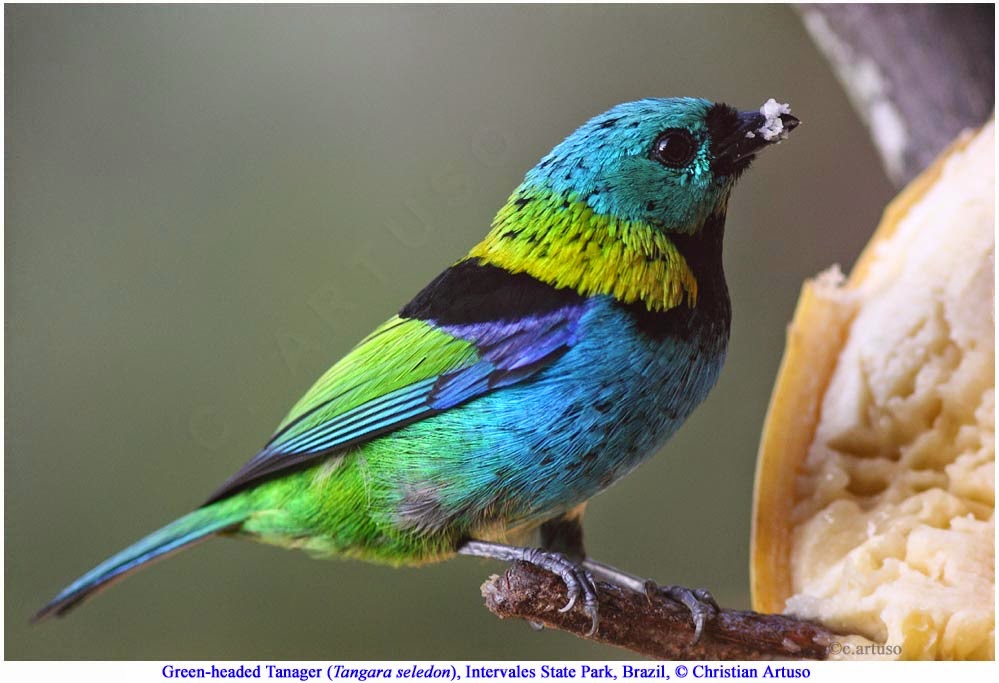
Green-headed Tanager (Tangara seledon)
These tanagers are sometimes attracted to fruit feeders
allowing one to gawk...
Swallow Tanager (Tersina viridis)
The unique Swallow Tanager is in a genus all of their own
(this is a male, females are a delightful green).

Grass-green Tanager (Chlorornis riefferii)
Personally, I’d go with “canopy-green”!

Multicolored Tanager
(Chlorochrysa nitidissima)
For such a colourful bird, the Multicolored Tanager is hard
to find in the canopy. This range-restricted Colombian endemic is considered
globally Vulnerable..

Orange-eared Tanager (Chlorochrysa calliparaea)
Another amazingly brilliant Chlorochrysa that lights up the forest (Alas, I have never managed
to photograph them well).

Black-capped
Hemispingus (Hemispingus atropileus)
A little less vibrant but very classy, the Hemispingus are also tanagers.

Rufous-chested
Tanager (Thlypopsis ornata)
May look like a warbler but this little gem is a high
elevation tanager!

Hooded Mountain
Tanager (Buthraupis montana)
The so-called “mountain tanagers” make high elevation
birding a treat. Here is the large and beautiful Hooded Mountain Tanager of the
high Andes.

Lacrimose Mountain Tanager (Anisognathus lacrymosus)
So named for the “teardrop” marking behind the eye, the
Lacrimose Mountain Tanager has a rather unique orange colour in my opinion.

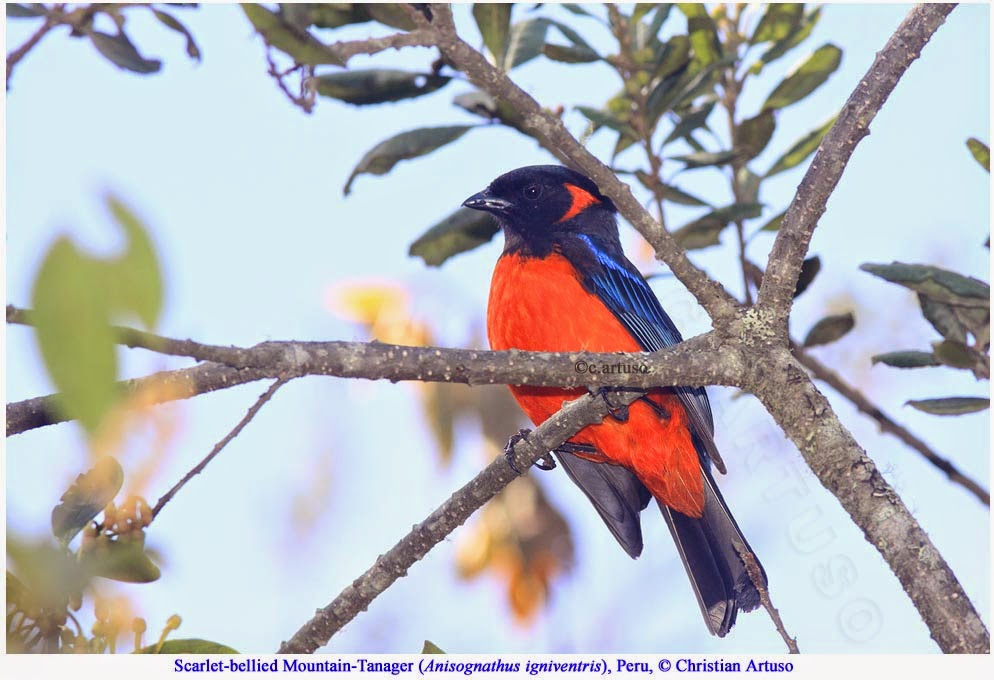
Scarlet-bellied Mountain Tanager (Anisognathus igniventris)
Studies have shown that nine out of ten birders run out of
adjectives before they lower their binoculars on a Scarlet-bellied Mountain
Tanager!
Blue-winged Mountain Tanager (Anisognathus somptuosus)
The Blue-winged
Mountain Tanager needs no
introduction as a very common species of the montane mixed-species flocks but “somptuosus” is an understatement!

Black-chinned Mountain Tanager (Anisognathus notabilis)
The range restricted Chocó endemic Black-chinned Mountain
Tanager is a lot harder to find than the former species (though similar in
appearance).

Golden-collared
Tanager (Iridosornis jelskii)
Another truly extraordinary beauty of the high Andes! These tanagers seem to hit you where it hurts when
you are already low on oxygen!

Blue-capped Tanager (Thraupis cyanocephala)
The Blue-capped Tanager is another tanager of mid to high
elevations.

Blue-grey Tanager (Thraupis episcopus)
Perhaps one of the most widespread and common tanager
species.

Golden-chevroned
Tanager (Thraupis ornata)
Another endemic of Brazil’s Atlantic forest.

Brazilian Tanager (Ramphocelus bresilius)
Switching from blue to red… the Ramphocelus tanagers, like this Brazilian Tanager, have some
extraordinarily brilliant shades of reds. This male also impressed me with his
twinkle toes.
Crimson-collared
Tanager (Ramphocelus sanguinolentus)
The Crimson-collared Tanager is another brilliant Ramphocelus tanager but with a little
less red... just don’t mistake them for
a bishop or a cardinal!

Flame-rumped Tanager (Ramphocelus flammigerus)
In the Flame-rumped Tanager and a few other Ramphocelus the brilliant splash of
colour is confined to the rump.

Lemon-rumped Tanager (Ramphocelus icteronotus)
The Lemon-rumped Tanager replaces red with yellow and was
formerly considered conspecific with Flame-rumped Tanager.

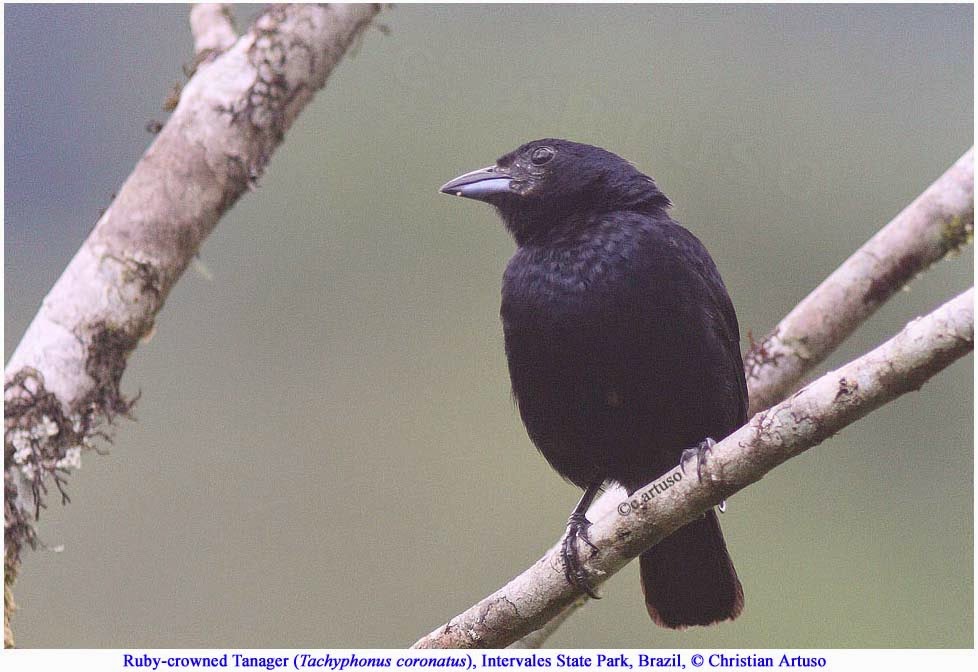
Ruby-crowned Tanager (Tachyphonus coronatus)
Unless you see the red crown spot of the Ruby-crowned
Tanager you could easily be forgiven for mistaking them for an icterid.
Flame-crested Tanager
(Tachyphonus cristatus)
The Flame-crested Tanager replaces a red crown with a red
crest! 
Fawn-breasted Tanager
(Pipraeidea melanonota)
The Fawn-breasted Tanager is now placed in their own genus.
Tanagers also eat invertebrates as you can see here!

Magpie Tanager (Cissopis leverianus)
Who needs colour when you can be this classy in black and
white!

Brown Tanager (Orchesticus abeillei)
The unique (monotypic) Brown Tanager showing the family’s
more sombre side.

Rufous-browed Conebill
(Conirostrum rufum)
The tanager family is actually remarkable large and diverse
(374 species in 97 genera by current IOC taxonomy). Many tanagers go by other
names and their diet can be primarily frugivorous, insectivorous or
granivorous. Two largely insectivorous genera of tanager are referred to as
conebills for obvious reasons. This
Rufous-browed Conebill demonstrates how the cone-shaped bill is used.

Giant Conebill (Oreomanes fraseri)
The unique Giant Conebill (monotypic genus) is a denizen of
the high elevation Polylepis forests and is listed
as Near-threatened because of the high degree of habitat loss and fragmentation
in this unique woodland type. This photo also gives a little
glimpse at the gnarled beauty of Polylepis.

Bay-chested
Warbling-Finch (Poospiza thoracica)
The warbling-finches are tanagers that feed on both
invertebrates and fruit.

Cuban Grassquit (Tiaris canorus)
Some readers may be surprised to learn that there are some
tanagers that are seed eaters with very finch-like bills (may also east small
fruits). This includes the Tiaris
grassquits like this magnificent Cuban endemic.

Plain-coloured
Seedeater (Catamenia inornata)
They may look more like finches but the “seedeaters” are
tanagers too! (yes, I know it is hard to believe)
 |
Saffron Finch (Sicalis flaveola)
No, I am not kidding, these so-called “finches” (and
certainly they are finch look-alikes) are really tanagers! If you’re just wild about saffron, this is a
bird you’ve got to see!

Chestnut-bellied
Seed-finch (Oryzoborus angolensis),
female.
No prizes for guessing what this tanager eats!

Wedge-tailed Grass Finch
(Emberizoides herbicola) and Great Pampa Finch (Embernagra
platensis)
Just in case you though all tanagers were forest birds, here
are two seed-eating tanagers of grassland and shrubland in a single photo.

Red Pileated Finch (Coryphospingus cucullatus)
Also called the Red-crested Finch, this is yet another
“unexpected” tanager in a genus with only two species. This is a poor photo but
I felt this species should be included in this overview.

Red-capped Cardinal (Paroaria gularis)
Ironically (especially since the genus Piranga which goes by the common English name of tanager, as in
Scarlet Tanager and Summer Tanager and others, has now been determined to
belong to the family Cardinalidae), some real tanagers in the genus Paroaria go by the common English name
of “Cardinal”. These recent taxonomic changes have certainly made the
nomenclature very confusing. This Red-capped Cardinal is trying to pick a fight
with their arch-nemesis!

Black Flowerpiercer (Diglossa humeralis)
Some tanagers are nectar specialists and have a hooked bill tip
that enables them to pierce flowers and extract nectar. This Black
Flowerpiercer demonstrates the unusual bill shape.

Masked Flowerpiercer (Diglossa cyanea)
This Masked Flowerpiercer shows how the bill tip is used in
foraging. This method is less likely to pollinate plants than the more
“straightforward” feeding style of hummingbirds but the flowerpiercers may
still transport some pollen.

Red-legged
Honeycreeper (Cyanerpes cyaneus)
As their name suggests, the honeycreepers are tanagers with
a penchant for nectar. They also pack a lot of colour. This is a male
Red-legged Honeycreeper.

Green Honeycreeper (Chlorophanes spiza)
A male Green Honeycreeper—widespread and unmistakable!
 |
| Add caption |
Yellow-bellied Dacnis
(Dacnis flaviventer)
Dacnis are a genus of small and stunning canopy-dwelling
tanagers, mostly from lower elevations. When someone calls “Dacnis!” they will
not be ignored (by other birders at least)!

Western
Spindalis (Spindalis zena)
Spindalis is a Caribbean
endemic genus that packs a lot of punch! This is a male Western Spindalis from Cuba.

I hope you enjoyed this glimpse into this incredible family of songbirds.
Subscribe to:
Posts (Atom)

