If you recall my post “Another one on the wrong list” (http://artusobirds.blogspot.com/2009/12/another-one-on-wrong-list.html) referring to Chestnut-collared Longspur as being added to the COSEWIC list of threatened species, well, history has repeated itself and nobody is surprised. Today COSEWIC recommended adding Bobolink to the list of Threatened Species.
Like the Chestnut-collared Longspur, the Bobolink is a grassland bird that has suffered significant declines as a result of habitat loss, (changes in) agricultural practices, and pesticide use. The Bobolink is an “Icterid”, i.e. in the group that includes the “New World” blackbirds, “New World” orioles, cowbirds, grackles, meadowlarks, oropendolas and caciques. Quite a few North American blackbirds have suffered from “bird control measures” in cropland areas in their wintering range and at large winter roosts. Both Rusty Blackbird (Special Concern) and Bobolink have suffered declines as a result of this practice.
It is worth pointing out that Bobolink is a little different to some of the other Threatened grassland birds of mixed grass and short grass prairies, such as Sprague’s Pipit and Chestnut-collared Longspur. Bobolinks are found in grasslands, alfalfa fields, pastures and wetland edges as far west and eastern British Columbia; however they also utilize taller vegetation such as the Tall Gras Prairie and the prairie/parkland transition zone and their range extends all the way to the east coast of North America in these tall grass habitats. The plight of the tall grasslands of eastern North America is absolutely dire to say the least and the Bobolink has suffered their most severe declines in the east.
A few of my photos of the beautiful Bobolink are added below. I used two photos of a breeding male and one of a bird in non-breeding plumage. In late summer, males and females in non-breeding plumage look extremely similar. In fact, Bobolinks are unusual in undergoing two complete moults per year. Their rich, cheery, bubbly song (from which their English name is derived) and spectacular display flutter flight have punctuated many a grassy field in parts of Manitoba I have visited and have filled many a morning with joy. It saddens me to see such a “common” bird listed but hopefully this will improve our ability to conserve this grassland treasure.
Tuesday, May 4, 2010
Friday, April 23, 2010
Peregrine courtship feeding
I just witnessed a fantastic urban wildlife scene unfold over the brilliant blue skies of western Winnipeg (Atlas code D = probable breeding) so decided to make a quick post. Homeward bound shortly around 6:30pm, I watched a pair of Peregrine Falcons exchange a prey item high above the bustling streets. The presumed male (smaller) was carrying a large, dark brown avian prey item, which may have been a duck or a grebe or because at one point i think i noted a webbed or possibly lobed foot. This bird was engaging in a slow flutter flight of sorts, decelerating until he was almost hovering but still ascending extremely slowly and the presumed female (larger bird) come in from underneath, performing a barrel role about two feet below him just as he let go of the prey so that it fell into her outstretched, inverted talons. Their timing was not perfect this time though, and she fumbled and had to swing back around and intercept the falling prey item, which she did remarkably quickly.
I witnessed all of the above from my car window and, after she took the prey to a high perch and began eating, I swung the car around and found a spot to park and get out the camera. By the time I had done so he had come and perched near where she was eating. Here he is waiting patiently as she eats.

He may look patient enough but he is hungry too!

Eventually she has had her fill and flies off, allowing me to snap a couple of flight shots.


He flies around and walks along the ledge to take his turn at the dinner table, allowing me to try to read his band number – looks like “08” as can be seen in the second shot, (cropped and enlarged).
Sunday, April 18, 2010
The Horned Guan - finding an enigma
High in the cloud forests on the slopes of the mountains and volcanoes of southwest Mexico and Guatemala, hides a bizarre endemic species that has long been considered one of the great enigmas of ornithology – the Horned Guan. Said to be the sole survivor of a unique and ancient radiation in the cracid family, hence with no other living close relatives, the Horned Guan has puzzled ornithologists since their discovery in 1844. On Christmas day last year, a small group of us made the pilgrimage to climb a Guatemalan volcano, departing in the pitch black well before dawn so as to be at elevation by early morning. The trail was narrow and muddy and, above all, steep. The reward was the lure of seeing this bizarre, little known, seldom seen creature in their natural habitat. Imagine something like a turkey with a large fleshy horn running around, not on the ground, but mostly through the large branches of the tallest cloud forest trees. That might be the best way to describe a Horned Guan to someone who hasn’t seen this amazing animal.
The habitat of the Horned Guan is of course part of the mystique – the glorious cloud forest ion the remotest areas of western Chiapas, Mexico and western Guatemala. The slopes of several Guatemalan volcanoes, may be the best place to look for this species. So the day before our big climb, we found ourselves taking a boat across Lago Atitlan to get to the foot of the volcano. This Lake sits at the base of several volcanoes and once held an endemic subspecies (or possibly species) of grebe, the Atitlan Grebe, a relative of the Pied-billed Grebe. As you cross the lake by boat you see the task ahead – steep volcanoes clad in dense forest – beautiful, inspiring, but also challenging! My friend Melanie tried to capture the mood with this photo of the lake – and one of me for good measure!


That evening we arrived at the base of the volcano – here is the view looking up! The ridge you see in the center of the volcano is the ridge we would climb the following day – six hours straight uphill, at least half of which under the cover of darkness.

So at 3am we stumbled out of bed and made our way to the trailhead. The climb was grueling but the anticipation was palpable. As dawn broke we heard the voices of Black-throated Jays and other target species, but from the narrow trail on the ridge seeing anything at all was difficult and crashing into the forest was even tougher. We worked hard to get brief views of a Tawny-throated Leaftosser but mostly we were focused on finding the guan. Just before 9am, having done little but walk straight up the muddy trail, our guide told us we had reached the lower altitudinal limit of the Horned Guan. Our pulses quickened but when checks of the fruiting trees where the enigma had been most recently seen all proved fruitless (i.e. no fruit and hence no guan), we started to have doubts about our chances of success.
The whole morning passed in this way – we split up and searched every fruiting tree we could find – no guan anywhere. The bird was living up to their reputation of being extremely furtive and difficult to detect despite their enormous size (90cm!). At one of the few places where you could see out through the trees, we looked back across the valley to see Volcán de Fuego living up to his name (Volcano of Fire) – smoke plume serpenting up into the brilliant blue sky!
The day wore on and we knew that, since we still hadn’t seen the guan, we might be coming off the volcano in the dark. One of our group gave up and headed back down. The rest of us split up and remained hopeful, even as with each passing minute hopes faded.
At nearly 3pm, knowing the time to get off the volcano was approaching, and separated from the rest of the group, I heard a noise that was like having my own nervous stomach rumbles removed from my body, amplified, and then played back to resonate in my ear drum and vibrate my jaw bone. As my body shook, there was no doubt – I had just heard the deep, booming, “volcanic” rumbling call of the Horned Guan! I tried to collect my wits and head as quickly and quietly up the trail to look for a way off the ridge towards the source of the boom, knowing full well that the call would be somewhat ventriloqual in nature (i.e. hard to pinpoint the direction it came from) and also knowing that any misstep, such as one that produced a loud noise, might scare off the bird I was trying to see. I also knew that if I did see the bird, alone, I would be extremely unpopular. The others however, were a fair distance uphill.
As I got off the trail and worked my way down, across the ridge, I heard the voice of our guide whispering and directing me towards him. It turns out that while he had been walking off to the side the guan had been walking up the volcano and, upon seeing him, had flown up into a tall tree and made the grunting call that I had heard. The way towards our guide was covered in leaf litter and vines so there were anxious moments as I tried desperately to be quick but quiet. Fortunately, two or three minute later I reached him and crouching to get into position, peering through the foliage, I saw the large dark shape in the canopy – none other than the Horned Guan! My pulse of course was racing so hard that it was hard to hold the binoculars steady to check the red horn and the dazzling red legs. But sitting in the dirt, I found a window through the leaves that allowed me to settle down and enjoy the spectacular view. Here are my first views of this magnificent creature, nestled in the shadows of the large branches of the subcanopy – large but easy to overlook without a clue to their presence.


Ordinarily in that situation I would have been in quite a quandary – stay with the bird or go fetch the others. Fortunately this time, our guide volunteered to get the others when I told him where they were. So, five anxious minutes or more followed as I watched the guan for signs of nerves and got ready to follow the bird if they flew. Amazingly, fortunately, this bird was content to remain in the canopy and moved very little. When I heard my friend footsteps approaching, there were a few more anxious minutes — “please stay just a few minutes more” i said to myself — and indeed, soon all four of us were huddled together on the volcano side staring in awe at trying to refrain from making audible sighs and expressions of pleasure.
Finally of course, the guan did fly, which in itself was a spectacle to watch — they seem to large and heavy and yet they fly with remarkable ease — but amazingly they went in the direction of the main trail. So we followed the movement and then crept along the trail until we got even better views of our prize. The photos that follow really say it all – what a feeling to be right under a bird of this size, listening to their booming call from so close (last photo shows the bird calling) and watching that red fleshy horn glow in the afternoon sun!!
The habitat of the Horned Guan is of course part of the mystique – the glorious cloud forest ion the remotest areas of western Chiapas, Mexico and western Guatemala. The slopes of several Guatemalan volcanoes, may be the best place to look for this species. So the day before our big climb, we found ourselves taking a boat across Lago Atitlan to get to the foot of the volcano. This Lake sits at the base of several volcanoes and once held an endemic subspecies (or possibly species) of grebe, the Atitlan Grebe, a relative of the Pied-billed Grebe. As you cross the lake by boat you see the task ahead – steep volcanoes clad in dense forest – beautiful, inspiring, but also challenging! My friend Melanie tried to capture the mood with this photo of the lake – and one of me for good measure!


That evening we arrived at the base of the volcano – here is the view looking up! The ridge you see in the center of the volcano is the ridge we would climb the following day – six hours straight uphill, at least half of which under the cover of darkness.

So at 3am we stumbled out of bed and made our way to the trailhead. The climb was grueling but the anticipation was palpable. As dawn broke we heard the voices of Black-throated Jays and other target species, but from the narrow trail on the ridge seeing anything at all was difficult and crashing into the forest was even tougher. We worked hard to get brief views of a Tawny-throated Leaftosser but mostly we were focused on finding the guan. Just before 9am, having done little but walk straight up the muddy trail, our guide told us we had reached the lower altitudinal limit of the Horned Guan. Our pulses quickened but when checks of the fruiting trees where the enigma had been most recently seen all proved fruitless (i.e. no fruit and hence no guan), we started to have doubts about our chances of success.
The whole morning passed in this way – we split up and searched every fruiting tree we could find – no guan anywhere. The bird was living up to their reputation of being extremely furtive and difficult to detect despite their enormous size (90cm!). At one of the few places where you could see out through the trees, we looked back across the valley to see Volcán de Fuego living up to his name (Volcano of Fire) – smoke plume serpenting up into the brilliant blue sky!

The day wore on and we knew that, since we still hadn’t seen the guan, we might be coming off the volcano in the dark. One of our group gave up and headed back down. The rest of us split up and remained hopeful, even as with each passing minute hopes faded.
At nearly 3pm, knowing the time to get off the volcano was approaching, and separated from the rest of the group, I heard a noise that was like having my own nervous stomach rumbles removed from my body, amplified, and then played back to resonate in my ear drum and vibrate my jaw bone. As my body shook, there was no doubt – I had just heard the deep, booming, “volcanic” rumbling call of the Horned Guan! I tried to collect my wits and head as quickly and quietly up the trail to look for a way off the ridge towards the source of the boom, knowing full well that the call would be somewhat ventriloqual in nature (i.e. hard to pinpoint the direction it came from) and also knowing that any misstep, such as one that produced a loud noise, might scare off the bird I was trying to see. I also knew that if I did see the bird, alone, I would be extremely unpopular. The others however, were a fair distance uphill.
As I got off the trail and worked my way down, across the ridge, I heard the voice of our guide whispering and directing me towards him. It turns out that while he had been walking off to the side the guan had been walking up the volcano and, upon seeing him, had flown up into a tall tree and made the grunting call that I had heard. The way towards our guide was covered in leaf litter and vines so there were anxious moments as I tried desperately to be quick but quiet. Fortunately, two or three minute later I reached him and crouching to get into position, peering through the foliage, I saw the large dark shape in the canopy – none other than the Horned Guan! My pulse of course was racing so hard that it was hard to hold the binoculars steady to check the red horn and the dazzling red legs. But sitting in the dirt, I found a window through the leaves that allowed me to settle down and enjoy the spectacular view. Here are my first views of this magnificent creature, nestled in the shadows of the large branches of the subcanopy – large but easy to overlook without a clue to their presence.


Ordinarily in that situation I would have been in quite a quandary – stay with the bird or go fetch the others. Fortunately this time, our guide volunteered to get the others when I told him where they were. So, five anxious minutes or more followed as I watched the guan for signs of nerves and got ready to follow the bird if they flew. Amazingly, fortunately, this bird was content to remain in the canopy and moved very little. When I heard my friend footsteps approaching, there were a few more anxious minutes — “please stay just a few minutes more” i said to myself — and indeed, soon all four of us were huddled together on the volcano side staring in awe at trying to refrain from making audible sighs and expressions of pleasure.
Finally of course, the guan did fly, which in itself was a spectacle to watch — they seem to large and heavy and yet they fly with remarkable ease — but amazingly they went in the direction of the main trail. So we followed the movement and then crept along the trail until we got even better views of our prize. The photos that follow really say it all – what a feeling to be right under a bird of this size, listening to their booming call from so close (last photo shows the bird calling) and watching that red fleshy horn glow in the afternoon sun!!
Wednesday, March 31, 2010
Improving on a masterpeice
Like many birders I have long enjoyed thumbing through field guides from exotic locals, marveling at the stunning avian wonders that can be seen there. This day dreamy habit has generated a strong interest in field guides and their relative strengths and weaknesses. Perhaps not surprisingly, there is a considerable range in quality in field guides. A good field guide enhances your birding experience; a bad one can lead to considerable frustration. If I had to rank the field guides I have read in terms of quality, I would say that beyond any shadow of a doubt, the best ever produced, to date, in my humble opinion (IMHO), is the Birds of Europe by Lars Svensson, Peter Grant, Killian Mullarney and Dan Zetterström (first published in 1999). Naturally, therefore, I was delighted to learn that a second edition has now been released! I should add though that, at the same time as being delighted, there was a little trepidation that they might have messed with a good thing – fortunately that fear was unfounded as overall the GISS of this new edition is much the same as the first!
The second addition is, in a nutshell, an improvement on a masterpiece. The same superb illustrations and ingenious format, cramming in an extraordinary amount of information in a small amount of space and presenting the reader with a wealth of tools to improve field identification. Killian Mullarney and Dan Zetterström’s illustrations are truly remarkable in their accuracy and beauty and the way they seem to capture the GISS of each species along with the intricate details of plumage and structure.
Allow me to illustrate this with an example — I have added a scan of the illustrations of the European Honey Buzzard. As you can see there are 18 different illustrations for one species crammed into half a plate. The level of detail in both text and illustration is extraordinary and so many of the variations in plumage of this highly variable species are accounted for. Compare the photo I took of this species on the right with the plate and see how identification and ageing and sexing (the bird in this photo is a darker juvenile – note the dark eye among other features). Very few field guides can match this level of detail! If any of thee pictures in this post seem too small to be legible, click on them for a larger version.

Another feature I love about the Birds of Europe is the way they compare and contrast similar species or common versus rare species from various angles and postures. Look at the illustrations for the North American vagrant Spotted Sandpiper (sorry for the poor quality scan). In a tiny amount of space they capture the GISS and illustrate all the subtle difference that enable separation from the Common Sandpiper, which as the name suggests is common in Europe.

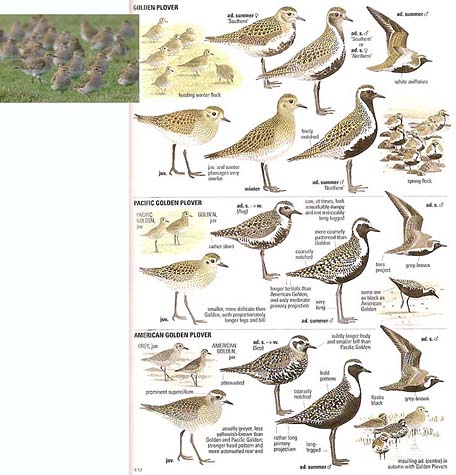
Likewise look at this full plate on the three species of golden plovers. Again, so many points of comparison in plumage, posture, age, sex, on the ground versus in flight – you name it! I also love the way they frequently include a “zoomed out” picture that portrays the way one might see the species under field conditions – in this case compare the illustration of a feeding flock with my photo of a loafing flock of European Golden Plovers. These “small” pictures really help one in learning and appreciating GISS. The “floating captions” with the picture also serve to direct the reader’s attention to the key points.
But perhaps above all, is the just the truly extraordinary quality of the illustrations themselves. To illustrate this allow me to juxtapose the illustrations of two North American species, Greater Yellowlegs and Lesser Yellowlegs in the Bird of Europe and the National Geographic Field Guide to the Birds of North America. In both cases these two species occupy half a plate and these two field guides are very similar in size. You might expect the North American guide to have more detail or better portray the species but as far as I am concerned, in terms of “capturing the species’ likeness”, quality, detail, comparative merit, and utility in the field, the Birds of Europe is the hand-down winner. In addition to the comparison between these two species, you’ll also notice the comparison with other potentially confusing species, Common Greenshank and Wood Sandpiper, on the same page (in addition to the more detailed treatment of those European species on previous pages) and other useful extras like a size comparison (as viewed from a distance) with a very common species, Common Redshank.

The second addition is, in a nutshell, an improvement on a masterpiece. The same superb illustrations and ingenious format, cramming in an extraordinary amount of information in a small amount of space and presenting the reader with a wealth of tools to improve field identification. Killian Mullarney and Dan Zetterström’s illustrations are truly remarkable in their accuracy and beauty and the way they seem to capture the GISS of each species along with the intricate details of plumage and structure.
Allow me to illustrate this with an example — I have added a scan of the illustrations of the European Honey Buzzard. As you can see there are 18 different illustrations for one species crammed into half a plate. The level of detail in both text and illustration is extraordinary and so many of the variations in plumage of this highly variable species are accounted for. Compare the photo I took of this species on the right with the plate and see how identification and ageing and sexing (the bird in this photo is a darker juvenile – note the dark eye among other features). Very few field guides can match this level of detail! If any of thee pictures in this post seem too small to be legible, click on them for a larger version.

Another feature I love about the Birds of Europe is the way they compare and contrast similar species or common versus rare species from various angles and postures. Look at the illustrations for the North American vagrant Spotted Sandpiper (sorry for the poor quality scan). In a tiny amount of space they capture the GISS and illustrate all the subtle difference that enable separation from the Common Sandpiper, which as the name suggests is common in Europe.

Likewise look at this full plate on the three species of golden plovers. Again, so many points of comparison in plumage, posture, age, sex, on the ground versus in flight – you name it! I also love the way they frequently include a “zoomed out” picture that portrays the way one might see the species under field conditions – in this case compare the illustration of a feeding flock with my photo of a loafing flock of European Golden Plovers. These “small” pictures really help one in learning and appreciating GISS. The “floating captions” with the picture also serve to direct the reader’s attention to the key points.

But perhaps above all, is the just the truly extraordinary quality of the illustrations themselves. To illustrate this allow me to juxtapose the illustrations of two North American species, Greater Yellowlegs and Lesser Yellowlegs in the Bird of Europe and the National Geographic Field Guide to the Birds of North America. In both cases these two species occupy half a plate and these two field guides are very similar in size. You might expect the North American guide to have more detail or better portray the species but as far as I am concerned, in terms of “capturing the species’ likeness”, quality, detail, comparative merit, and utility in the field, the Birds of Europe is the hand-down winner. In addition to the comparison between these two species, you’ll also notice the comparison with other potentially confusing species, Common Greenshank and Wood Sandpiper, on the same page (in addition to the more detailed treatment of those European species on previous pages) and other useful extras like a size comparison (as viewed from a distance) with a very common species, Common Redshank.

Another useful comparison is these plates of North American Thrushes (Birds of Europe on the left versus National Geographic on the right). Both are excellent for field identification but again the European guide does at least as good, and in my opinion even better, a job of the North American vagrants as the American guide does. The Birds of Europe also makes several comparisons with Song Thrush (not necessary in North America). Small wonder I often keep a copy of the Birds of Europe with me as I bird around the North American continent!

Now, even a masterpiece cannot be perfect and, unfortunately, some of the inconsistencies that weakened the first edition have also crept into the second. There are still inconsistencies in the treatment of rarities and vagrants as to whether or not they get included in the main section of the guide or get relegated to the appendix (in which case quite a few are not illustrated). There has been some shuffling of species, especially the introduced ones, with species like Mandarin Duck and Wood Duck moved from the main section to an appendix, but not nearly enough for consistent treatment.
North American readers, many of whom, like me, consider this book a highly valuable resource, will be frustrated that there has still been no effort for consistency in nomenclature. Some Holarctic species are given both British and American English names, e.g. under Lapland Bunting the text reads (Am: Lapland Longspur), and after Slavonian Grebe in brackets we see (Horned Grebe) but many others still lack this “courtesy” such as Goosander, Guillemot and Kentish Plover (Common Merganser, Common Murre and Snowy Plover respectively).
It is wonderful that the book treats new splits so well, but an oversight was made in not indicating their former names or what they were split from. For example, a person who had the first edition and who wanted to compare Little Shearwater will not find it anywhere in the second edition (not even in the index nor anywhere in the text nor is there any table of splits or additions) unless they already know to look for Macronesian Shearwater.
Typesetting is expensive, so perhaps the authors wanted to make some of these changes but space or cost meant sticking with the old. On the whole though, a great amount of care has gone into improving most aspects of this guide and I am delighted to conclude that the very best modern field in the world (IMHO) is now even better! Looks like I am going to need two copies again – one for the book shelf and one for the glove compartment! Maybe it’ll help me find a European stray (in Manitoba not too likely but hey…).

But is this new edition worth buying if you have the old? I would say yes — there are enough good changes to make it worth owning. Of course, this includes treatment of the various splits that have occurred since the publication of the first edition and, clearly, the taxonomic treatment is consistent and carefully considered. The text has been updated and the results of various recent publications as they pertain to field identification incorporated, especially if you are a “larophile” (lover of gulls) – there is a lot of new information on gulls! The maps have also been improved where relevant; for example, I was happy to see that the new map for Rock Partridge had been corrected to show the southern Italian population. Some of the drawings are redone and others added (love the new half plate on scops owls!), with about 16 extra pages from the first edition. The Nearctic Wood-Warblers have been redone by Killian Mullarney in a style that is much more consistent than previously (in the first edition the two plates by Larry McQueen were in a different style than the rest of the book). As always, the additions and changes are treated with superb precision and care (perhaps only the illustration of Yellow Warbler is a little below the usual high standard in terms of capturing the GISS).
Now, even a masterpiece cannot be perfect and, unfortunately, some of the inconsistencies that weakened the first edition have also crept into the second. There are still inconsistencies in the treatment of rarities and vagrants as to whether or not they get included in the main section of the guide or get relegated to the appendix (in which case quite a few are not illustrated). There has been some shuffling of species, especially the introduced ones, with species like Mandarin Duck and Wood Duck moved from the main section to an appendix, but not nearly enough for consistent treatment.
North American readers, many of whom, like me, consider this book a highly valuable resource, will be frustrated that there has still been no effort for consistency in nomenclature. Some Holarctic species are given both British and American English names, e.g. under Lapland Bunting the text reads (Am: Lapland Longspur), and after Slavonian Grebe in brackets we see (Horned Grebe) but many others still lack this “courtesy” such as Goosander, Guillemot and Kentish Plover (Common Merganser, Common Murre and Snowy Plover respectively).
It is wonderful that the book treats new splits so well, but an oversight was made in not indicating their former names or what they were split from. For example, a person who had the first edition and who wanted to compare Little Shearwater will not find it anywhere in the second edition (not even in the index nor anywhere in the text nor is there any table of splits or additions) unless they already know to look for Macronesian Shearwater.
Typesetting is expensive, so perhaps the authors wanted to make some of these changes but space or cost meant sticking with the old. On the whole though, a great amount of care has gone into improving most aspects of this guide and I am delighted to conclude that the very best modern field in the world (IMHO) is now even better! Looks like I am going to need two copies again – one for the book shelf and one for the glove compartment! Maybe it’ll help me find a European stray (in Manitoba not too likely but hey…).
Subscribe to:
Posts (Atom)