Tropical oceans are often fairly low in productivity, in part (and this is a bit of an over-simplification) because the rich nutrient-loaded cold water remains deep and does not mix with the warm water near the surface, where photosynthesis can occur (plants need light for photosynthesis but they also need nutrients). Unless there are upwellings to mix cold and warm water, tropical waters quickly become nutrient depleted and they therefore cannot support a wide variety of life. People often asked me why the waters off the coast of some tropical destination they have visited seemed so void of life compared to the temperate waters and this is a large part of the answer. The people who ask this question often assume that because tropical terrestrial ecosystems are generally more biodiverse than temperate ones, this might also be the case in marine ecosystems (not true) or they may associate tropical oceans with the amazing diversity of coral reefs. Coral reefs are in fact a remarkable exception to the general pattern of ocean biodiversity, mainly because their nutrients remain “trapped” and recycled in the reef ecosystem rather than sinking to the light-deprived depths of the ocean floor.
Since Peru lies close to the equator, you might expect her waters to be low in productivity. However, off the coast of Peru, the remarkable Humboldt Current brings nutrient-rich cold water northward along the Pacific coast of South America (then west towards the Galapagos) to equatorial latitudes. This upwelling and mixing of cold and warm water, creates the conditions for phytoplankton to thrive, i.e. there is high primary productivity. Where you have high primary productivity, a food chain can form and Peruvian waters therefore draw an astounding array of fish, marine birds and marine mammals. In fact, Peruvian waters support some of the highest biodiversity of any area of the world’s oceans (outside of coral reefs). Consequently, a trip to a Peruvian beach or rocky coastline is bound to be accompanied by sightings of marine birds. This post will highlight a few of them…
One of the first birds you are likely to encounter along the Peruvian coast is the large and spectacular Peruvian Pelican. Although very similar to a Brown Pelican in plumage, the Peruvian Pelican is much larger. When seen up close, as seems so easy to do in Peru, these pelicans are surprisingly colourful and their black and white streaked plumage is particularly handsome!

Penguins (family Spheniscidae) are confined to the nutrient rich cold waters of the southern oceans. Most species are Antarctic or Sub-Antarctic in distribution; however, thanks to the Humboldt Current, there are two species that occur in the tropics close to the equator – the Galapagos Penguin and the Humboldt Penguin that occurs off the Peruvian coast (a third species, the African Penguin, breeds just barely north of the Tropic of Capricorn and hence technically in tropical waters). The Humboldt Penguin is of course named for the current that permits their existence by providing the primary productivity that supports the huge shoals of anchovies that the penguins rely on. The Humboldt Penguin is listed by Birdlife International as Vulnerable to extinction, who suggest their decline is due to incidental take (these birds are often accidentally caught in fishing nets), illegal hunting and capture (for the pet trade believe it or not!!), over-fishing, guano-mining, predation by rats and cats, and global warming, in particular in the form of El Niño, that greatly reduces the normal pattern of upwelling that all marine life in this region depends on.
The penguins are well camouflaged on the coastal rocks. See if you can spot the Humboldt Penguin in this photo alongside the Peruvian Pelicans and others… If not, look at the second photo (cropped in) then back at the first photo again…


Here is a view of these birds swimming just off the coast. They are very difficult to photograph as they don’t surface for long…

Rocky outcrops, headlands and islands are also the home of the Peruvian Booby and you may have spotted one in the first penguin photo above (the lowest bird on the rocks). As you can tell from the shape of their beak, they are superb plunge divers, feeding in the rich coastal waters. They also have a habit of flying by in steady streams of birds, revealing their distinctive sulid shape...

Surely, one of the most spectacular inhabitants of the rocky coast in the Inca Tern. The unique plumage of this bird seems to be a blend of camouflage (against grey rocks)…

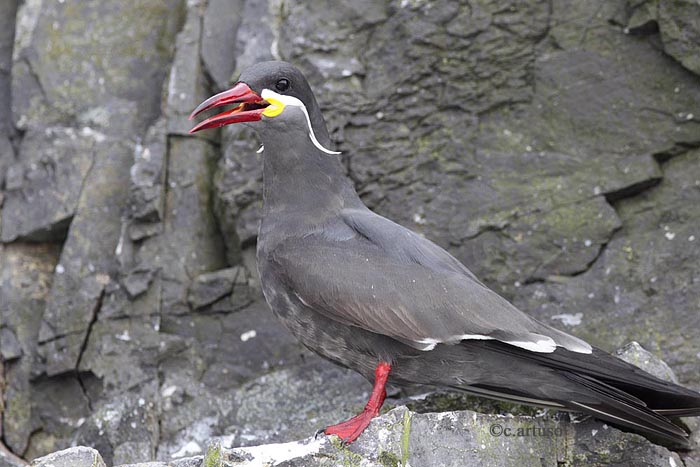
... and showiness (what a face pattern - check out that 'stache!!)

If you had super sharp eyes you may also have picked out the flying Inca Terns in the first penguin photo above (look for their dark grey plumage with white trailing edge to wings).
Several shorebirds also make a living on the rocky coast. Feeding at the water’s edge, is a Blackish Oystercatcher (Haematopus ater). They use their long, powerful bill to probe and forage as shown here.

The Blackish Oystercatcher is the South American equivalent of the Black Oystercatcher (Haematopus bachmani) in the Northern Hemisphere; however, it would take consummate skill to separate these species on plumage!! Here is a scan of an old slide I dug out of a Black Oystercatcher taken on Vancouver Island for comparison – bill structure (Blackish seems to have broader tip), leg colour and possibly mantle colour seem to be some of the only subtle differences…

The Blackish Oystercatchers also share their home with American Oystercatchers. Unlike Black and Blackish Oystercatcher, the American Oystercatchers found in the southern and northern hemispheres are considered conspecific. Here is a pair whipping along the coast…

Cormorants are another group that benefit from the rich coastal waters. In addition to the widespread and common Neotropic Cormorant, there are two species of coastal cormorants in Peru. This is the distinctive Guanay Cormorant.

And this is the stunning Red-legged Cormorant.

Take a closer look at their remarkable eye pattern!
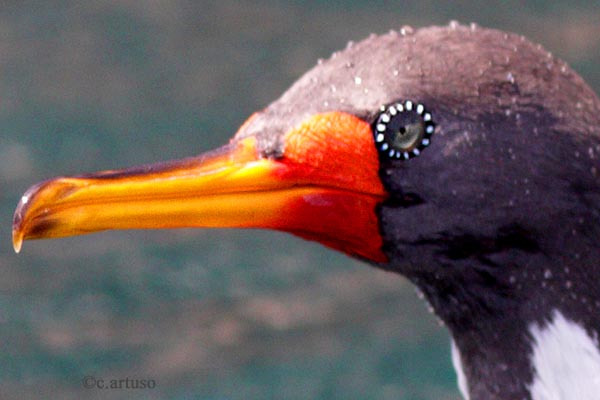
And here is a series of a Red-legged Cormorant coming in to land on the water...


It is not just birds that capitalize on the abundance of plankton and fish in this area. Hauled out on the rocks are also some Southern Sealions.


The sealions offer oppotunities for scavengers like Black Vulture and Turkey Vulture to find an easy meal in the form of scraps and maybe the odd carcass. The Black Vulture in this photo may have been picking parasites off the sealions body, although I could not get close enough to be sure of this...

Gulls are more common in cold waters than in warm waters so the coast of Peru has a surprising number of Gull species for a location so close to the equator. Here is part of the roll call:
Band-tailed Gull (A.K.A Belcher’s Gull), adult then immature,


Gray Gull, accompanied by a Sanderling,

Gray-hooded Gull,

and Kelp Gull, adult perched then immature in flight.


You might not expect to find many passerines along the rocky coast and intertidal zone, but this is home to an exceptional songbird, the Surf Cinclodes. Cinclodes are a member of the very large Neotropical suboscine family Furnariidae. Cinclodes are quite terrestrial in their habits so the Surf Cinclodes has managed to adapt to foraging on coastal rocks and sand (as opposed to the rocks and sandy habitats of deserts and high elevations that some of their relatives exploit). Here are two images of this unique bird taking a break between foraging bouts amist the mussels on the pier…


The “miners” are relatives of the Cinclodes (in the same family) and are clad in the same brown tones and share similar terrestrial habits. Like the cinclodes they are also more diverse at high elevations and, also like the cinclodes group, at least one member has managed to adapt to coastal living. The Coastal Miner is well camouflaged in the open sandy habitats they prefer (not right on the beach but nearby in dune areas). This bird has found a tasty morsel by probing in woody debris.

Before leaving the coast, I want to share a nice surprise I found just a few hundred metres from the ocean – a roosting Lesser Nighthawk, a resident of the coastal strip throughout Peru, that presented a super photo opportunity.

Next, we move back from the coast proper into the surrounding arid scrub and woodlands.


