In addition to the endemics, Cuba is great for watching waterbirds, so let’s start off with just a few of the many we saw: American Flamingo, Reddish Egret and Clapper Rail:


In the endemics, we begin with the non-passerines. The Cuban Black-Hawk (split from Common Black Hawk) is one of three endemic hawks on Cuba (the others being the rare Gundlach’s Hawk, which I saw only briefly, and the almost extinct Cuban Kite, a split from Hook-billed Kite). Here are an adult (in the early morning light) and a juvenile Cuban Black-Hawk. Although seemingly common in the right habitat in Cuba (mangroves and swamps), this species listed as Near-threatened because much of the habitat it specializes in is being drained, fragmented or otherwise degraded:


Cuba is replete with interesting Columbids (pigeons and doves). The shy quail-doves are arguably the most sought after and include gems like the endangered endemic Blue-headed Quail-Dove, which kept just too far away from my lens) and the near-endemic Gray-headed Quail-Dove (a.k.a Gray-fronted Quail-Dove), which is listed as globally Vulnerable (due to habitat loss and hunting), shown here.

Though not endemic, the magnificent Key West Quail-Dove is a true beauty and a difficult species to see as they keep to the dark forest floor. It was only by dint of effort, after a few failed attempts to see one, that, by creeping around on a forest trail just after dawn on our final morning in Cuba, I managed to sneak up on this bird to take this photo. Look closely at the marvelous iridescence!

The Zenaida Dove was relatively easy to see in Cuba, (unlike in the Yucatan Peninsula, where I had once worked hard to see one).

Cuba also has an endemic parakeet, Cuban Parakeet (Vulnerable), and the sad memory of the magnificent endemic Cuban Macaw, which is now extinct. The third Cuban parrot is the Cuban Parrot (a.k.a Rose-throated Parrot or Cuban Amazon) is a near-endemic species that is listed as Near-threatened, (with one extinct, one vulnerable and one near-threatened species, Cuba has done very poorly by its parrots!).

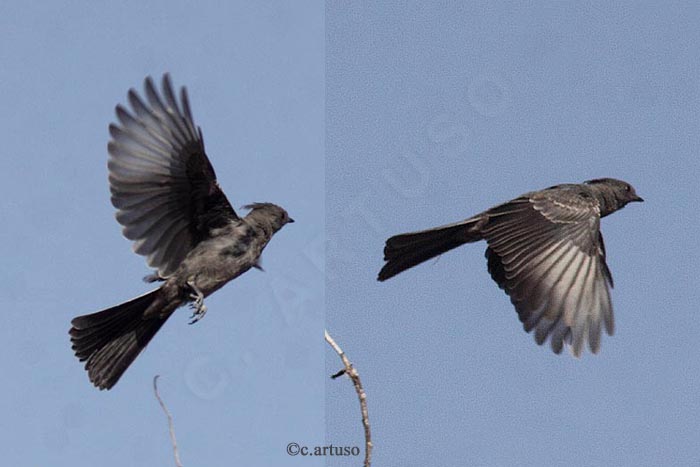
The Great Lizard-Cuckoo is another near-endemic (like the Cuban Parrot it is shared with the Bahamas). This large cuckoo often feeds on the ground, catching lizards and other small prey with their long bill, and it an absolute delight to watch. This flight shot shows some of their hidden colours!

Cuban has some great nightlife too! By, that I means the birds of course! There are two endemic owls: firstly, the unique (monotypic genus Gymnoglaux) Bare-legged Owl, which is something of an avian enigma whose relationship to other owls has been debated (lack of ear tufts, long unfeathered legs, longish tail with only 10 rectrices, song similar to the A-song of the screech-owls but no known B-song, are just some of the puzzling features of this owl),

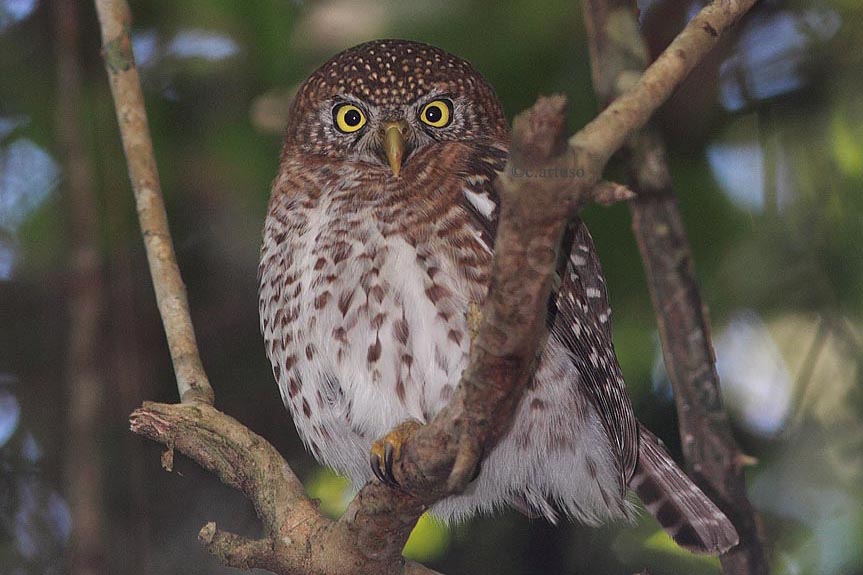
and the Cuban Pygmy-Owl (shown twice here).

In addition, Cuban is home to the widespread but nonetheless enigmatic Stygian Owl,

And its resident race of Barn Owl (but alas the giant owls and giant barn owls of Cuba’s fossil record are no longer with us).

Cuba and Hispaniola also share another night bird in the Greater Antillean Nightjar, shown here on a day roost (and you’ll need to look twice to see them).

Next come the swifts, including the Antillean Palm-Swift, which is found on several Caribbean islands.

And then, there’re the hummingbirds. The beautiful Cuban Emerald is by far the most common and easy to see. This is a male.

However, all visitors to Cuba should be on the look out for the diminutive endemic Bee Hummingbird (a.k.a Cuban Bee Hummingbird), who, at a mere 5 cm (2 inches) in length, is the smallest bird in the world! Here are two photos of the tiny hummer – the male with the bluish back (this bird is in non-breeding plumage and lacks the pink) about to land on a tiny twig, and a female feeding on small white flowers. The Bee hummingbird is much more difficult to locate than the Cuban Emerald, and seems to require denser forests and edges, and is listed as Near-threatened.


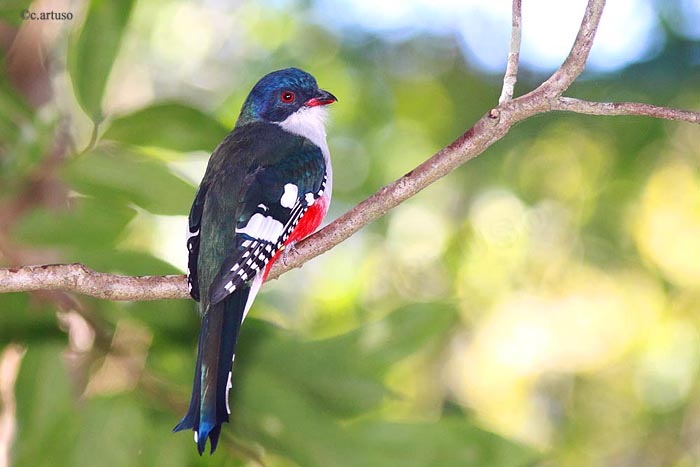
Another Cuban endemic in a monotypic genus (i.e. the only member of its genus) is the truly magnificent Cuban Trogon, affectionately known by the onomatopoeic name tocororo in Cuba and the country’s national bird. Every Cuban I met seemed to have an affinity wit hthis species and to be proud of their national bird. One of my favourite explanations for why it became the national bird is because Cubans think of this bird as an icon of freedom (trogons in general are reputed to be extremely difficult to keep in captivity and it is said that when placed in a cage, the tocororo will fly against the bars to commit suicide rather than live in captivity – too bad the same is not true for the Cuban Grassquit, which is being decimated due to rampant tramping). Here are two views of Cuban Trogon, one from the front and one from the back to show you the unique tail shape and the distinctive colouration of the white breast and red belly, contrasting with the head and mantle… magnificent!

And speaking of unique – the Caribbean has an endemic family, i.e. a family that is found ONLY there – the Todidae (Todies). Interestingly enough, the fossil record shows that this family was once more widespread (European fossils exist) so, more precisely, Todidae is a relictual endemic family. Todies are relatives of kingfishers and rollers (within Coraciiformes) but they are tiny little birds (hence the name), ranging from a mere 9 to 12 cm in total length! There are five species of tody in the world, two on Hispaniola, one of Puerto Rico, one on Jamaica, and this one, the aptly named Cuban Tody. The first time you see this tiny ball of flaming colour, you can hardly believe your eyes! So, once again, I have gone for two photos showing the soft white plumage of the underparts with the suffuse red and blue highlights and the brilliant green of the upperparts and underparts. Seeing a representative of a bird family you have never seen before is always special but the Cuban Tody was extra special for me!


Cuba is home to some stunning woodpeckers, not least of which is the Ivory-billed Woodpecker, now presumed extinct and not seen on Cuba since the late 1980s in Cuba’s easternmost province, Guantánamo. I didn’t mount an expedition to look for this species on this trip, tempting though that be! Nonetheless, I was treated to some fantastic looking woodpeckers. Look at this stylish West Indian Woodpecker for example!

An here is yet another Cuban endemic in a monotypic genus (the only bird in the genus Xiphidiopicus), the endemic Cuban Green Woodpecker.

The Fernandina's Flicker is now listed as globally Vulnerable because their already small and fragmented population appears to be in rapid decline.

Moving to the passerines, we start with the flycatchers of course, and on Cuba we find a fascinating selection, starting with the widespread and abundant Cuban Pewee,

the subtle yet classy La Sagra's Flycatcher,

the large Loggerhead Kingbird (note the head shape), that is similar to Eastern Kingbird in appearance (about an inch larger). This one is fearlessly dispatching a tasty morsel.

And one of the key target birds of a visit to Cuba, the Giant Kingbird. This species is superficially similar to the Loggerhead Kingbird but with a rounder head and a much larger bill (also larger overall I feel; however the various field guides disagree on the measurements) but differs in habits and is usually seen high in the canopy. The Giant Kingbird is now classified as globally Endangered due to a massive decline (reasons unknown) that has led to their extirpation on two of the three islands where they occurred (older records from the Bahamas and the Turks and Caicos) leaving this species effectively a Cuban endemic. Even in Cuba, the seem to be in some trouble and are no longer present in areas they used to occupy such as Zapata. Consequently, there are believed to be less than 1,000 Giant Kingbirds left on Cuba in a few small and isolated patches, so seeing this species at two sites (Sierra de Najassa and La Guira) was a special privilege. This photo gives you a good sense of the bill proportions.

Another species we worked hard to see on Cuba was the Thick-billed Vireo. Although not globally threatened, on Cuba this species is confined to a few locations (much more common elsewhere, especially smaller islands). It was a windy afternoon when we caught up with this species in a mangrove area on Cayo Paredon Grande (from Cayo Coco) as you can see by this poor bird’s “bad hair day”!

The endemic Cuban Vireo, on the other hand, is widespread and common.

In case you hadn’t already noticed, Cuba is home to some very rare species. One of the rarest extant species is the Zapata Wren, found only in the Ciénaga de Zapata (Zapata Swamp). The Zapata swamp holds the large expanses of sawgrass that this species called home but, curiously, it does not seem to found in all areas of the swamp. The population appears tiny and the global range is miniscule (<1,000 km2), making this species Endangered, and they forms yet another monotypic genus. Even rarer of course is the Zapata Rail which has not been seen in over 10 years and is listed as Critically endangered (the call of this species is not known, previous recordings being misidentifications of other rails). Of course, we did not see the Zapata Rail, but we did track down the ultra-elusive Zapata Wren after a long wait. Here first is a bird singing in their characteristic sawgrass habitat, followed by an extremely rare close up view that few people have had the privilege to enjoy!


Another Cuban endemic species, the Cuban Gnatcatcher, and another one with an odd and patchy distribution in central - eastern Cuba only and mostly along the coast, but locally quite common within their small range. This photo admittedly does not show the distinctive black crescent so well but I just love the way this bird was innocently” studying the spider web at this moment before robbing the spider of a prey item…

And… is this getting predictable?... yet another Cuban endemic with a patchy distribution, the Cuban Solitaire is found only in the mountains of the far west and far east of Cuba and is considered Near-threatened.

The Red-legged Thrush is found on many Caribbean islands. I was blown away by the unique beauty of this thrush, which is placed in the genus Turdus, though I would never have guessed it!

The Bahama Mockingbird is uncommon and local on Cuba, though more common elsewhere. We worked hard to see this one.

Cuba also boasts 3 endemic Wood-warblers, which is fascinating for such a highly migratory family (apparently some Wood-Warbler preferred the sedentary tropical life to the perils and rewards of migration). The Olive-capped Warbler is in the genus Setophaga (formerly in Dendroica) – a highly migratory genus within a migratory family – yet this species has settled down to the life of permanent resident in the montane pine forests. As with the Cuban Soliatire, the distribution of such montane habitat means that this warbler is found only in the far east and far west of the island!

Cuba’s two other endemic Wood-warbler constitute their own genus, i,e,. the genus Teretistris is endemic to Cuba with two allopatric species: the Yellow-headed Warbler (western Cuba) and Oriente Warbler (eastern Cuba).


Cuba has a few neat tanagers as well, though none of them endemic. This is the beautiful Western Spindalis (formerly Stripe-headed Tanager). Spindalis is a Caribbean endemic genus of tanagers with four species - Hispaniola, Puerto Rico and Jamaica each have an endemic species but the Western Spindalis is more widespread, being found on Cuba, the Bahamas, the Cayman Islands and Cozumel Island just off the coast of the Yucatán Peninsula… and occasionally straying to Florida.

The Red-legged Honeycreeper is a truly stunning tanager and very widely distributed, though not so common on Cuba.

Cuba has some beautiful small seed-eating birds including the near-endemic Cuban Bullfinch (Cuba + Grand Cayman),

And the elegant Cuban Grassquit (two photos, male then female), which is a common species in decline due to the cage-bird industry.


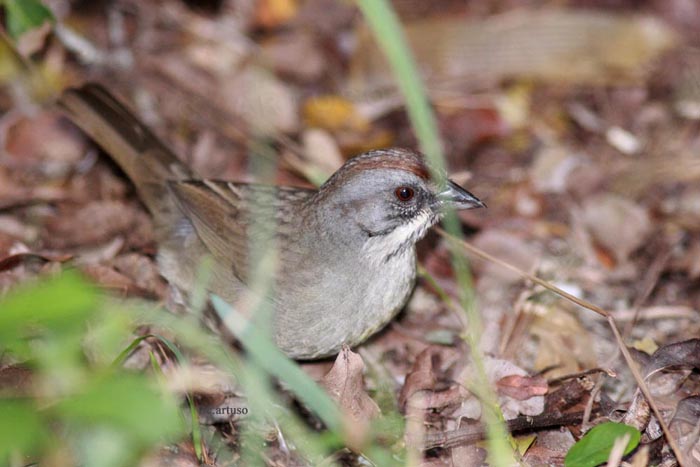
The intriguing Zapata Sparrow (a.k.a Cuban Sparrow) is a Cuban endemic Endangered species with a patchy distribution and also belongs to a monotypic genus (do you sense a pattern?)! There really are a lot of unique birds in Cuba! This species though is one of the most fascinating of all as their scientific name, Torreornis inexpectata, attests. The three distinct subspecies in Zapata Swamp (inexpectata), Cayo Coco (varonai), and Guantánamo province (sigmani) look rather different. Here the paler Cayo Coco race (first photo) that occurs mostly in dry scrub is contrasted with the yellowier Zapata race that occurs in sawgrass marshes (the eastern race is said to occur in thorn scrub)…. How’s that for ecological distinction – really makes you want to do genetic work! Although the population in the Zapata Swamp appears relatively stable, the other two populations are said to be in steep decline and habitat loss poses a major threat.

The Red-shouldered Blackbird may look an awful lot like Red-winged Blackbird but this is a Cuban endemic and, yet again one with a rather patchy distribution (only in western Cuba) and really very different from Red-winged Blackbird in terms of behaviour. I found them to be quite skulky and required work to see in the extensive sawgrass areas with scattered shrubs of the Zapata swamp.


The Greater Antillean Grackle is widespread and common and on several Caribbean islands – like so many grackles you have to look closely to appreciate their sheen!

The Cuban Oriole (Icterus melanopsis) was only recently split from the Greater Antillean Oriole (I. dominicensis, now separated as Hispaniolan Oriole) which had, prior to that, been split from the Black-cowled Oriole (I. prosthemelas)! Cuba loves to keep you on your toes…


This is not all the endemic we saw but that is about as many photos as I can squeeze into one post. As I mentioned at the beginning, click on the first image to view as a slideshow… Hope you enjoy this little sample of Cuba’s unique and imperiled avifauna!