Saturday, January 17, 2015

Tanager dreamin’ on such a winter’s day!

Just because we don’t have any tanagers in Canada anymore (the Piranga genus that includes species like Scarlet Tanager is now considered to belong to the family Cardinalidae) and because it is -30°C and blanketed in snow, I decided to share a splash on colour with some of the MANY tanagers (family Thraupidae) that have brightened my Neotropical haunts. I tried to pick 50 species that represented the diversity of the family (currently 374 species in 97 genera), although that wasn’t easy! I hope you are sitting down—this could be overload so I will add photos approximately 10 at a time over the course of this week!

Beryl-spangled Tanager (Tangara nigroviridis)
The seemingly electric colour of the genus Tanagara tanagers, such as this Beryl-spangled Tanager, have bedazzled many an observer. A good mixed-species flock of these gems feels like a kaleidoscope exploding in your binoculars!


Burnished-buff Tanager (Tangara cayana)
Possibly the best named tanager, this male Burnished-buff Tanager sure flexes some bicep colour!


Paradise Tanager (Tangara chilensis)
I missed the bright red rump in this photo but even still you can’t miss the Paradise Tanager!


Brassy-breasted Tanager (Tangara desmaresti)
This beauty is a Brazilian endemic from the southeastern Atlantic forest.


Golden Tanager (Tangara arthus)
Not so mellow yellow!


Saffron-crowned Tanager (Tangara xanthocephala)
Sheer elegance!


Bay-headed Tanager (Tangara gyrola)
The Santa Marta endemic subspecies is very green (other subspecies have blue underparts).


Scrub Tanager (Tangara vitriolina)
There’s no vitriol when you see this tanager! The Latin species name describes the colour, deriving from “vitriolium” referring to suphates such as copper sulphate (>“vitrium” (glass)).  Note how this tanager is feeding on an insect/bug.


Blue-necked Tanager (Tangara cyanicollis)
A gem in the rain, here demonstrating the genus’s frugivorous side.


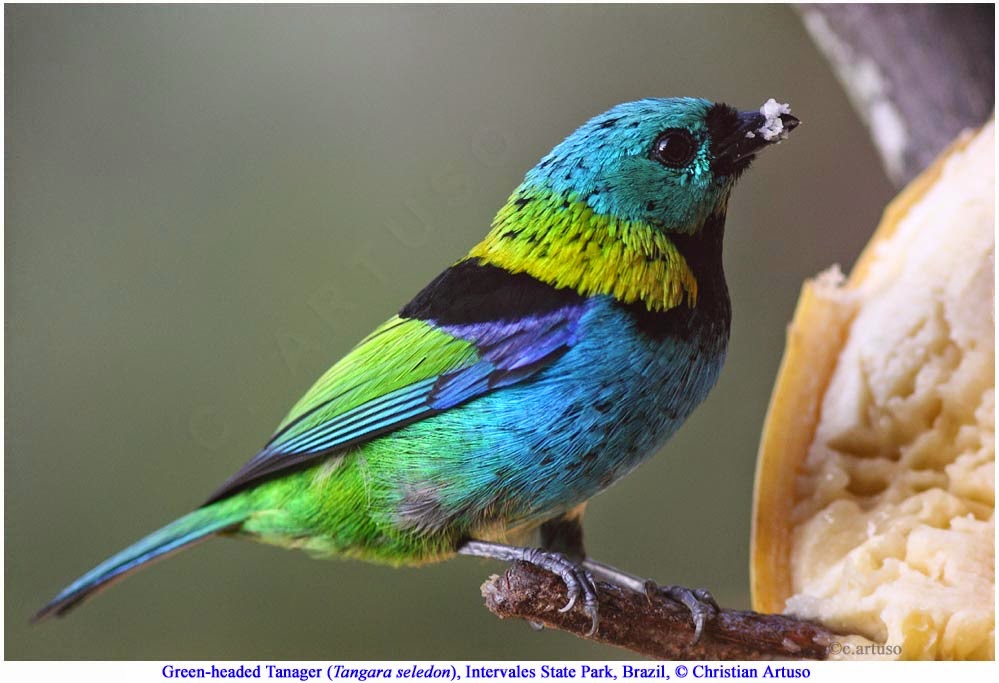
Green-headed Tanager (Tangara seledon)
These tanagers are sometimes attracted to fruit feeders allowing one to gawk... 


Swallow Tanager (Tersina viridis)
The unique Swallow Tanager is in a genus all of their own (this is a male, females are a delightful green).


Grass-green Tanager (Chlorornis riefferii)
Personally, I’d go with “canopy-green”!


Multicolored Tanager (Chlorochrysa nitidissima)
For such a colourful bird, the Multicolored Tanager is hard to find in the canopy. This range-restricted Colombian endemic is considered globally Vulnerable..


Orange-eared Tanager (Chlorochrysa calliparaea)
Another amazingly brilliant Chlorochrysa that lights up the forest (Alas, I have never managed to photograph them well).


Black-capped Hemispingus (Hemispingus atropileus)
A little less vibrant but very classy, the Hemispingus are also tanagers.


Rufous-chested Tanager (Thlypopsis ornata) 
May look like a warbler but this little gem is a high elevation tanager!


Hooded Mountain Tanager (Buthraupis montana)
The so-called “mountain tanagers” make high elevation birding a treat. Here is the large and beautiful Hooded Mountain Tanager of the high Andes.


Lacrimose Mountain Tanager (Anisognathus lacrymosus)
So named for the “teardrop” marking behind the eye, the Lacrimose Mountain Tanager has a rather unique orange colour in my opinion.


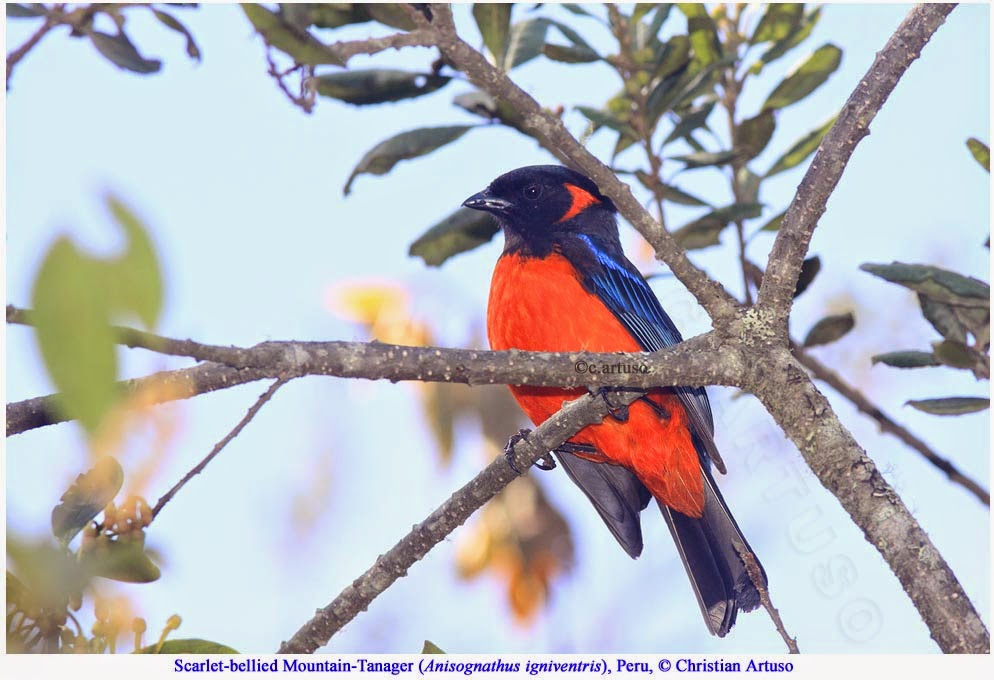
Scarlet-bellied Mountain Tanager (Anisognathus igniventris)
Studies have shown that nine out of ten birders run out of adjectives before they lower their binoculars on a Scarlet-bellied Mountain Tanager!

Blue-winged Mountain Tanager (Anisognathus somptuosus)
The Blue-winged Mountain Tanager needs no introduction as a very common species of the montane mixed-species flocks but “somptuosus” is an understatement!


Black-chinned Mountain Tanager (Anisognathus notabilis)
The range restricted Chocó endemic Black-chinned Mountain Tanager is a lot harder to find than the former species (though similar in appearance).


Golden-collared Tanager (Iridosornis jelskii)
Another truly extraordinary beauty of the high Andes! These tanagers seem to hit you where it hurts when you are already low on oxygen!


Blue-capped Tanager (Thraupis cyanocephala)
The Blue-capped Tanager is another tanager of mid to high elevations.


Blue-grey Tanager (Thraupis episcopus)
Perhaps one of the most widespread and common tanager species.


Golden-chevroned Tanager (Thraupis ornata)
Another endemic of Brazil’s Atlantic forest.


Brazilian Tanager (Ramphocelus bresilius)
Switching from blue to red… the Ramphocelus tanagers, like this Brazilian Tanager, have some extraordinarily brilliant shades of reds. This male also impressed me with his twinkle toes.


Crimson-collared Tanager (Ramphocelus sanguinolentus)
The Crimson-collared Tanager is another brilliant Ramphocelus tanager but with a little less red...  just don’t mistake them for a bishop or a cardinal!


Flame-rumped Tanager (Ramphocelus flammigerus)
In the Flame-rumped Tanager and a few other Ramphocelus the brilliant splash of colour is confined to the rump.


Lemon-rumped Tanager (Ramphocelus icteronotus)
The Lemon-rumped Tanager replaces red with yellow and was formerly considered conspecific with Flame-rumped Tanager.


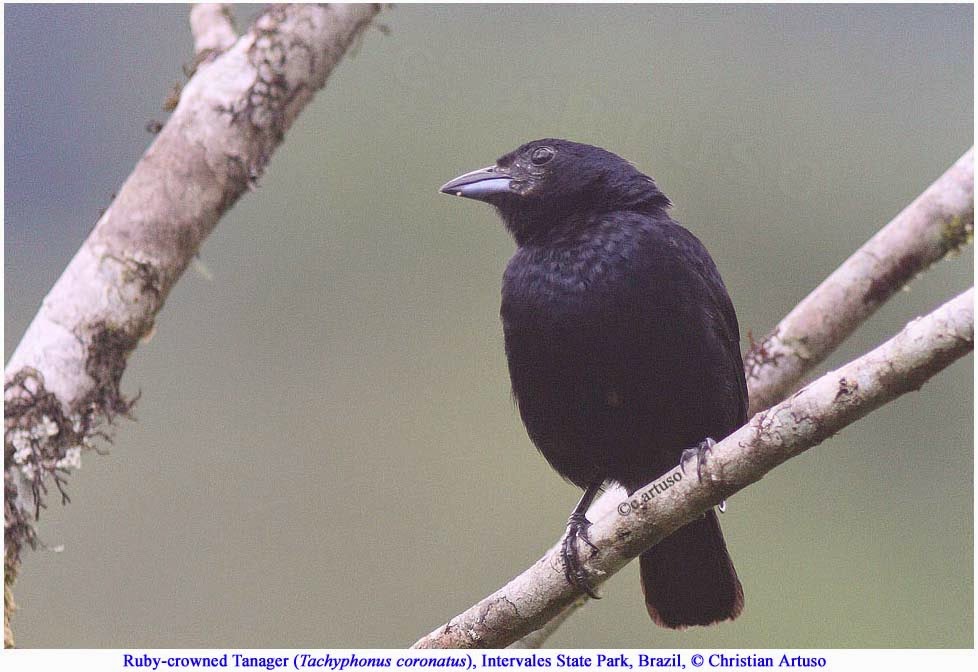
Ruby-crowned Tanager (Tachyphonus coronatus)
Unless you see the red crown spot of the Ruby-crowned Tanager you could easily be forgiven for mistaking them for an icterid.


Flame-crested Tanager (Tachyphonus cristatus)
The Flame-crested Tanager replaces a red crown with a red crest!


Fawn-breasted Tanager (Pipraeidea melanonota)
The Fawn-breasted Tanager is now placed in their own genus. Tanagers also eat invertebrates as you can see here!


Magpie Tanager (Cissopis leverianus)
Who needs colour when you can be this classy in black and white!


Brown Tanager (Orchesticus abeillei)
The unique (monotypic) Brown Tanager showing the family’s more sombre side.


Rufous-browed Conebill (Conirostrum rufum)
The tanager family is actually remarkable large and diverse (374 species in 97 genera by current IOC taxonomy). Many tanagers go by other names and their diet can be primarily frugivorous, insectivorous or granivorous. Two largely insectivorous genera of tanager are referred to as conebills for obvious reasons. This Rufous-browed Conebill demonstrates how the cone-shaped bill is used.


Giant Conebill (Oreomanes fraseri)
The unique Giant Conebill (monotypic genus) is a denizen of the high elevation Polylepis forests and is listed as Near-threatened because of the high degree of habitat loss and fragmentation in this unique woodland type. This photo also gives a little glimpse at the gnarled beauty of Polylepis.


Bay-chested Warbling-Finch (Poospiza thoracica)
The warbling-finches are tanagers that feed on both invertebrates and fruit.


Cuban Grassquit (Tiaris canorus)
Some readers may be surprised to learn that there are some tanagers that are seed eaters with very finch-like bills (may also east small fruits). This includes the Tiaris grassquits like this magnificent Cuban endemic.


Plain-coloured Seedeater (Catamenia inornata)
They may look more like finches but the “seedeaters” are tanagers too! (yes, I know it is hard to believe)


Saffron Finch (Sicalis flaveola)
No, I am not kidding, these so-called “finches” (and certainly they are finch look-alikes) are really tanagers! If you’re just wild about saffron, this is a bird you’ve got to see!


Chestnut-bellied Seed-finch (Oryzoborus angolensis), female. 
No prizes for guessing what this tanager eats!


Wedge-tailed Grass Finch (Emberizoides herbicola) and Great Pampa Finch (Embernagra platensis)
Just in case you though all tanagers were forest birds, here are two seed-eating tanagers of grassland and shrubland in a single photo.


Red Pileated Finch (Coryphospingus cucullatus)
Also called the Red-crested Finch, this is yet another “unexpected” tanager in a genus with only two species. This is a poor photo but I felt this species should be included in this overview.


Red-capped Cardinal (Paroaria gularis)
Ironically (especially since the genus Piranga which goes by the common English name of tanager, as in Scarlet Tanager and Summer Tanager and others, has now been determined to belong to the family Cardinalidae), some real tanagers in the genus Paroaria go by the common English name of “Cardinal”. These recent taxonomic changes have certainly made the nomenclature very confusing. This Red-capped Cardinal is trying to pick a fight with their arch-nemesis!


Black Flowerpiercer (Diglossa humeralis)
Some tanagers are nectar specialists and have a hooked bill tip that enables them to pierce flowers and extract nectar. This Black Flowerpiercer demonstrates the unusual bill shape.


Masked Flowerpiercer (Diglossa cyanea)
This Masked Flowerpiercer shows how the bill tip is used in foraging. This method is less likely to pollinate plants than the more “straightforward” feeding style of hummingbirds but the flowerpiercers may still transport some pollen.


Red-legged Honeycreeper (Cyanerpes cyaneus)
As their name suggests, the honeycreepers are tanagers with a penchant for nectar. They also pack a lot of colour. This is a male Red-legged Honeycreeper.


Green Honeycreeper (Chlorophanes spiza)
A male Green Honeycreeper—widespread and unmistakable!
Add caption


Yellow-bellied Dacnis (Dacnis flaviventer)
Dacnis are a genus of small and stunning canopy-dwelling tanagers, mostly from lower elevations. When someone calls “Dacnis!” they will not be ignored (by other birders at least)!


Western Spindalis (Spindalis zena)
Spindalis is a Caribbean endemic genus that packs a lot of punch! This is a male Western Spindalis from Cuba.

I hope you enjoyed this glimpse into this incredible family of songbirds.

Sunday, January 4, 2015

Why The Woodpecker Lost a Toe

I often get asked why the three-toed woodpeckers have only three toes. Here is my best attempt at explanation for why the woodpecker lost a toe (first taking a big step back). The zygodactyl foot of woodpeckers has two toes forward and two toes back (first and fourth toes). This arrangement is excellent for gripping branches and is found in other arboreal bird families such as parrots, cuckoos, and owls. This arrangement also helps woodpeckers to brace themselves on vertical tree limbs. This photo of a preening male Golden-fronted Woodpecker (Melanerpes aurifrons) from Yucatan, Mexico shows the zygodactyl arrangement (apologies for the motion blur).


This next photo of a female Red-rumped Woodpecker (Veniliornis kirkii) from Colombia shows how the zygodactyl arrangement is used for gripping. It is very rare to see a woodpecker positioned upside-down like this and that is because they have other climbing tools at their disposal.


This male Cuban Green Woodpecker (Xiphidiopicus percussus) shows a much more typical woodpecker posture. In addition to the four-toed grip of the feet, the stiffened,pointed central tail feathers brace against the trunk providing further support from below. You can also see one of the woodpeckers’ other amazing adaptations, the long tongue, that enables them to probe for wood-boring larvae.


The toes are not completely fixed in the position relative to the leg and have a little maneuverability that also helps as shown by these Great Slaty Woodpeckers (Mulleripicus pulverulentus) from Palawan in the Philippines.


The zygodactyl toe arrangement has such a great advantage for the woodpecker tree-climbing lifestyle that you might be surprised to learn that not all woodpeckers have four toes. Some woodpeckers have lost a toe along their evolutionary road, which begs the eternal question of just why did the woodpecker lose a toe?  You could perhaps divide up the woodpecker family in the following way:

A)  Small species with four toes and a rounded or square tail (not stiffened). This includes the piculets and the larger but mostly ground-dwelling wrynecks.
B)  Medium-sized species with four toes and a pointed, stiffened tail
C)  Medium-sized species with three toes and a pointed, stiffened tail
D)  Large species with four toes and a pointed, stiffened tail

The differences in the woodpecker family are fascinating. The differences boils down to how much they weigh (how they support that weight while conducting their head-banging lifestyle) and how they forage. Let us look at a few examples from each group to illustrate:

Group A) This female Rufous Piculet (Sasia abnormis) from Malaysia demonstrates the typical stance of the smallest woodpeckers, the piculets. The Piculets are so small that they don’t need to support their weight with their tails and often grip horizontal branches in the manner shown here.


Group A) This male Mottled Piculet (Picumnus nebulosus) from southern Brazil shows how piculets can grip vertical branches and trunks without using their tail as a brace.


Group D) Large woodpeckers need all the help they can get to support their weight and still be able to pound a tree trunk. They do this with a combination of the zygodactyl foot and their stiffened tail as shown by this male Scaly-bellied Woodpecker (Picus squamatus) from India.


Group D) Nonetheless, even among large woodpeckers there are some subtle differences. This photo composite shows two of the largest genera of woodpeckers, Dryocopus and Campephilus. The largest woodpeckers in the world, the Imperial Woodpecker and Ivory-billed Woodpecker (both now sadly believed to be extinct) belong to the genus Campephilus. Being so large, they have developed an extra trick to support their weight. These large woodpeckers use their four toes and their stiffened tail feathers but they also spread their trasometatarsus wide with the joint resting against the trunk as an extra support. In this photo composite, you can see this is the male Crimson-crested Woodpecker (Campephilus melanoleucos) on top and the male Powerful Woodpecker (Campephilus pollens) on the right (notice how the legs are angled wide of the bird’s body.  Although they are almost as large, Dryocopus woodpeckers don’t do this, having a more typical “straight” stance as shown by the female Lineated Woodpecker (Dryocopus lineatus) on the bottom of this photo composite.


These differences seem straightforward enough but it is amongst the medium-sized woodpeckers that things get really interesting. Let us first compare a coupe of similar sized woodpeckers.

Group B) This male Yellow-bellied Sapsucker (Sphyrapicus varius) is a typical medium sized woodpecker in terms of their stance—four-toed grip plus tail support.


Group C) These Pale-headed Woodpeckers (Gecinulus grantia) (male on right with pink crown spot) are slightly larger than the sapsucker above but apparently still small enough to have just three toes per foot as shown in these photos. This may have to do with the bamboo forests they call home or their style of foraging. The key thing is that at this size they are capable of supporting their weight with just three toes plus tail. The three-toed adaptation occurs in several genera and could have evolved more than once.


Group C) There is another group of medium-sized three-toed woodpeckers that have a particularly interesting foraging style, viz. the Black-backed, American Three-toed and Eurasian Three-toed Woodpeckers. I had often wondered what would cause their common ancestor to lose a toe. I only first started down the road of figuring our why when photographing them foraging. Normally, when one photographs a woodpecker feeding there are some shots where the head and neck are blurred that you throw away. Take a look at the blurred photo of a female Black-backed Woodpecker (Picoides arcticus) below and see if you can spot the difference that got me thinking… and reading!


What you may notice in that photo that it is not just the head that is blurred but also the wing tips! That observation is key. When these three woodpecker species forage they “scale” the bark of the tree away, often leaving a visible trace of their handiwork. To do this, they are striking the tree and flicking the bark away, effectively two different motions in one smooth stroke. The ingenious three-toed design functions a bit like a fulcrum with the strong backward-pointing toe effectively pushing the bird off the tree and thrusting them into the stroke with the whole body, followed by the flicking action of the bill on contact. This gives them a surprising amount of force with their deceptively soft tapping and facilitates bark removal by striking and flicking in the same stroke. Whereas other woodpeckers are mostly striking with their head and upper body, these three put their whole body into the stroke and the three-toed design “frees” them up to do just that. As a result the lower part of the body is also in motion during the stroke and the wing tips appear blurred.

This photo of a male Black-backed Woodpecker shows you how strong the rear toe is. As you can also see, they still use their tail as a prop and are similar in other anatomical aspects to their congenitors in Picoides. They also have reinforced skulls and super long tongues like other woodpeckers.


This photo of a male American Three-toed Woodpecker (Picoides dorsalis), shows the end of the sideways flicking motion and the heavily scaled tree trunk as a result. You can see some of the points of impact where the bill hit the trunk before the flick too.


The rear toe can move around to the side when the bird is moving or resting as this male American Three-toed Woodpecker shows. He is using his tongue after flicking a small area of bark clear—listening and probing for food.


So why did they lose a toe? All the better to whack trees with! (in some cases)

Wednesday, December 17, 2014

SPECIAL CONCERN

This number of species listed by COSEWIC (Committee on the Status of Endangered Wildlife in Canada) that occur in Manitoba continues to grow. At the spring 2014 meeting, Western Grebe (Aechmophorus occidentalis) was added as Special Concern and at the fall 2014 meeting Red-necked Phalarope (Phalaropus lobatus) was also added as Special Concern. With so many species continuing to experience declines, the ever-growing list is cause for ever-growing concern. I took both these photos in Manitoba. 


See also: http://www.registrelep-sararegistry.gc.ca/species/speciesDetails_e.cfm?sid=1253 and http://www.cosewic.gc.ca/eng/sct1/searchdetail_e.cfm?id=1278&StartRow=151&boxStatus=2%2C3%2C4%2C5%2C7&boxTaxonomic=All&location=All&change=All&board=All&commonName&scienceName&returnFlag=0&Page=16

Sunday, December 7, 2014

SIGNS OF STRESS IN OWLS


I am going to share a few pointers based on my observations made over the years on signs of stress that owls may reveal. Please note that it is hard to interpret what an owl is doing from a single photo so do not take these pointers as absolutes; they need to be used in trying to assess the whole picture as much as possible. Context is often key. The intention here is to get people to think about looking for behavioural clues when they are lucky enough to observe an owl in the wild. Furthermore, there are some situations where the observer is not the cause of stress as a few of the following examples will show. I have tried to talk about the features one by one below, but also remember to look for the combination of different clues and overall behaviour. 

VOCAL CLUES:   
 You can learn a lot about an owl by listening to their song and calls. Owls of course signal to each other and other animals vocally.  Owls have a repertoire of calls, in addition to their “song” (song is used in territorial defense and advertising and is what we humans hear most often). Imagine a situation where a nest predator such as a raccoon is approaching the cavity nest of an Eastern Screech-Owl – obviously a stressful situation. The screech-owls will make a few single-note calls at the first sign of danger (quite unlike their A-song or B-song). These may proceed to a series of 3, 4 or 5 single notes, often on a descending pitch: oooh-oooh-oooh-oooh.  I have sometimes seen human observers ignore these subtle and soft calls. I even once had to intervene when a nonchalant dog walker was about to be whacked in the head.  If the danger persists, the single note calls will sound increasingly agitated and start to sound more like a bark. Barks may be accompanied by whinny calls and aggressive rattle calls, especially as the owl switches from a defensive to an aggressive position. Some owls give a very cat-like call as well. If the perceived intrusion persists, the screech-owl starts clacking its bill and shortly after may strike or dive-bomb the intruder. If you notice any vocal behaviour along the gradated scale, and if you suspect that you are the perceived intruder, then back off sooner rather than later. If you hear bill clacking, you’re already at the high alert stage. 

VISUAL CLUES:
1)  The Eastern Screech-Owl (Winnipeg, Manitoba) in this photo is highly stressed. Before you read on, take a moment to look at the photo for any clues. This bird is in the situation I described above – a raccoon approaching their nest. At this point, the male has signaled to the female with a few single note calls and she has come off the nest. About 5 minutes later, in what looked to me like a coordinated attack, the male flew in front of the raccoon and then the female whacked the raccoon on the back of the head with her talons—a bold and risky manouevre that may have saved the lives of their 5 nestlings. I know this owl is stressed from the context but there are a couple of visual clues in the photo too. Note the fairly stiff and erect posture of this owl with the ear tufts close to fully extended (not complete because this is fairly early on in the proceedings – I put my camera away after this so I could observe). This is sometimes called the “tall thin posture” and owls use it in a variety of contexts including as a way to make themselves look less visible to a potential threat but also in direct response to some threats. If you are observing an owl and notice the body posture change to become more elongated (“tall and thin”) then I would suggest you back up and give the owl more space. On species with ear-tufts like this, the position of the ear-tufts is an added clue. The tall thin posture doesn’t always mean the same thing but you should be on the look out for it.


2) This roosting Eastern Screech-Owl (Winnipeg, Manitoba) is also in the tall thin posture. This bird is trying to avoid detection by some noisy pedestrians on a popular suburban trail. You can see how stretched the body looks and even though the ear-tufts are partially hidden, you can also see that they are raised. This owl is using another trick too – “squinting”. Squinting refers to the practice of almost closing the eyelids so that the owl’s eyes are barely visible but still permitting the owl to see. This seems to be most prevalent in species with yellow eyes (perhaps because yellow is an obvious break from their otherwise brown/grey colouration) but it is not exclusive to those species. It is presumed that this behaviour is an attempt to avoid detection by a potential threat. This is subtly different from having the eyes closed (owls are certainly not opposed to closing their eyes for a daytime snooze).  If you see an owl with open eyes and notice that the eyes appear to be closing or squinting then the owl has seen you. It is wisest to give the owl some space. Never risk scaring an owl from a roost site in the day as this costs them energy and may expose them to mobbing. This may make them vulnerable (especially small owls).


3)   This female Great Gray Owl is highly agitated by an intrusion near their nest site that she perceives as a threat to her chicks (Great Gray Owls on the nest must be vigilant for black bear, ravens and other threats). Great Gray Owls don’t have ear-tufts but you can see one key sign of stress in this bird. Look closely at the rictal bristles (the long thin feathers at the base of the bill). These feathers normally fall over the nostrils to protect them from dust but they are raised here leaving the nostrils clearly visible. This clue may be subtle and is not always easy to see under field conditions, but it is a key indicator! If you see this behaviour, back off immediately! An owl in this state of alert may seem to be “frozen” and may remain motionless for quite a long period but never mistake that lack of action for tolerance—this owl is not happy and could even choose to attack. 


4)   I was walking on a narrow trail in eastern Manitoba when I came around a sharp bend and surprised this Great Gray Owl perched on a fairly low branch above the trail. We were both surprised as we found ourselves suddenly face to face. Since I had my camera in my hands I took this photo (two versions: first full and then heavily cropped) as I backed up. In fact I backed up a fair distance and retraced my route to avoid causing the owl to move. This owl’s head has turned 180 degrees and once again you can see the raised rictal bristles. This told me immediately that I had startled the owl. I was lucky on this occasion as the owl didn’t leave the perch and seemed to settle back down once I had backed away.  

Here is a crop of the same photo:


5)   Though some may assume otherwise, this Boreal Owl in southeastern Manitoba (photo heavily cropped) is actually not stressed. The rictal bristles are relaxed on this bird and the posture is “normal” (the owl’s leaning forward has to do with focusing here and is not a sign of aggression in this case). Basically, this bird is hunting—listening and looking at a chickadee in fact. A few minutes after I took this photo, this owl flew out and tried to capture that chickadee but failed. A Boreal Owl would not normally attempt to catch a chickadee in daylight so this bird must have been fairly hungry to attempt it. The posture of this owl shows intense focus. The owl is leaning forward and positioning their facial disk in order to best pinpoint their target. In this case the owl was following the chickadee visually but owls also frequently move their head to facilitate pinpointing sound acoustically (especially those species with asymmetrical ears). 


6)   This Snowy Owl (Oak Hammock Marsh, Manitoba) is stressed and it isn’t hard to figure out that the cause of this stress is aerial—a Peregrine Falcon to be precise (probably stressful for most birds). In the case, because the threat is from above, the posture is very revealing.  The Snowy Owl appears recoiled like a snake before striking… any animal that recoils defensively in this way is usually getting prepared to turn defence into attack. This Snowy is prepared to do a full back flip, talons pointed skyward, to ward off the stoop of the falcon. Snowies are of course a Bubo species and very closely related to the Great Horned Owl. They have relictual ear-tufts which even show occasionally in these types of circumstances (other round-headed owls can also raise the feathers on their head or raise the top of the facial disk). You won’t see this same posture in response to an intruder on the ground but there are still a few clues to look for such as the raised mantle feathers. Notice this Snowy Owl’s “fluffed” feathers and how the wings are held slightly away from the body. This can be a sign of a defensive posture and a way that the owl attempts to make themself look bigger to the intruder. Look also at the eye of this bird - - the constricted pupils could be another sign of this type of aggressive posturing (stress can cause pupils to constrict, dilate or "flash" between the two). When you see this type of combination, take it as a clear signal to back off. If you see these signs you know that something is bothering the owl. 


7)   This Barn Owl (Yorkshire, U.K) is stressed for another reason…. OK, just kidding!


Looking for the combination of the above postures and vocalizations may help you in your observations. Thank you for your time and patience and thank you for being observant and considering the best interests of the birds you observe!  
 
Nature Blog Network Birdwatching Blogs - BlogCatalog Blog Directory Fatbirder's Top 500 Birding Websites