Note to self: here is the year that was...
2010 Year list = 1018 species seen (↑) from 4 countries, of which
* 580 species from Peru was a huge boost
* ~375 species were lifers
* First bird of the year = Bearded Screech-Owl
* Last bird of the year = Black-throated Blue Warbler
On the way, I:
* saw 2 species in Canada for the first time (=) (Curve-billed Thrasher & Yellow-throated Warbler)
* saw 4 species in Manitoba for the first time (↑) (Rock Wren, Lazuli Bunting, Curve-billed Thrasher & Yellow-throated Warbler)
* submitted 5654 records for 254 Breeding Bird Atlas squares
* completed 383 point counts
* did 1 BBS (=), and co-lead 1 CBC (=)
* submitted 2004 ebird checklists (↑) (5th highest in Canada)
* published one peer-reviewed article and several other articles (↓)
Lots of room for improvement in 2001, but hey, since the first bird of the year was a Barn Owl, it’s gotta be a good year!
Thursday, January 6, 2011

Saturday, January 1, 2011
ID Challenge #2
HAPPY NEW YEAR EVERYONE!!
And here, to make everyone feel great, is just what you wanted for New Year - an ID challenge!! See if you can identify the bird in this photo without looking at the few clues below:

Clue 1: I am a common Nearctic (North American) passerine,
Clue 2: This photo is seasonally inappropriate,
Clue 3: Once lumped but maybe soon to be re-split.
Happy New Year!!
And here, to make everyone feel great, is just what you wanted for New Year - an ID challenge!! See if you can identify the bird in this photo without looking at the few clues below:

Clue 1: I am a common Nearctic (North American) passerine,
Clue 2: This photo is seasonally inappropriate,
Clue 3: Once lumped but maybe soon to be re-split.
Happy New Year!!
Tuesday, December 28, 2010
Peru: Part 4 - Descent into the Elfin Forest
As you descend eastward from the altiplano and the sparse vegetation of the high Andes, you notice the humidity increasing and the vegetation becomes covered in moss. Around 3000 m ASL you come into the habitat type often referred to as “elfin forest”. Trees are stunted and gnarled at this high elevation. In a sense it feel a bit like being at treeline in the northern hemisphere because, at least in terms of plant growth, moving up a mountain side can be similar to moving north, although in the case of the elfin forests, the cold winds and nutrient poor soils are apparently the major factor in determining the extent of plant growth.
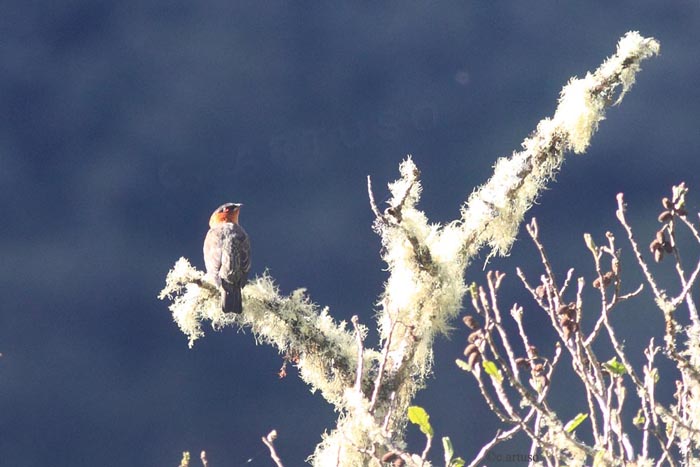
I wish I had managed some photos of the beautiful elfin forest but every time I was in this habitat type it was extremely foggy. So I thought I would start this post with this photo of a Red-crested Cotinga sitting atop a high elevation shrub with the cloud-covered Andean slope looming in the background.

And here is a closer look at this impressive bird. The cotingas are a fascinating, mostly-frugivorous Neotropical family (recall the Peruvian Plantcutter from my post on the dry forest). The Red-crested Cotinga may not be quite as colourful as some of the all blue members of this family, or some of the mostly green members (the fruiteaters), or some of the large and bizarre cotingids we will meet later in this series like umbrellabirds and cock-of-the-rock, but they are sleek and stylish in the grey plumage with erectable red crest. As with many cotingas, they like to sit on very high perches. On this particular occasion (unlike so many of my break-neck experiences trying to photograph cotingas), I was on a ridge and so didn’t have to look up very high into the small treetops to get his photo.
A little lower in elevation one meets the Red-crested Cotinga’s cousin, the Chestnut-crested Cotinga. This first photo shows this cotinga, once again, perched high in the canopy. On this occasion I was looking out across a forested valley. You will notice the heavily moss-laden branches in this humid habitat. The second photo shows the plumage to better effect; however, in both cases, the crest us held flat and so it is a little bit difficult to see the feature that earned this species their name.

Sticking with the suboscine passerines for a while, here is one of my favourite ovenbirds (family Furnariidae), creeping around the mossy branches, the Pearled Treerunner. Like the vast majority of their family they are clad in cryptic browns and soft reddish-browns, but the exceptional distinctive “pearl” markings make this bird extremely attractive. I particularly appreciate the white teardrop-shaped spots bordered in black of the underparts (only a few are visible in this photo). This species creeps along the moss-covered branches of the elfin forest, sometimes moving in mixed species flocks. You may notice the stiff, pointed tail feathers of this bird. They can use their stiff tail to brace themselves when necessary (a bit like a woodpecker), an adaptation that can make them seem like a woodcreeper, even though they are not (the woodcreepers are also suboscines but usually placed in their own family, Dendrocolaptidae; however, due to recent genetic evidence many authors now place them within the much larger Furnariidae family).

The Andes are home to a confusing array of small, brown, long-tailed ovenbirds – LBJs with long tails (the term LBJ stands for “little brown job” and usually refers to birds with nondescript brown plumage that are difficult to identify). In the Andes, you have the tit-spinetails, the thistletails, the canasteros (see previous post), the spinetails, the softtails, the thornbirds and others, all of which can have you scratching your head about how to separate one species from another… This bird is a Puna Thistletail. You might think that the sharp little red bib might make identification easy but not so fast – several species of thistletail and canastero show this feature. This little bird was probing the underside of fern fronds in the understorey and allowed me to sneak up to within a few metres away to try and find a window of photographic opportunity.

The elfin forest also hosts several flycatchers including a few species of chat-tyrants, small and rather colourful flycatchers that are mostly found in humid forests and relatively high elevations. They all have a broad supercilium that seems to enhance their character (maybe the way it sets off the eye). Here a Rufous-breasted Chat-Tyrant takes advantage of the frequent drizzle for a quick shower.


And here is one perched on some roadside rocks, looking for a prey on or near the ground (as they so often do).

One of the most common birds is this habitat (and elsewhere) is the Great Thrush. This large and handsome thrush is a familiar companion in the Andes, even in towns and cities (above about 2500 m ASL).

The dense vegetation affords plenty of hiding places to the skulking Mountain Wren; however, sometimes their curiosity gets the better of them (this one responded to pishing).

One of the real highlights of Andean birding (and elsewhere in the tropics) is the joy of bumping into a mixed species flocks. Suddenly, the trees are alive with birds moving vaguely together, scaring up bugs as they move and capitalizing on their loose group formation to ensure that no tasty morsel is overlooked. Sometimes these flocks contain just a few species, sometimes you can have 20 or more species moving together, in which case, it becomes a mad rush to try and find and identify everybody in the flock before they move on. In the Andes, most mixed flocks will contain several species of tanagers.
Before I start to share some photos of the wonderful Andean tanagers, I feel it is worth embarking on a biogeographical tangent. The tanagers are a truly extraordinary group and more diverse than you might realize; for example, some are extremely colourful, others not at all; some are sexually dimorphic, others not so; some are primarily fruit eaters, some nectar eaters; some primarily seed eaters, some insect eaters and many are omnivores. The fact that they are nine-primaried oscine passerines (not suboscines) would suggest that they probably did not first evolve in South America (the nine-primaried oscines are prevalent in North America) but they are extraordinarily diverse in South America. The tanagers have received a fair bit of genetic attention recently and those readers who follow an AOU (American Ornithologists Union) taxonomy will know that the Piranga “tanagers” (e.g. Scarlet Tanager, Western Tanager) are no longer considered tanagers but rather more closely relate to cardinals. As result of all this genetic attention, some authors such as Burns (1997) propose a Caribbean origin to the tanager family. If true, when they reached the South America, they underwent a radical radiation, i.e. quickly evolved into hundreds of different species occupying different ecological niches. I find it mind-boggling to think of this extraordinary evolution; for example, there are over 100 species of tanager in Peru alone! The following is just a smattering of the tanagers you can enjoy watching in mixed flocks at high elevation (the species composition of tanager flocks changes as you change elevation).
Most of the “mountain-tanager” group are confined to the Andes, which suggests that the geologic upheaval that occurred relatively recently (geologically speaking) in this region gave rise to speciation through processes such as the formation of barriers (e.g. mountain folding) that split gene pools and gave rise to allopatric speciation (imagine a mountain chain being forced up and splitting a population of a given species in two). The Hooded Mountain-Tanager is one of the largest tanagers and a true gem of the high Andes. At 24 cm, this tanager is thrush-sized (roughly the same size as an American Robin or a Redwing) and is a whole load of colour in your binoculars! This photo was taken on a morning that was so foggy it seemed that the water drops were condensing on the birds’ feathers.

The Scarlet-bellied Mountain-Tanager needs no introductions… wowsers!!


Another beauty – the Blue-winged Mountain-Tanager…

The Golden-collared Tanager is yet another stunner that is easy to view as they feed on low fruits in the short elfin forest.

When the fog lifted, I caught a glimpse of the magnificent Blue-and-black Tanager (hey, at least they didn’t call them Black-and-blue Tanager). Some of the high elevation plants have a bluish-green hue so this vibrantly coloured bird can be harder to spot than you might think in a mixed-species flock.

This Rust-and-yellow Tanager is an immature bird that seems to be just starting to moult into adult plumage (the adult has a full rust-coloured head).

Enough tanagers for you? The flowerpiercers go by a different name but they are also a group of tanagers, some of which specialise in nectar feeding (though by no means the only ones). Their hooked bill can be used to poke a hole in the base of a flower and “rob” them of their nectar. This behaviour is likened to theft because this style of feeding means that they don’t act as pollinators for the plant (no pollen gets transferred to their feathers). Maybe the plants will evolve to change this seeming imbalance eventually… This is a Moustached Flowerpiercer feeding in a flowering bush.

And this is a Black-throated Flowerpiercer.

If you recall my point about traveling northward being somewhat similar to traveling up a mountainside, it may not surprise you to learn that North Americans will encounter some familiar species in the high Andes. Admittedly, not a lot and admittedly most of these are boreal migrants but some are resident here. This is a photo of none other than a Sharp-shinned Hawk! The plumage of the Andean birds is highly variable with some looking like the North American birds but others, like the one shown here, having a different underpart colouration; however, this is a Sharp-shinned (well, unless they split them) and they are just as at home in the high Andes as they are in the high latitudes of North America.

Next, we continue our descent and the trees get taller…
I wish I had managed some photos of the beautiful elfin forest but every time I was in this habitat type it was extremely foggy. So I thought I would start this post with this photo of a Red-crested Cotinga sitting atop a high elevation shrub with the cloud-covered Andean slope looming in the background.

And here is a closer look at this impressive bird. The cotingas are a fascinating, mostly-frugivorous Neotropical family (recall the Peruvian Plantcutter from my post on the dry forest). The Red-crested Cotinga may not be quite as colourful as some of the all blue members of this family, or some of the mostly green members (the fruiteaters), or some of the large and bizarre cotingids we will meet later in this series like umbrellabirds and cock-of-the-rock, but they are sleek and stylish in the grey plumage with erectable red crest. As with many cotingas, they like to sit on very high perches. On this particular occasion (unlike so many of my break-neck experiences trying to photograph cotingas), I was on a ridge and so didn’t have to look up very high into the small treetops to get his photo.

A little lower in elevation one meets the Red-crested Cotinga’s cousin, the Chestnut-crested Cotinga. This first photo shows this cotinga, once again, perched high in the canopy. On this occasion I was looking out across a forested valley. You will notice the heavily moss-laden branches in this humid habitat. The second photo shows the plumage to better effect; however, in both cases, the crest us held flat and so it is a little bit difficult to see the feature that earned this species their name.

Sticking with the suboscine passerines for a while, here is one of my favourite ovenbirds (family Furnariidae), creeping around the mossy branches, the Pearled Treerunner. Like the vast majority of their family they are clad in cryptic browns and soft reddish-browns, but the exceptional distinctive “pearl” markings make this bird extremely attractive. I particularly appreciate the white teardrop-shaped spots bordered in black of the underparts (only a few are visible in this photo). This species creeps along the moss-covered branches of the elfin forest, sometimes moving in mixed species flocks. You may notice the stiff, pointed tail feathers of this bird. They can use their stiff tail to brace themselves when necessary (a bit like a woodpecker), an adaptation that can make them seem like a woodcreeper, even though they are not (the woodcreepers are also suboscines but usually placed in their own family, Dendrocolaptidae; however, due to recent genetic evidence many authors now place them within the much larger Furnariidae family).

The Andes are home to a confusing array of small, brown, long-tailed ovenbirds – LBJs with long tails (the term LBJ stands for “little brown job” and usually refers to birds with nondescript brown plumage that are difficult to identify). In the Andes, you have the tit-spinetails, the thistletails, the canasteros (see previous post), the spinetails, the softtails, the thornbirds and others, all of which can have you scratching your head about how to separate one species from another… This bird is a Puna Thistletail. You might think that the sharp little red bib might make identification easy but not so fast – several species of thistletail and canastero show this feature. This little bird was probing the underside of fern fronds in the understorey and allowed me to sneak up to within a few metres away to try and find a window of photographic opportunity.

The elfin forest also hosts several flycatchers including a few species of chat-tyrants, small and rather colourful flycatchers that are mostly found in humid forests and relatively high elevations. They all have a broad supercilium that seems to enhance their character (maybe the way it sets off the eye). Here a Rufous-breasted Chat-Tyrant takes advantage of the frequent drizzle for a quick shower.


And here is one perched on some roadside rocks, looking for a prey on or near the ground (as they so often do).

One of the most common birds is this habitat (and elsewhere) is the Great Thrush. This large and handsome thrush is a familiar companion in the Andes, even in towns and cities (above about 2500 m ASL).

The dense vegetation affords plenty of hiding places to the skulking Mountain Wren; however, sometimes their curiosity gets the better of them (this one responded to pishing).

One of the real highlights of Andean birding (and elsewhere in the tropics) is the joy of bumping into a mixed species flocks. Suddenly, the trees are alive with birds moving vaguely together, scaring up bugs as they move and capitalizing on their loose group formation to ensure that no tasty morsel is overlooked. Sometimes these flocks contain just a few species, sometimes you can have 20 or more species moving together, in which case, it becomes a mad rush to try and find and identify everybody in the flock before they move on. In the Andes, most mixed flocks will contain several species of tanagers.
Before I start to share some photos of the wonderful Andean tanagers, I feel it is worth embarking on a biogeographical tangent. The tanagers are a truly extraordinary group and more diverse than you might realize; for example, some are extremely colourful, others not at all; some are sexually dimorphic, others not so; some are primarily fruit eaters, some nectar eaters; some primarily seed eaters, some insect eaters and many are omnivores. The fact that they are nine-primaried oscine passerines (not suboscines) would suggest that they probably did not first evolve in South America (the nine-primaried oscines are prevalent in North America) but they are extraordinarily diverse in South America. The tanagers have received a fair bit of genetic attention recently and those readers who follow an AOU (American Ornithologists Union) taxonomy will know that the Piranga “tanagers” (e.g. Scarlet Tanager, Western Tanager) are no longer considered tanagers but rather more closely relate to cardinals. As result of all this genetic attention, some authors such as Burns (1997) propose a Caribbean origin to the tanager family. If true, when they reached the South America, they underwent a radical radiation, i.e. quickly evolved into hundreds of different species occupying different ecological niches. I find it mind-boggling to think of this extraordinary evolution; for example, there are over 100 species of tanager in Peru alone! The following is just a smattering of the tanagers you can enjoy watching in mixed flocks at high elevation (the species composition of tanager flocks changes as you change elevation).
Most of the “mountain-tanager” group are confined to the Andes, which suggests that the geologic upheaval that occurred relatively recently (geologically speaking) in this region gave rise to speciation through processes such as the formation of barriers (e.g. mountain folding) that split gene pools and gave rise to allopatric speciation (imagine a mountain chain being forced up and splitting a population of a given species in two). The Hooded Mountain-Tanager is one of the largest tanagers and a true gem of the high Andes. At 24 cm, this tanager is thrush-sized (roughly the same size as an American Robin or a Redwing) and is a whole load of colour in your binoculars! This photo was taken on a morning that was so foggy it seemed that the water drops were condensing on the birds’ feathers.

The Scarlet-bellied Mountain-Tanager needs no introductions… wowsers!!


Another beauty – the Blue-winged Mountain-Tanager…

The Golden-collared Tanager is yet another stunner that is easy to view as they feed on low fruits in the short elfin forest.

When the fog lifted, I caught a glimpse of the magnificent Blue-and-black Tanager (hey, at least they didn’t call them Black-and-blue Tanager). Some of the high elevation plants have a bluish-green hue so this vibrantly coloured bird can be harder to spot than you might think in a mixed-species flock.

This Rust-and-yellow Tanager is an immature bird that seems to be just starting to moult into adult plumage (the adult has a full rust-coloured head).

Enough tanagers for you? The flowerpiercers go by a different name but they are also a group of tanagers, some of which specialise in nectar feeding (though by no means the only ones). Their hooked bill can be used to poke a hole in the base of a flower and “rob” them of their nectar. This behaviour is likened to theft because this style of feeding means that they don’t act as pollinators for the plant (no pollen gets transferred to their feathers). Maybe the plants will evolve to change this seeming imbalance eventually… This is a Moustached Flowerpiercer feeding in a flowering bush.

And this is a Black-throated Flowerpiercer.

If you recall my point about traveling northward being somewhat similar to traveling up a mountainside, it may not surprise you to learn that North Americans will encounter some familiar species in the high Andes. Admittedly, not a lot and admittedly most of these are boreal migrants but some are resident here. This is a photo of none other than a Sharp-shinned Hawk! The plumage of the Andean birds is highly variable with some looking like the North American birds but others, like the one shown here, having a different underpart colouration; however, this is a Sharp-shinned (well, unless they split them) and they are just as at home in the high Andes as they are in the high latitudes of North America.

Next, we continue our descent and the trees get taller…
Monday, December 20, 2010
Peru: Part 4 - High Elevation Wetlands
As you can see from the photo below (which was taken by my wife, Youn-Young Park, and the only photo in this post not taken by me), the valleys between ridges and the high plateaus of the Andes will gather water (even when there is little to go around) and create wetlands, some large some small. Some form expansive reed beds, whereas others have very little vegetation around them. A wide variety of species call these wetlands home.

Among the waterfowl of the high Andes is the distinctive Puna Teal, shown here taking off, which is quite common at large high elevation lakes. The Puna Teal is a relatively recent split from the similar-looking Silver Teal, who occurs further south.

The Speckled Teal was also recently split into two species, the Andean Teal (greyish bill) and the Yellow-billed Teal (yellow bill). No prizes for guessing which species this is…

This next photo shows just how bustling with life some of the high altitude marshes can be: in the foreground a pair of Yellow-billed Pintails and in the background a Puna Ibis stands alert while a Plumbeous Rail makes a dart across an open area. The Yellow-billed Pintail is superficially similar to the Yellow-billed Teal but is larger and has different shape, lacks the dark grayish head and a different underpart pattern.

Here you can see a Puna Ibis in flight. This bird is in basic (non-breeding) plumage. In breeding plumage (alternate plumage) the bill becomes red and the overall colour richer.

And here is a closer look at the distinctive Plumbeous Rail – pinkish legs and a lime green bill, what a colour combination!!

This juvenile Plumbeous Rail has not acquired the adult colour yet…

The Andes have given rise to the evolution of several interesting coot species. This is the Andean Coot (not quite as famous as their cousin the Giant Coot)

Wherever you find high altitude bogs, or relatively open marsh edges and other types of open grassy areas, including agricultural fields (a pasture in this case), there is a good chance of finding the subtly beautiful Andean Lapwing. These large shorebirds (like all lapwings) are related to plovers.

Boreal migrant shorebirds also utilize the high altitude wetlands, mostly as stop-over sites. It is always fun to see a familiar face in an unfamiliar environment and so I took some time to observe this Wilson’s Phalarope (a species that breeds in my neck of the woods in Canada) feeding in typical fashion at a high elevation pool on their way to the “southern cone” of the South American continent.

These wetlands don’t have the gull diversity of the coast but the Andean Gull is very common here.

The Cinereous Harrier is beautifully plumaged and seems to blends in well with the brown reeds. They seem very skill and “harrying” prey by flying very low over the reeds. These two photos are of a female (the male is also well barred below but has a pale grey back).


The Andean Negrito is another one of those Andean flycatchers that has taken to hunting on the ground. I thoroughly enjoyed watching this individual run down invertebrate prey on the exposed mud in the drier parts at the marsh edge. In this photo you can see the relatively long-legged, short-tailed shape of this bird that accompanies this lifestyle (though not as long-legged as a ground-tyrant and also lacking the ground-tyrant's vertical posture).

In the reeds in the wetter portions of the marsh, skulks a rather different flycatcher. You may not think of flycatchers as reed-bed skulkers and you may have the impression that the majority of this large family are not brightly coloured but the Many-colored Rush-Tyrant is not your typical tyrant flycatcher. I wish I had a managed a photo that would show off their spectacular colours to better effect but you still get a sense of the magic of this bird from this poor photo…

The Wren-like Rushbird looks rather like a Marsh Wren, except for the tail shape (and seems to be just a skulky, if not more so). This unique species is a member of the Furnariidae (ovenbird family) but has evolved to fill an ecological niche that is dissimilar from nealy all other furnarids. This species is placed in their own genus (Phleocryptes).

This next photo gives you a sense of how tall some of the reed beds can grow. These birds are Yellow-winged Blackbirds, although the yellow on the wing is often concealed when perched (if you look closely you can see a hint of yellow on the bird that is second from the right).

Here is a photo of a female Yellow-winged Blackbird (notice the resemblance to a female Red-winged Blackbird).

Next we begin our descent of the lush eastern Andes, where biodiversity goes through the roof!

Among the waterfowl of the high Andes is the distinctive Puna Teal, shown here taking off, which is quite common at large high elevation lakes. The Puna Teal is a relatively recent split from the similar-looking Silver Teal, who occurs further south.

The Speckled Teal was also recently split into two species, the Andean Teal (greyish bill) and the Yellow-billed Teal (yellow bill). No prizes for guessing which species this is…

This next photo shows just how bustling with life some of the high altitude marshes can be: in the foreground a pair of Yellow-billed Pintails and in the background a Puna Ibis stands alert while a Plumbeous Rail makes a dart across an open area. The Yellow-billed Pintail is superficially similar to the Yellow-billed Teal but is larger and has different shape, lacks the dark grayish head and a different underpart pattern.

Here you can see a Puna Ibis in flight. This bird is in basic (non-breeding) plumage. In breeding plumage (alternate plumage) the bill becomes red and the overall colour richer.

And here is a closer look at the distinctive Plumbeous Rail – pinkish legs and a lime green bill, what a colour combination!!

This juvenile Plumbeous Rail has not acquired the adult colour yet…

The Andes have given rise to the evolution of several interesting coot species. This is the Andean Coot (not quite as famous as their cousin the Giant Coot)

Wherever you find high altitude bogs, or relatively open marsh edges and other types of open grassy areas, including agricultural fields (a pasture in this case), there is a good chance of finding the subtly beautiful Andean Lapwing. These large shorebirds (like all lapwings) are related to plovers.

Boreal migrant shorebirds also utilize the high altitude wetlands, mostly as stop-over sites. It is always fun to see a familiar face in an unfamiliar environment and so I took some time to observe this Wilson’s Phalarope (a species that breeds in my neck of the woods in Canada) feeding in typical fashion at a high elevation pool on their way to the “southern cone” of the South American continent.

These wetlands don’t have the gull diversity of the coast but the Andean Gull is very common here.

The Cinereous Harrier is beautifully plumaged and seems to blends in well with the brown reeds. They seem very skill and “harrying” prey by flying very low over the reeds. These two photos are of a female (the male is also well barred below but has a pale grey back).


The Andean Negrito is another one of those Andean flycatchers that has taken to hunting on the ground. I thoroughly enjoyed watching this individual run down invertebrate prey on the exposed mud in the drier parts at the marsh edge. In this photo you can see the relatively long-legged, short-tailed shape of this bird that accompanies this lifestyle (though not as long-legged as a ground-tyrant and also lacking the ground-tyrant's vertical posture).

In the reeds in the wetter portions of the marsh, skulks a rather different flycatcher. You may not think of flycatchers as reed-bed skulkers and you may have the impression that the majority of this large family are not brightly coloured but the Many-colored Rush-Tyrant is not your typical tyrant flycatcher. I wish I had a managed a photo that would show off their spectacular colours to better effect but you still get a sense of the magic of this bird from this poor photo…

The Wren-like Rushbird looks rather like a Marsh Wren, except for the tail shape (and seems to be just a skulky, if not more so). This unique species is a member of the Furnariidae (ovenbird family) but has evolved to fill an ecological niche that is dissimilar from nealy all other furnarids. This species is placed in their own genus (Phleocryptes).

This next photo gives you a sense of how tall some of the reed beds can grow. These birds are Yellow-winged Blackbirds, although the yellow on the wing is often concealed when perched (if you look closely you can see a hint of yellow on the bird that is second from the right).

Here is a photo of a female Yellow-winged Blackbird (notice the resemblance to a female Red-winged Blackbird).

Next we begin our descent of the lush eastern Andes, where biodiversity goes through the roof!
Subscribe to:
Posts (Atom)

