Since I spend rather a lot of time discussing the difference between
subadult plumages of Bald eagle versus Golden Eagle (when people send me
photos or in reviewing eBird records etc.), I decided to share a series
of 9 slides on their identification. These slide should be self explanatory so click on the first one to follow the sequence in full screen:
Showing posts with label raptors. Show all posts
Showing posts with label raptors. Show all posts
Sunday, September 6, 2020
Distinguishing the Golden Eagle and the Bald Eagle


Sunday, February 12, 2017
Great Gray Owl hunting series
I have posted photographic series before of Great Gray Owls hunting but I could not resist sharing a few recent photos. The first 11 photos below show a Great Gray Owl (presumed first-year female by size and moult) hovering over a sound then plunging into the snow unsuccessfully before flying off. She was one of 11 Great Grays Owl seen that morning (not a large number by Manitoba standards but always thrilling to watch). The last three show a different owl flying and landing.


Enjoy!


Enjoy!
Monday, October 10, 2016
Northern Pygmy-Owl
The Northern Pygmy-Owl (scientific name differs by taxonomy; IOC: Glaucidium californicum; AOU: G. gnoma) is Canada's smallest owl and the only pygmy-owl (Glaucidium) that occurs here. This tiny little resident is found mostly in the mountains of western North America (in Canada mostly in British Columbia but it does occur east of the Continental Divide in westernmost Alberta).
After a recent conference in Banff, I managed to photograph two Northern Pygmy-Owls. The first was along the Bow Valley in Banff National Park and the second in the foothills east of the park. The first five photos below show the first of these two owls. I was lucky to spot this bird atop a pine near dusk and, even better, watched it fly down to an aspen and then dive into a spruce to grab a small bird.
The first photo below (followed by a crop of the same photo) shows of the owl with the snow-covered mountains in the background:


This mountain shot also shows the owl's 180 degree head turn:

This is the point where the pygmy-owl dove into the spruce. Although I suspected it was hunting I wasn't sure at first...

until it emerged with a small bird (looking at the photos later I suspect the prey was a Dark-eyed Junco). As this was right at dusk, I suspect the junco has already settled in to roost for the night (I have watched Eastern Screech-Owls grab prey at the roost like this several times):

These next two photos show the second owl in the foothills east of the Rockies; the first perched high atop some hoarfrost laden needles and then in a leafless aspen.


I hope you enjoy these photos as much as I enjoyed the thrill of seeing these tiny owls. Special thanks to Doug Collister and family for their exceptional hospitality!
Friday, October 24, 2014
Identyfying the Golden Eagle in Manitoba
Early spring and late fall is the time to be on the look out
for Golden Eagles, a very uncommon species in Manitoba. Of course, you always have to be
careful to distinguish immature Bald Eagles from Goldens (probably at least 99
out of every 100 brown-headed eagles you see in Manitoba will be immature Bald
Eagles) so I am sharing these four photos of a Golden Eagle (prob. 2nd cycle),
two perched from front and back and two in flight showing underparts and
upperparts. I photographed this bird on a Nature Conservancy of Canada property
south of Riding Mountain National Park in early October (thanx Sandra for the
nudge – better late than never, eh!)
Things to look for include in this series of images:
* golden nape patch of GOEA shows in all
plumages but can be hard to see on a soaring bird (always look for this
feature)
* small-headed appearance of GOEA, esp. in
flight (BAEA head and bill more elongated and “stick out” more from body)
* the tail pattern of GOEA is distinctive but
be aware of the difference between immature that show a very distinctive white
band and adults that show much less white in tail (subtle bands) and compare
the extent of white in the various plumages of immature Bald Eagle
* larger size of GOEA sometimes useful but
difficult to judge in field and , as always with raptors, be aware of size
difference between the sexes
* typically darker colouration of GOEA than
immature BAEA, although this can be tricky to judge under field conditions
Also worth noting:
* size
compared to Canada Geese in photo (they were passing by – eagle not chasing
them)
* regrowing
primaries on this bird that give the wing an odd shape
* for
ageing of this bird, look for the limited white in the underwing and the
partially translucent effect at the base of the primaries, along with a
relatively limited amount of white in the tail (e.g. note how when viewed from
underside no white visible but when fanned and viewed from above a white band
is clearly present, even though not quite as extensive nor as defined nor as
contrasting as a first year bird) and also more gold in the shoulder than a
first year bird
* the
sheer awesomeness of this creature!


All the best to all the best!
Monday, February 11, 2013
Brazilian Nightlife
Before I begin this post showing just a few of the beautiful owls of southeastern Brazil, I felt it worth a brief introduction to the area. I will follow this post on Brazilian nightbirds with a series of overdue posts on the birds and wildlife of southeastern Brazil in general.
The humid Atlantic Forest of southeastern Brazil is an area of rich endemism and biodiversity. Although not nearly as long or tall tall as the Andes in western South America, the Serra Do Mar Mountain Range reaches nearly 3,000 m ASL and is separated from the Andean montane forests by the lowland Chaco region (Gran Chaco, in essence a large depression of Bolivia, Paraguay, northernmost Argentina and a small part of western Brazil) and the Pantanal, and from the Amazonian rainforests by the intervening belt of relatively open and drier Caatinga and the Cerrado habitats (paler green in map below). On the Google Earth image below this can be seen this belt of darker rainforest in the pink oval, although note that it also extends northward a fair distance in a very narrow belt along the coast and (now) patchily inland.

The Atlantic forest, in particular the lowland portions, is a highly endangered ecosystem, possibly now reduced to a mere 7% of its former extent (according to www.atlanticrainforest.org/index.php?page=facts). The endemic bird area of Atlantic forest lowlands is in critical shape (http://www.birdlife.org/datazone/ebafactsheet.php?id=71) though the mountain EBA is not considered quite as severely threatened (due to access limitations). You can view a polygon map of the Atlantic forest on the WWF site at http://wwf.panda.org/what_we_do/where_we_work/atlantic_forests/ although note that much of this area no longer contains intact rainforest. With the already major and expanding urban centers of Sao Paolo and Rio de Janeiro placed in the heart of the Atlantic Forest, it is not hard to understand the pressure that these forests now face.
To give you a little sense of the forest that once covered this rugged coastal region, here are two photos from Intervales State Park, part of an important connection of five protected areas, the first showing a view from the Carmo Road and the second of flowering trees (Ype) around the lake.

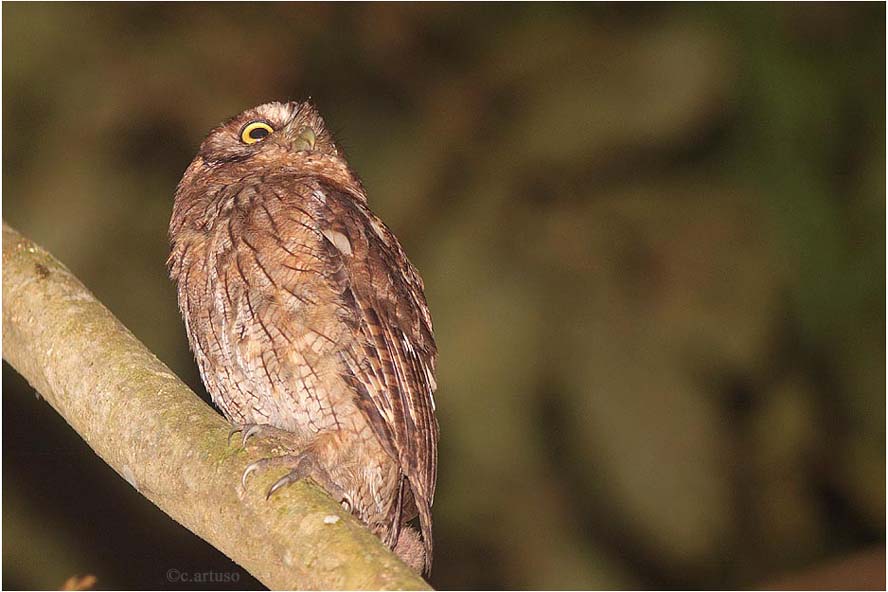
As these rainforests are separated from other humid rainforests as described above, it is not surprising that they hold their share of unique species (endemics). Amongst the owls, there are two endemic screech-owls (genus Megascops). The range-restricted Long-tufted Screech-Owl has a more southerly distribution within this region and the Black-capped Screech-Owl (shown below with their dark crown) has the more northerly distribution of these two similar species, mostly along the coastal forests from Sao Paolo State northward and also somewhat inland in forested areas.

This rufous-morph Black-capped Screech-Owl (same bird as in photo above) put on such an excellent show when feeding in a lit area near the park entrance that I could not resist compiling this collage of three photos showing slightly different postures.

The much more widespread Tropical Screech-Owl also occurs in this area (and beyond) but is a little smaller and with a different voice. Both species are polychromatic (contain 2 or more colour morphs) so here is a photo of a similar brownish-red morph Tropical Screech Owl from this region. To be honest, I found the differences, except for size and voice, extremely difficult to discern in the field.
One of the larger owls of southeastern Brazil is another regional endemic in the Pulsatrix genus (the “spectacled owls”, name for the pale facial marking surrounding the eyes), the Tawny-browed Owl. The Tawny-browed Owl is found in the regions humid forests and also in the regions high elevation Araucaria forests (Araucaria is a genus of coniferous trees from the Southern Hemisphere with a bizarre distribution in only South America and Australasia, including some Pacific islands, and which includes the famous "monkey puzzle tree" of Chile). The rich colour and distinctive patterning of this large owl is reason enough to admire them but their indescribable call, like other Pulsatrix owls, will send shivers down your spine! This bird was perched very high above the ground so the photo does not do them justice.

The genus Strix (large round-headed forest owls) also has a representative that is endemic to this region, the beautiful Rusty-barred Owl. Although very similar in appearance to other owls of their genus, I found the rufous and white barred pattern much more beautiful than depicted in any illustration.

The region also has a Pygmy-Owl who may be endemic – I say “may be” because the taxonomy of this tiny owl is still somewhat controversial. More “generous” (i.e. more likely to split species complex into multiple species) taxonomies consider the Brazilian Pygmy-Owl, also known as Sick’s Pygmy-Owl (Glaucidium sicki), whereas others consider this taxon to be part of the more widespread Least Pygmy-Owl (Glaucidium minutissimum) complex. At only 14cm in length, this is one of the smallest owl species in the world. We had to work very hard to get views of this little bird calling high in the canopy!

In addition to the endemics discussed above, there are various other non-endemic species of owls who occur in southern Brazil. I have already given an example above with the comparison of Black-capped Screech-Owl and Tropical Screech-Owl. In many cases in fact, the various genera shown here have both a regional endemic and a more widespread species that occur in sympatry in southeastern Brazil. As a general rule, the endemics are the more habitat specialized and the endemics have stronger associations with particular regional habitat types. In the case of the Pygmy-Owls, the widespread congenitor of the Brazilian Pygmy-Owl is the Ferruginous Pygmy-Owl. This species is a little larger than the Brazilian Pygmy-Owl and has differences in crown pattern, tail pattern and call. You can compare the two by looking at my photo below of Ferruginous Pygmy-Owl; however, the above photo of Least Pygmy-Owl is really too poor to show the differences well at all.

Related to the endemic Rusty-barred Owl is the more widespread Black-banded Owl. The extremely distinctive black and white owl species (Black-and-white Owl and Black-banded Owl) that were formerly considered in their own genus Ciccaba are now considered to belong to the genus Strix. The Black-banded Owl is mostly a lowland species and occurs in greater densities in the Amazon region, although there is a smaller disjunct population in southeastern Brazil. I was delighted to spot this bird perched high up by their eyes shine, while I was walking in a rather disturbed forest patch, as they were not calling at all in the post-breeding season (as with other species).

The genus Bubo (large “horned” owls) does not have an endemic species in the Atlantic forest region; however there is a disjunct population of Great Horned Owls here. In this region (as often elsewhere), this species mostly occurs in more open lightly wooded habitats rather than in rainforest proper, including more savannah like habitat such as the “Caatinga”. Despite this disjunction, they look and sound quite similar to Great Horned Owls elsewhere (voice was a little deeper than I am used to in Canada and eyes more orange). I found this species when I heard the distinctive hissing scream of a begging immature owl. While I was trying to sneak a look at the youngster, this adult flew in right above my head. You can tell that this owl is stressed by the posture, the erect ear tufts, and especially by the raised rictal bristles that reveal the nostrils (when relaxed, the rictal bristles lay flat to cover the nostrils to protect them from dust). I realised this of course as I was raising my lens, so I very quickly snapped three photos and then left the area.

There is also one species of owl here from a different family - the Tytonidae or Barn Owls. The Barn Owl, or American Barn Owl depending on your preferred taxonomy, is in fact one of the most cosmopolitan bird species on the planet (unless you split them into multiple species) and has also found a home in this region. I assume this bird to be a female based on large size, and the buffy breast with fairly extensive spotting.

In addition to the owls, it is worth mentioning a few other examples of Brazilian nightlife. The Common Potoo is a widespread species that also occurs in this region. The two photos show the huge eyes and the huge gape that enable the potoos to catch insects on the wing with the aid of the tactile rictal bristles around their mouth.

Although there is an a regional endemic nightjar in southeastern Brazil (the Long-trained Nightjar), I did not have a lot of luck photographing nightjars in the wet conditions. The best I can offer on this occasion is this photo of the extremely widespread Common Parauque that occurs from this region all the way north to southern U.S.A.

I plan to complete a series of posts on this fascinating corner of Planet Earth over the course of the next few months.
Subscribe to:
Posts (Atom)


