Sunday, August 1, 2010

Late Atlas Rarities +++

The end of July may not seem like the best time to be atlassing but it can produce some great results! My good friend Jo Swartz and I just completed a short visit to southwestern Manitoba to tie up some loose ends and try to find a new atlas record or two. Here is the first bonus of the weekend - a gorgeous male Lazuli Bunting - quite a rarity in Manitoba. This bird has been on territory since the end of May and was first noted by proud property owners. I was hoping to find a nest and to secure the first documented breeding in the province but, alas, we had to be content to watch the male for several hours and did not find a female this time. Nonetheless, he is quite a bird!


Of course, we knew that the Lazuli Bunting was around - we just had to find him but we had no idea there was also a Northern Mockingbird in the area (another rare bird in Manitoba although not nearly as rare as Lazuli Bunting). As we drive down the highway, I spotted a large, long-tailed mimid on someone's front lawn as we were travelling at high speed. Since the only expected mimids in Manitoba are Gray Catbird and Brown Thrasher, I called it as a Brown Thrasher based on shape (the bird was in shadow as I caught them out of the corner of my eye). Wanting to be sure of the record, we decided to turn around for a better look. Well, as it turned out, this bird was in fact a Northern Mockingbird, and the generous home owners did not object to us sticking around to look for evidence of a nest. Sure enough, we found the bird carrying nesting material (photo below) and a possible nest but no proof of breeding. A real bonus nonetheless!


At Whitewater Lake we looked for breeding evidence of some of the rare egrets and White-faced Ibis that have frequented the site in the last few years as water levels have risen. We indeed saw White-faced Ibis, Great Egret, Cattle Egret and this Snowy Egret but, alas, did not find any juvenile birds that might have confirmed breeding. Can anyone lend me an airboat?


One thing that can be done while atlassing in the late season is to revist areas to try to obtain higher breeding evidence codes. This weekend I was able to increase some of the "possible breeding"codes I had ("S" for singing bird, or "H for bird in suitable "breeding habitat in the breeding season) to higher codes (probable or confirmed breeding). For example, the Grasshopper Sparrow was still singing in his old spot, allowing me to use the code T (bird on territory).


And the same goes for this handsome Black-billed Cuckoo, such a striking image in this wispy Peachleaf Willow (took this photo with my crew on July 13th and heard him in the very same yard on July 30th)...

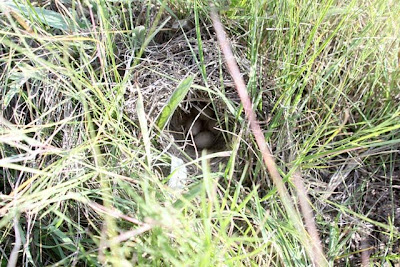
Now, not all birds have finished breeding at the end of July. I found this Vesper Sparrow nest with four eggs in the grasslands and hastily snapped this record photo before leaving as quickly as possible.
Other birds are a little more advanced but still with young in the nest. While we were waiting for the Northern Mockingbird I heard the song of an Orchard Oriole in the distance. I went a little closer and saw this male fly in towards us with food in his beak that was obviously not for his own consumption... guess, that is what you get for singing with your mouthful!!

Alerted to the possibility of a pair with young, it didn't take us long to spot the female and she led us right to her well-hidden nest in a Shubert Chokecherry. She has just fed the young, who were audible but not visible in the nest, a grasshopper.

Other birds have young out of the nest - it was an agitated parent Upland Sandpiper that alerted me to the presence of four downy young (juveniles) in the grass...

Some young birds have been outside the nest a little longer and have more developed feathers (immatures). This Gray Catbird looks almost like an adult, although if you look closely you can still see the down feather and note how the markings are not fully developed. The "Atlas question" in this situation is always "Is this youngster capable of sustained flight?" If the answer is yes, you can't count it as breeding evidence because you don't know where breeding occured. In this case, the youngster was begging and follwing their parents so I felt it was good enough evidence of local breeding. Won't be long before this one will be fending for themself though!

I am finding atlassing is really opening my eyes to observing behaviour - a great way to improve one's skill!

Wednesday, July 28, 2010

A taste of atlassing

This is the first year of the Manitoba Breeding Bird Atlas. There has been a LOT going on!! (see http://www.birdatlas.mb.ca/). I thought I would like to share a photographic highlight or two from a summer's worth of atlassing (see the "Atlas Photos" section under the "About the Atlas" tab on the web site for more)...

One of the first nests I found in Riding Mountain National Park this year was of the beautiful Black-backed Woodpecker.

A territorial Connecticut Warbler is always a good find... what a powerful song!

Eastern Phoebe's like to nest under eaves of various human structures and are easy to get confirmed breeding of...

Finding owl nests is mostly a lot of hard work, with the exception of Great Horned Owl nests (their nests are usually easy to find because they start so early in the year when there are no leaves on the trees and they often nest in conspicuous places like old stick nests). here are some of this year's owl finds...

A Short-eared Owl nest


An Eastern Screech-Owl leaving the nest in their typical stealthy fashion (they fly low in the shadows and swoop up into or down away from a nest rather than a direct line flight).


Finding a Great Gray Owl nest was one of the summer highlights for me (as always)!


Great Horned Owl fledglings have a lot of character!


Gray Jays breeding remarkably early and I found fledged young in mid May...


A young Wilson's Phalarope out for a promenade - put that down as FY (fledged young)!


Red-headed Woodpeckers put on a good show this year... This one, seen first flying through the trees...


happened to have a partner...


allowing me to eventually track down the nest site.


A big find was a Loggerhead Shrike on territory just south of Riding Mountain National Park, well north of their expected range...


And as always, atlassing gives you the opportunity to refine your knowledge of different species and their habitat associations... here is a Le Conte's Sparrow singing in typical habitat (along with other marsh buzzers!)


And there is sometimes time for a close-up too!


Waterbirds are relatively easy to atlas - we would find them either nest building like ths pair of Horned Grebes


Or more commonly with fledged young like this Eared Grebe family....


Two heads are better than one - well if you find a pair of birds that is - here is a handsome male and female Evening Grosbeak pair...


I enjoyed doing some grassland atlassing this year. One of my favourite Manitoba Grassland species, the Chestnut-collared Longspur put on a splendid show. Here is some agitated behaviour, an angelic pose, and a nest I found near St Lazare...


Plenty more great finds! An awesome summer contributing to monitoring and conservation.

Wednesday, July 21, 2010

Floppy ears

Been a crazily busy summer but got loads of atlassing done! Sorry for the lack of blog posts of late! Getting back into the swing now and thought I'd start with this photo of a Long-eared Owl that I took this evening. Usually when Long-eared Owls are alert their ear tufts stand up, but this bird, although clearly aware of my presence, was content to "hang loose"...

Tuesday, June 1, 2010

Little Brown Rarity

On May 30th 2010, I was walking back on the Grasshopper Trail at Riding Mountain National Park after having completed a morning exercise with my point count trainees. As we approached the bridge over Lake Audy Dam, who should pop up in front of me but a Rock Wren - the very first one I have seen in Manitoba. We all got to enjoy watching this little brown rarity, even a lifer for a few, as the bird fed along the rocks at the base of the bridge. The neat thing was watching this natural behaviour (Rock Wren on the rocks) even though this bird was hundreds and hundreds of miles off course. You can see what the wren was catching in the second photo.


Quite a treat!
 
Nature Blog Network Birdwatching Blogs - BlogCatalog Blog Directory Fatbirder's Top 500 Birding Websites